Paid a Business Expense With a Personal Card? Record It Once
Connect supplier receipts, personal-card payments, and later transfers with worked examples that keep one business purchase from becoming two expenses.

You bought $84 of supplies for client work, then realized you used your personal card. Later, you moved $84 from the business account to your personal account. Your expense list now has two $84 entries. Did the business spend $168? No: the records describe one purchase and a later movement of money.
For a US freelancer keeping sole-proprietor records, the practical task is to connect the purchase, its business purpose, the payment source, and any later transfer. Keep those events linked so the same cost does not enter your expense total twice.
This guide is an organizational workflow, not a set of journal entries or a determination of deductibility. Corporations, partnerships, employees, and businesses with reimbursement arrangements need entity-specific advice before applying it. Examples are invented USD amounts. Federal recordkeeping sources were checked on November 6, 2026; no tax-year-specific rates, limits, deadlines, or state rules are asserted.
Separate the purchase from how you funded it
Start by asking what happened, rather than which account showed a withdrawal. A supplier sold you something. You paid using a particular card. You may later have moved money between accounts. Those are connected events, but they are not three purchases.
Use one expense reference, such as PC-1106-01, for the underlying purchase. Keep a separate reference for a later transfer. Your expense list should let a reviewer see which event represents the supplier cost and which merely explains how it was funded or settled.
For a sole proprietor, ask your bookkeeper which owner-related account should carry the other side of a personally funded purchase. This article deliberately does not prescribe a debit, credit, reimbursement policy, or tax reporting date. The immediate objective is a complete evidence trail with one purchase counted once.
The IRS recordkeeping overview allows a system suited to the business that clearly shows income and expenses. A spreadsheet can organize this workflow; software is useful only if the records remain understandable and complete.
Build an evidence packet for the original transaction
Save documents that answer different questions. A card statement helps show a payment; an itemized supplier receipt helps explain what was purchased. A short contemporaneous note connects the items to your business activity.
For each personally paid purchase, collect:
- Supplier evidence: the original itemized receipt or invoice, including any tax charged and discounts.
- Payment evidence: the relevant card transaction, its date, amount, currency, and a reference that identifies it.
- Business explanation: what the items were used for and the related work or project, where relevant.
- Funding label: “paid personally,” with a masked card identifier sufficient for your own matching.
- Follow-up evidence: a later transfer reference, refund, correction, or unresolved question.
The IRS supporting-document guidance explains that expense records should establish the payee, amount, payment, date incurred, and nature of the business expense. Several documents may be needed together. Keep source documents alongside your summary rather than expecting a category label to prove the transaction.
Do not send an accountant a full personal statement when a relevant extract will do. Keep the original securely, and use a review copy that masks unrelated purchases and sensitive account details. Confirm what your accountant needs before redacting information necessary to verify the payment.
Work through an $84 purchase and a later transfer
Consider an invented purchase of paper and shipping supplies used entirely for client deliverables. The supplier receipt totals $84, including any tax shown on that receipt. This example does not determine whether the amount is immediately deductible.
On November 6, you pay the supplier using a personal card. On November 9, you transfer $84 from the business bank account to your personal bank account. Your bookkeeping review contains:
- Purchase PC-1106-01: supplier cost $84; paid personally; receipt and card transaction attached.
- Transfer TR-1109-01: $84 moved to your personal account; linked to PC-1106-01 for your bookkeeper's classification.
- Expense summary: one supplier purchase of $84, not two purchases totaling $168.
If you subsequently pay your personal card bill, that payment is not another purchase of the same supplies. Keep the original supplier transaction as the reference. The way the card balance is settled should not generate another copy of the supplier cost in your expense list.
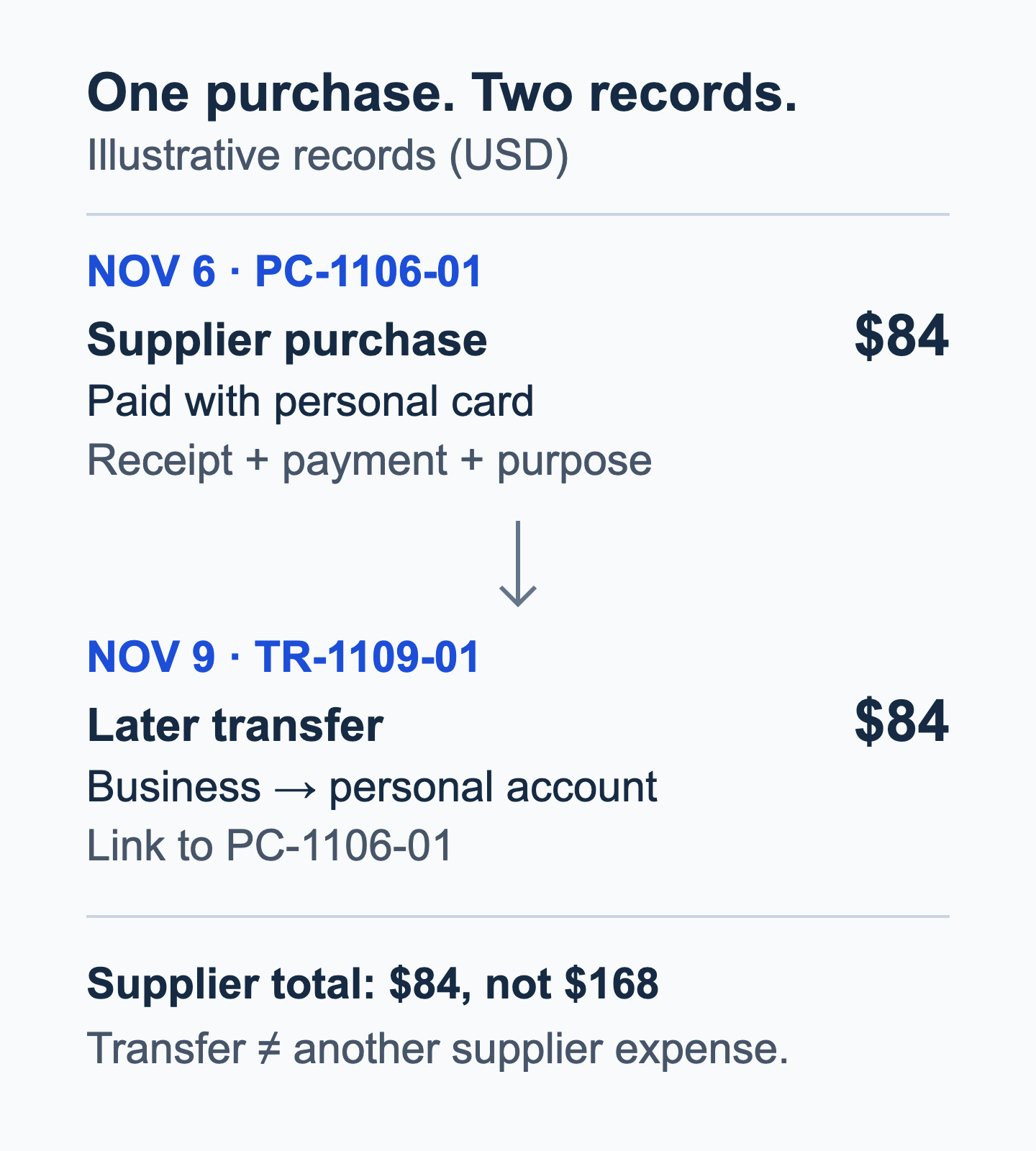
This diagram illustrates the review trail, not a mandatory accounting method. In actual books, your accountant may use an owner contribution, owner account, or another appropriate classification based on the facts. A transfer description alone does not establish its correct treatment.
Split a mixed basket before entering the business amount
A personal card statement may show one store charge covering both business and household items. Recording the whole charge as business spending loses that distinction.
Suppose an itemized receipt totals $120: $84 relates to supplies for client work and $36 relates to household items. In this illustration, those amounts already include their respective portions of any receipt tax. The check is simple: $84 + $36 = $120.
Keep the full supplier receipt, mark the relevant lines, and show:
- Total charged to the personal card: $120.
- Business portion identified for review: $84.
- Personal portion excluded from the business expense list: $36.
- Explanation of the split: itemized receipt lines and the business use of those items.
The $84 is a business-record amount to review, not an automatic tax deduction. A durable asset, prepaid service, mixed-use item, meal, vehicle cost, or other special category may require different treatment or additional records. Do not turn an arbitrary percentage into evidence. If the supplier document does not support the split, obtain clarification and flag the entry.
Keep this basket separate from the earlier $84 example. They illustrate two different situations and should not be added together as if they were real transactions.
Check imports before adding another expense
A personally paid cost can appear more than once when you combine a receipt log, a card export, and business bank transactions. Before adding an entry, search for its supplier, date, amount, and receipt or transaction reference.
For a practical review, compare four possible appearances:
- A manually entered supplier purchase.
- The same purchase in a personal-card export.
- A later business-to-personal transfer.
- The eventual payment of the personal card balance.
Only the first two might be alternative records of the same supplier purchase. The other two describe money movements. Link matching evidence to the existing expense instead of creating fresh supplier costs from each appearance.
Do not automatically delete equal amounts. Two genuine purchases can have the same price on the same day. Check the original receipts and transaction identifiers before deciding that something is a duplicate. Preserve a correction note if you remove a duplicate from the summary.
If you have already imported the business-bank transfer as a supplier expense, pause before changing historical books. Show the original purchase and the transfer to your bookkeeper, identify the suspected duplicate, and ask for the appropriate correction. Keep the evidence explaining the change.
Use a simple personal-payment review log
A useful log needs enough detail to close open questions. Suggested columns are purchase reference, supplier, purchase date, total charged, business portion, personal portion, paid-by label, receipt location, transfer reference, and review status.
For PC-1106-01, a clear status note might read:
“Supplier receipt $84; business use documented; paid personally November 6; transfer TR-1109-01 dated November 9 linked; classification confirmed with bookkeeper; no duplicate supplier expense.”
Avoid a bare “reimbursed” checkbox when it hides which transfer was involved or how much it covered. If one transfer covers several purchases, list their references and check the total. For example, separate supported purchases of $84 and $26 would explain a $110 transfer; it would not create a new $110 supplier expense.
If you use Eonebill's expense tracking overview to plan your recordkeeping, use the same references in your source documents and working log. The suggested paid-by and transfer columns here are a manual review design, not a promise that the product automatically identifies personal-card funding or posts owner-account entries.
Keep company reimbursements and client billing distinct
The same packet can be useful to an accountant reviewing a company owner's out-of-pocket costs, but the accounting and tax treatment cannot be copied from a sole-proprietor example. If you operate through a corporation or partnership, or you are an employee, ask how the business should document, approve, classify, and settle the amount under its applicable arrangements.
Also distinguish getting money from your own business from charging a client for an agreed project expense. The client-facing invoice is a separate document and may involve different contractual and tax questions. Use the client reimbursable expense guide for the billing-document workflow; do not treat a client repayment as interchangeable with an owner-related transfer.
IRS Publication 583, currently displayed as the December 2024 revision when checked, recommends keeping business checking separate from personal checking. For future purchases, a dedicated business payment method can make the evidence easier to follow. This is a recordkeeping recommendation, not a claim that a card's label determines whether an expense is deductible.
Finish with a review someone else can follow
Before closing the entry, confirm that a reviewer can identify the supplier, the business purpose, the amount included in the business summary, the payment source, and any related transfer. Check that the expense appears once and that personal items stay outside the business total.
Keep uncertain entries open with a specific question: missing supplier detail, unclear business use, unsupported split, possible duplicate, or classification awaiting advice. A tidy folder is useful, but an unresolved question should remain visible.
For income documents, Eonebill's free invoice generator can prepare the customer invoice. For this spending workflow, retain the supplier's actual evidence. A self-created receipt does not replace proof of what the supplier sold or what you paid.
General educational information for US freelancers and small businesses. Examples and transaction identifiers are fictional. This is not individualized tax, accounting, or legal advice. Recordkeeping does not itself establish deduction eligibility, timing, reimbursement treatment, or compliance with an entity's obligations.
Ready to manage invoices, contracts & proposals in one place? Try Eonebill free — no credit card required.
Start Free →Frequently Asked Questions
More Posts

Check Received in December, Deposited in January: Which Tax Year?
Find the tax year for a December customer check deposited in January, then match the bank entry without counting the income twice.

Form 1099-NEC Amount Wrong? How to Reconcile It
Trace a Form 1099-NEC Box 1 mismatch to specific invoices and payments, then send the payer a documented correction request.

How to Reconcile a Stripe Refund in a Later Payout
Trace a Stripe refund into a later payout, match the bank deposit, and link it to the original invoice with a worked two-month example.
Newsletter
Join the community
Subscribe to our newsletter for the latest news and updates