Form 1099-NEC Amount Wrong? How to Reconcile It
Trace a Form 1099-NEC Box 1 mismatch to specific invoices and payments, then send the payer a documented correction request.

Your client sends a Form 1099-NEC with $5,400 in Box 1. Your records show $4,500 from that client. Before changing an invoice or recording another payment, find out what the extra $900 represents. An open invoice, a payment you missed, and a duplicate in the payer’s records can all produce the same difference. Each calls for a different response.
Start with one payer, one tax year, and a list of individual payments. Compare the payer’s detail with your invoices and actual payment evidence. If the form still appears wrong, ask the payer to review the specific transactions and issue a correction if warranted. Keep the original form and the correspondence with your records.
Build a payment list for that payer
Check the year printed on the form, the payer’s legal name, and the recipient details. The legal name might differ from the brand on your invoices. A client may also use a separate company to handle payments. Ask which entity the form covers if you cannot identify it from your records.
Pull the invoices for that payer, including open invoices and invoices issued near the previous year-end. Then list each payment with the invoice number, payment reference, amount, method, date you received it or could access it, and date it cleared or settled. Add a separate field for the amount and date the payer shows. The invoice and payment references let both sides find the same transaction even when their dates differ.
Keep the full payment, any processing fee, and the bank deposit in separate fields. A single deposit can represent several payments, and a fee can reduce the bank deposit without reducing what the client paid. Use the processor transaction detail to connect those records before treating the difference as an error. The IRS guide to supporting records describes the role of invoices, deposit records, and other documents in supporting business entries.
Work the difference down to one transaction
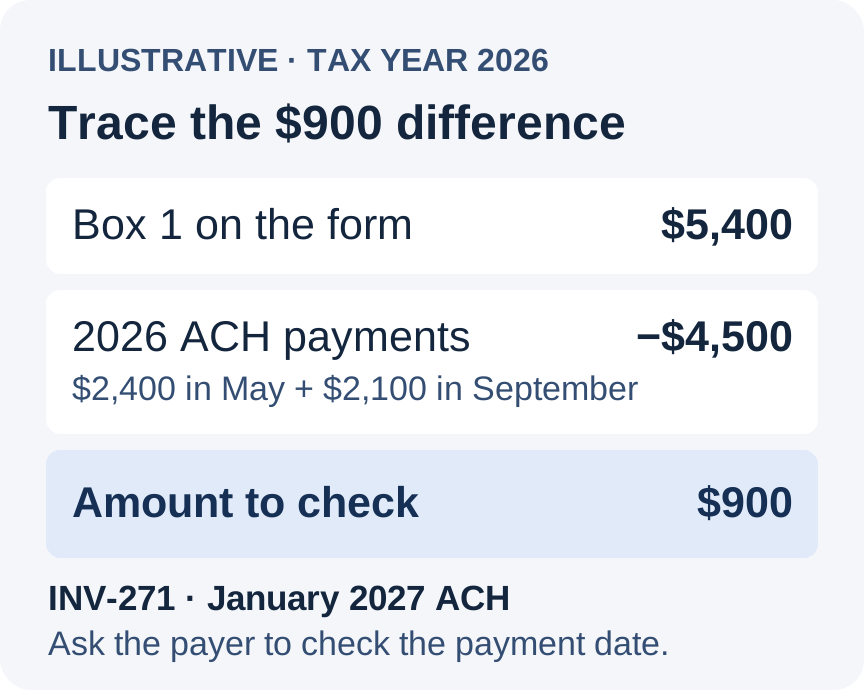
Suppose a design contractor using the cash method is reviewing a Form 1099-NEC for tax year 2026. All amounts are illustrative. In this example, there are no fees, credits, refunds, withheld taxes, or processor payments. The three invoices went to the same payer.
- INV-214 · $2,400. Paid by ACH in May 2026. The invoice and bank entry agree.
- INV-238 · $2,100. Paid by ACH in September 2026. The invoice and bank entry agree.
- INV-271 · $900. Issued in December 2026. The first payment is an ACH in January 2027. For this example, no check, account credit, or other payment was available to the contractor in 2026.
The two supported 2026 payments add up to $4,500. Adding the open December invoice brings the billed total to $5,400, which matches the form. The $900 difference points to one invoice. It gives the payer a specific item to check, even though matching totals alone do not prove how the payer prepared the form.
For cash-method taxpayers, the IRS generally distinguishes when income is received or made available from when it is deposited. A check available in December can raise a different timing question from an ACH first available in January. If the payer says a check was delivered or a payment was available before year-end, ask for the delivery or access details before drawing a conclusion. See the IRS discussion of cash accounting and constructive receipt. This example does not establish the reporting treatment for a different accounting method.
Check other causes before asking for a correction
An invoice has more than one payment
A $2,400 invoice might have a $600 deposit and a $1,800 balance paid later. Compare both amounts and dates with the payer’s list. If the form includes the deposit twice, identify which two payer rows refer to the same payment. If your own records omitted the deposit, update your records from the payment evidence.
The bank shows a net deposit
Find the original customer payment and the fee line in the processor report. Then match the net payout to the bank. If you also received a Form 1099-K, compare its underlying transactions before assuming the two forms report separate payments or the same payments. The 2026 IRS instructions for Form 1099-NEC describe how payment-card and qualifying third-party network transactions are handled under the information reporting rules.
Two forms cover the same client
Save both copies and check the tax year, recipient details, payer, account number if present, and whether one is marked corrected. Ask the payer which payments each form covers. Keep the forms and their underlying payment references together so a duplicate document does not turn into a duplicate payment in your books.
Send a correction request the payer can act on
Use the contact on the form or a verified accounts-payable address. Ask for the transaction breakdown behind Box 1, then point to the exact row that differs. Use a secure channel for supporting documents and share only the relevant lines. A full tax identification number or an unredacted bank statement is rarely useful in the first email.
Subject: Please review 2026 Form 1099-NEC for North Quay Design
Hi Accounts Payable, my 2026 Form 1099-NEC shows $5,400 in Box 1. I can match $4,500 to ACH payments for INV-214 and INV-238. The remaining $900 matches INV-271, which my records show was paid by ACH in January 2027. Could you share the payments included in Box 1 and confirm the payment date or reference for INV-271? If your review shows the amount was reported in error, please file the correction and send me the corrected recipient copy through your secure portal.
Save the original form, your payment list, the request, any response, and the corrected form together. Add a note with the date you contacted the payer and which entry remains disputed. If your filing deadline approaches with the discrepancy unresolved, take that packet to a qualified tax professional for help deciding how to file. The IRS guidance on incorrect or missing tax documents recommends requesting the document or correction from the issuer.
Keep the invoice and the payment easy to find next year
Give each invoice a unique number and use it in payment instructions and follow-up emails. When a client combines invoices into one ACH, save the remittance advice with the deposit reference. When December work remains unpaid, keep the invoice open in your records and keep later payment evidence alongside it. These habits make a year-end discrepancy easier to check without rebuilding your entire billing history.
Use the Eonebill invoice generator to put consistent invoice numbers, client details, and payment instructions on new invoices. Save those invoices with the corresponding remittance and payment evidence so you can trace the numbers if a form arrives with a different total.
U.S. federal recordkeeping education. Form instructions checked November 10, 2026, for tax year 2026. The example is fictional and does not determine the amount or year you should report on an individual return.
Ready to manage invoices, contracts & proposals in one place? Try Eonebill free — no credit card required.
Start Free →Frequently Asked Questions
More Posts

Check Received in December, Deposited in January: Which Tax Year?
Find the tax year for a December customer check deposited in January, then match the bank entry without counting the income twice.

How to Reconcile a Stripe Refund in a Later Payout
Trace a Stripe refund into a later payout, match the bank deposit, and link it to the original invoice with a worked two-month example.

Paid a Business Expense With a Personal Card? Record It Once
Connect supplier receipts, personal-card payments, and later transfers with worked examples that keep one business purchase from becoming two expenses.
Newsletter
Join the community
Subscribe to our newsletter for the latest news and updates