Check Received in December, Deposited in January: Which Tax Year?
Find the tax year for a December customer check deposited in January, then match the bank entry without counting the income twice.

A client hands you a check on December 30. You deposit it on January 4, and your bank feed shows the payment in January. Which year gets the income? For a U.S. business using the cash method, a valid, unrestricted check received in December generally belongs to December's tax year. If the client merely mailed it in December and it first reached you in January, the answer can be January, assuming the payment was unavailable to you earlier.
The bank statement still matters. Use it to show when the payment reached the bank and match that deposit to the check you already recorded. This guide walks through the dates and the records you need for a calendar-year close.
Start with the date you could receive the payment
The IRS small-business tax guide explains that cash-method income includes amounts you actually or constructively receive. Constructive receipt can occur when a payment is made available to you without restriction. A valid check in hand at year-end generally counts that year, even when you deposit or cash it in January. If an authorized agent receives a payment for you, that can count as receipt by you as well.
A date printed on a check tells you when the payer dated it. A postmark tells you when it entered the mail. A deposit date tells you when it went to the bank. To decide which year applies, document when the check reached you or was otherwise available without restriction. For example, if a client tells you an unrestricted payment is ready for pickup before year-end and you choose to wait, review the availability date under the constructive receipt rules.
Work through two $1,250 checks
Suppose a freelance drafter uses the cash method for federal income tax and closes the books on December 31. Both fictional clients pay by ordinary check. Each check covers a separate $1,250 invoice issued in December 2026. Both deposits show up at the bank in January 2027.
- Invoice INV-482. The client hands over a valid check on December 30, 2026. The drafter deposits it on January 4, 2027. Record $1,250 of gross receipts for 2026 and match the January deposit to the existing payment.
- Invoice INV-483. The client mails the check on December 30, 2026. The drafter receives and deposits it on January 5, 2027. The client made no payment available earlier, and nobody received it on the drafter's behalf in December. Record $1,250 of gross receipts for 2027.
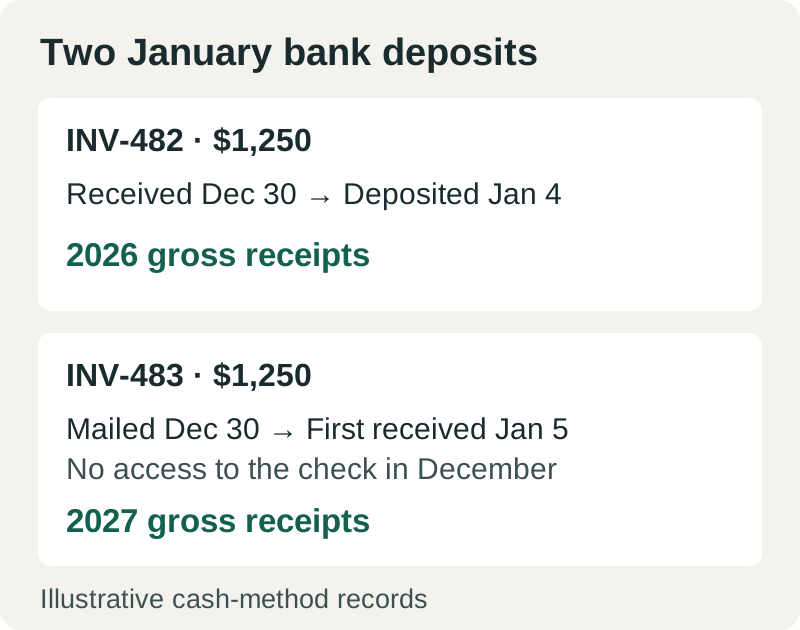
The January bank statement shows $2,500 across both deposits. Only $1,250 of that amount is new 2027 income in this example. The other $1,250 completes the bank reconciliation for a payment already counted in 2026.
Keep a record that explains both dates
Start with a short list of December checks that reached the bank after year-end. Give each payment its own row so you can also handle a bank deposit that combines several checks. Record the invoice number, client, check number or reference, amount, date first received or available, and bank deposit date. Include a note about the evidence behind the receipt date.
For INV-482, a note might read: “$1,250, check 2048, handed over at the project review on December 30. Deposited January 4. Match January bank entry to the December receipt.” Keep the invoice, a secure copy of the check or payment record, and the bank deposit confirmation. When mailing dates matter, save the envelope or tracking details and the date you actually received the check. If a payer says a check was available for pickup, ask for the date, location, and any conditions on collecting it.
IRS recordkeeping guidance describes keeping records that support gross receipts. Use consistent invoice numbers so payment records can be traced to the original work. Eonebill's free invoice generator can help you put the number and payment instructions on new invoices.
Match the January bank entry to the existing payment
When closing December, flag any checks already received but still awaiting deposit. In accounting software that supports an undeposited-funds or clearing workflow, record the December customer payment there and use the January deposit to clear it into the bank account. The January bank-feed entry should match the existing deposit or payment workflow. In a spreadsheet, add the January bank reference to the December payment row and mark it reconciled.
For a batch deposit, list the individual checks and confirm their sum matches the bank amount. If a bank-feed rule has already categorized the full deposit as January sales, review and correct the categorization using your existing bookkeeping workflow. Keep the original invoice and deposit evidence linked. The invoice-to-bank reconciliation guide covers the same matching process for other kinds of payments.
Set aside checks with restrictions or missing evidence
A postdated check, a returned check, or a disputed delivery can require a fact-specific review. Keep the original dates, any restrictions or bank notices, and the client's correspondence. Ask a qualified tax professional to review the transaction if you cannot tell when payment was available or how a reversal affects a closed year.
If a payer's Form 1099-NEC groups the payment into a different year, compare the payer's transaction detail with your receipt evidence and ask how the date was determined. Our 1099-NEC reconciliation guide walks through that conversation.
This guide covers general U.S. federal income tax recordkeeping for calendar-year cash-method businesses. The examples use tax years 2026 and 2027 and fictional amounts. IRS Publication 334 (2025 edition), Publication 538, and IRS recordkeeping guidance were checked November 11, 2026.
Ready to manage invoices, contracts & proposals in one place? Try Eonebill free — no credit card required.
Start Free →Frequently Asked Questions
More Posts

Form 1099-NEC Amount Wrong? How to Reconcile It
Trace a Form 1099-NEC Box 1 mismatch to specific invoices and payments, then send the payer a documented correction request.

How to Reconcile a Stripe Refund in a Later Payout
Trace a Stripe refund into a later payout, match the bank deposit, and link it to the original invoice with a worked two-month example.

Paid a Business Expense With a Personal Card? Record It Once
Connect supplier receipts, personal-card payments, and later transfers with worked examples that keep one business purchase from becoming two expenses.
Newsletter
Join the community
Subscribe to our newsletter for the latest news and updates