How to Invoice a Client for Reimbursable Expenses
Learn how to list client-approved travel and project costs on a freelance invoice, keep receipts, and separate billing records from US tax reporting.
You buy a train ticket to visit a client, pay a printer for project materials, or cover a courier charge. The client agreed to reimburse you. Should you add the cost to your next invoice, send a separate expense report, or leave it off because you made no profit on it?
The useful starting point is to separate what the client owes you from how the payment is treated on your tax return. An invoice should make the reimbursement easy to understand and approve. Your records should show what you spent and why. The tax treatment depends on the facts and the applicable rules; a line labeled “reimbursement” does not settle it by itself.
In brief: agree on the cost before you incur it, identify it separately from your service fee, and keep the approval and vendor receipt with the invoice. When tax time arrives, review the actual reimbursement arrangement instead of treating the invoice label as a tax answer.
Agree on expenses before spending
Put the reimbursement terms in your contract, statement of work, or written approval. Name the types of costs the client will cover, any spending limit, whether approval is required before purchase, and whether the client needs copies of receipts. If travel is involved, state who books it and whether the client pays the vendor directly.
This prevents a familiar disagreement: the freelancer considers a purchase necessary for the project, while the client expected it to be included in the project fee. If the scope is unclear, ask before you spend. A short email approval is better evidence than a memory of a call.
For costs that belong to several clients, agree on a fair allocation before invoicing. Do not bill the same receipt to two clients. Keep your own working copy of the allocation and the original receipt.
Which purchases belong on the client's invoice?
An expense belongs on the client invoice when it is connected to the engagement and the client agreed to pay it. A trip to the client's office, a project-specific printing order, or a courier delivery can be straightforward examples when the agreement covers them. A subscription used for many clients, ordinary home-office costs, and your own business overhead need a clearer agreement before they can be billed separately.
The vendor receipt may contain mixed personal and business items. Bill only the approved client portion, and document how you calculated it. If a train ticket includes an optional personal upgrade, or a purchase serves two projects, a full-cost line item can mislead the client even if the receipt itself is genuine.
Keep cancellation terms in the same conversation. If the client cancels after you make a nonrefundable booking, the contract should say whether they still cover it. If the vendor later issues a refund or credit, update the client invoice or issue an appropriate adjustment; do not keep a reimbursement for a cost you no longer bear unless the agreement clearly provides otherwise.
Show reimbursable costs as separate invoice lines
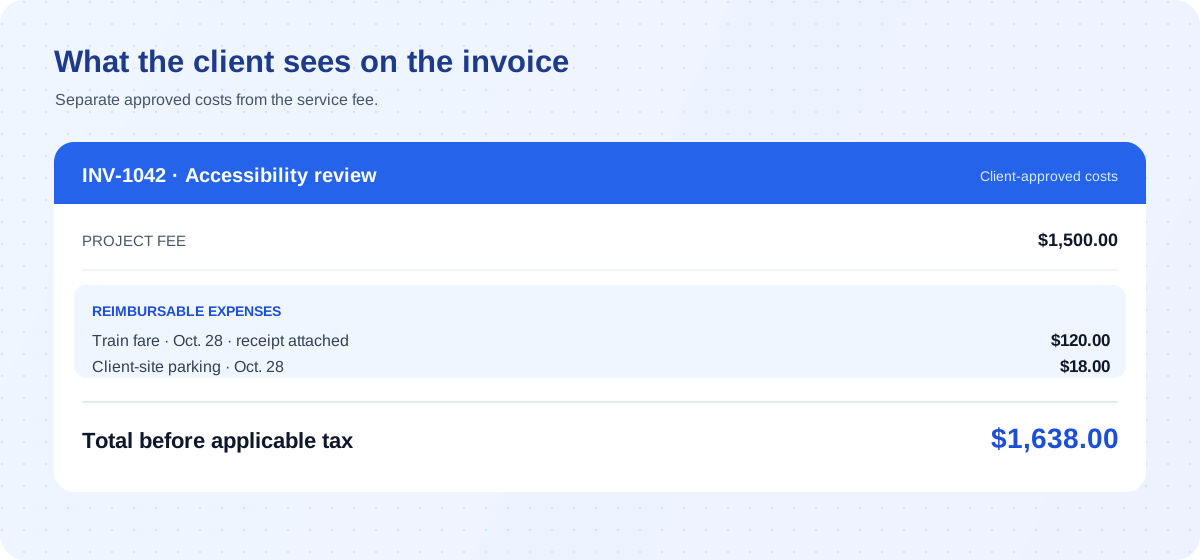
Use the same invoice number, client details, invoice date, due date, and payment instructions you would use for your service fee. Put each approved cost on its own line or group only genuinely similar costs that the client has agreed can be summarized. State the date or project reference, the nature of the purchase, and the amount. If you charged a markup, disclose it under your agreement instead of calling the marked-up amount a cost reimbursement.
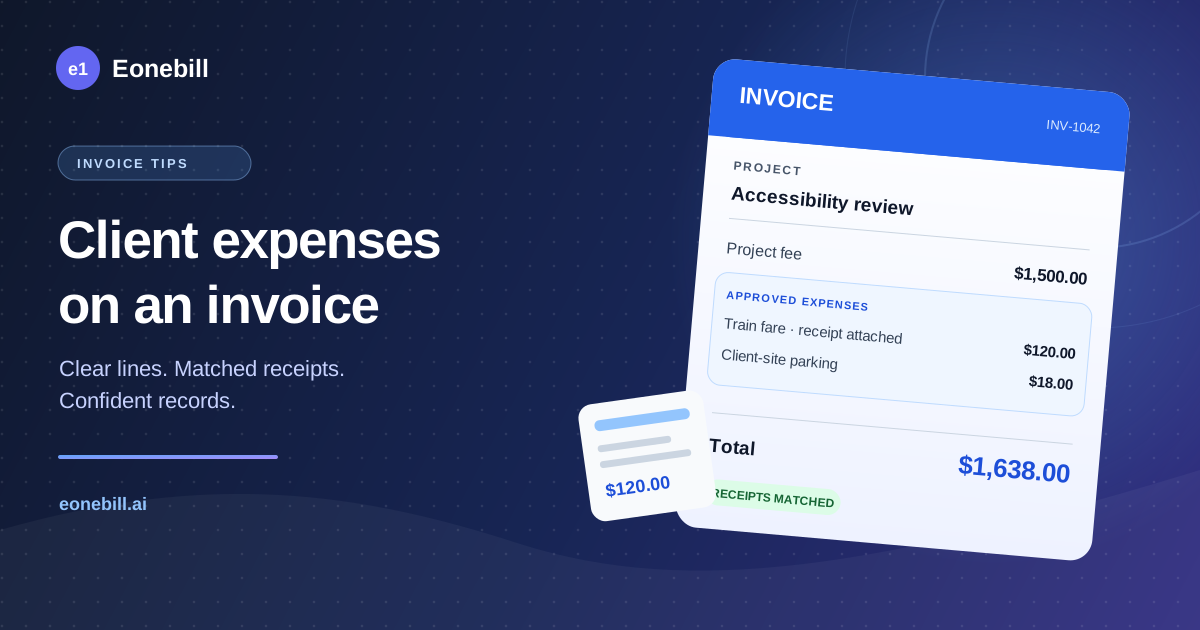
For example, suppose a consultant charges a $1,500 project fee and the client approved a $120 train ticket and $18 parking charge:
- Website accessibility review — project fee: $1,500.00
- Client-approved train fare, Oct. 28 — receipt attached: $120.00
- Client-site parking, Oct. 28 — receipt attached: $18.00
- Total before any applicable tax: $1,638.00
The $138 in costs is visible without changing the description of the $1,500 service fee. This example does not assume sales tax is due or exempt. Whether a charge is taxable depends on the jurisdiction, what was sold, and how the charge is structured. Check the applicable state or local tax authority before adding tax to the invoice.
The invoice total is not a profit calculation. In this illustration, the $120 and $18 lines repay specific costs; they are not another $138 of service fees. Your accounting treatment still needs to reflect the actual arrangement. Keep a copy of the itemized invoice the client received so you can explain later why the payment was larger than your project fee.
If your client needs separate approval, send an expense summary with the receipts and then use the approved amount on the invoice. Reference the approval in your records. If a client pays a vendor directly, do not invoice the client again for that payment.
Three common billing arrangements
At-cost reimbursement: You pay an approved vendor bill and ask the client to repay the exact amount. Attach or offer the receipt and show the actual cost on the invoice. The client can see that the expense line is separate from your fee.
Billable purchase with an agreed charge: You buy something for the project and your agreement permits a fixed charge or markup. Show the charge your client agreed to pay. Keep your underlying purchase record, but do not describe the entire client charge as a pure at-cost reimbursement when it includes compensation for procurement or handling.
Client pays the vendor: The client books travel or pays a supplier directly. Refer to the arrangement in the project records, but do not add an unpaid cost to your own invoice. If you also owe the vendor a separate amount, document which party is responsible before sending a bill.
Keep a record that connects the invoice to the receipt
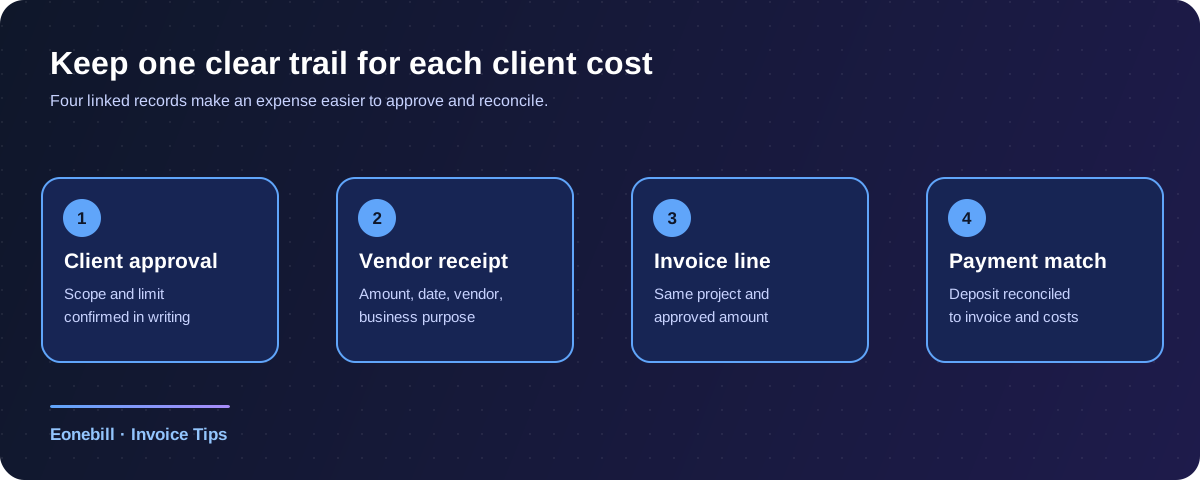
For every reimbursable cost, retain the original vendor receipt or invoice, proof of payment, the client's approval, and a link to the invoice line. A useful expense log records the date, vendor, amount, project, business purpose, client approval, invoice number, and payment status. For travel, meals, and gifts, the IRS has additional substantiation rules, so keep the details required for that expense type.
The IRS rules for independent contractors and clients say that contractors who receive reimbursements or allowances for certain client travel or gift expenses should adequately account to the client and keep adequate records whether or not they do so. For a self-employed person, adequate accounting means reporting actual expenses and following the IRS recordkeeping rules. A receipt alone may not explain the business purpose or which client requested the cost.
Do not discard the receipt after the client pays. You may need it to reconcile your books, a later client question, or a tax return. Store the invoice and supporting records together in a way you can retrieve by client and project.
Reconcile the money with a simple example
Return to the $1,638 invoice. Your project fee is $1,500; approved expenses total $138. When the client pays $1,638, mark the invoice paid and match the deposit to that invoice. Then match the $120 train receipt and $18 parking receipt to the expense lines. If the client pays only $1,500, the invoice is partially paid: $138 remains outstanding unless the client disputes or rejects those costs.
Keep the payment processor or bank fee separate. If the client pays $1,638 but the processor deposits less after a fee, that does not mean the client underpaid. Record the gross client payment and the fee according to your accounting method so the invoice can still be reconciled.
If the client reimburses only part of a cost, document the agreed difference. For example, a $120 ticket with a $100 client cap leaves $20 that the client did not approve. Your invoice should request $100, while your business records should still preserve the full vendor transaction and explain the $20 difference.
Does the reimbursement count as taxable income?
Do not assume that every amount called a reimbursement is tax-free. Do not assume that every reimbursed cost produces a deduction, either. The answer depends on the expense, who incurred it, what was documented for the client, and how the payment was reported.
For the travel and gift expenses covered by IRS Publication 463, the IRS says that if an independent contractor does not adequately account to the client, the reimbursement or allowance must be included in income. The same publication describes a different information-return treatment when the contractor adequately accounts to the client. It also says to keep records in either case.
If a client includes a reimbursed amount on an information return, reconcile it against your invoices, payments, and expense records. Do not silently ignore the form or subtract a cost that is not deductible. Schedule C instructions separate business receipts from allowable expenses, and the rules for a particular cost can differ. Ask a qualified US tax professional to review a disputed reimbursement or an information-return mismatch before filing or amending a return.
Questions to take to your bookkeeper or tax preparer
- What did the agreement require you to spend, and did you give the client an adequate accounting?
- Which amounts were paid to vendors by you, and which did the client pay directly?
- Did the client report the payment on an information return, and does it match your records?
- Are any costs personal, shared between clients, subject to a special deduction limit, or otherwise nondeductible?
- Which instructions apply to the tax year being filed? An older article or form may use different rules.
These questions help you collect the facts needed for a correct answer. They are more useful than assuming that every client reimbursement either disappears from your books or automatically creates a matching deduction.
Common mistakes that delay payment or complicate records
Billing first and requesting permission later. A client may refuse a cost that was never approved. Keep a dated approval linked to the purchase.
Writing only “expenses” on the invoice. A vague lump sum forces the client to ask for details. Name the purchase, date, project, and amount.
Using a receipt as the only record. The receipt shows what a vendor charged; it may not show why the purchase served the client or whether the client approved it.
Billing a refunded purchase. If a vendor returns your money, reconcile the credit and adjust the client charge when appropriate.
Confusing the invoice total with service revenue. Keep the fee and expense lines distinct so you can explain a deposit that is larger than your fee.
Assuming the tax answer from the word “reimbursement.” The IRS looks at the underlying facts and records. Review the arrangement and applicable current guidance.
Email template for sending the invoice and expense backup
Subject: Invoice [number] — [project] fee and approved expenses
Hi [client name],
Attached is invoice [number] for the [project] work. The service fee is [amount]. The separately listed [travel / printing / delivery] expenses total [amount] and match the receipts and approval from [date]. The total due is [amount] by [due date].
Please let me know if your accounts-payable team needs the expense summary in a different format.
Thanks,
[your name]
Use the same invoice number in the subject and expense summary. If the client has a purchase-order number, include it too. This gives the person approving payment a direct path from the email to the invoice and the supporting documents.
A simple workflow for the next client project
- Confirm reimbursable categories and approval limits in writing.
- Record the cost when it happens and save its receipt and payment proof.
- Tag the record to the client and project; note its business purpose.
- Send the required expense detail for the client's approval.
- Add approved costs as clear, separate lines on the invoice.
- Reconcile the amount received to the invoice and your expense log.
- Review tax reporting separately using current IRS instructions and professional advice where needed.
Need a starting layout? The consulting invoice template shows where billable expenses fit alongside service fees and payment terms. You can also start from the invoice template library and add expense lines that match your client agreement.
This article provides general education for US independent contractors. It is not individual tax or legal advice. Tax rules and forms change; check the IRS and the relevant state tax authority for the year and transaction at issue.
Create this in 30 seconds — free invoice with Eonebill, no sign-up required.
Create Free Invoice →Frequently Asked Questions
More Posts

Check Received in December, Deposited in January: Which Tax Year?
Find the tax year for a December customer check deposited in January, then match the bank entry without counting the income twice.

Form 1099-NEC Amount Wrong? How to Reconcile It
Trace a Form 1099-NEC Box 1 mismatch to specific invoices and payments, then send the payer a documented correction request.

How to Reconcile a Stripe Refund in a Later Payout
Trace a Stripe refund into a later payout, match the bank deposit, and link it to the original invoice with a worked two-month example.
Newsletter
Join the community
Subscribe to our newsletter for the latest news and updates