Utility Statement vs. Official Utility Bill
Understand the difference between a self-prepared utility statement and an official provider bill, and when each record is appropriate.

An official utility bill is issued by the service provider. It comes from the provider's account system and shows the account, service period, charges, and amount due according to that provider's records.
A utility statement is a record prepared by a person or business. It can summarize usage, allocate a shared bill, or explain a charge for internal records. It should be labeled clearly and supported by the original provider bill.
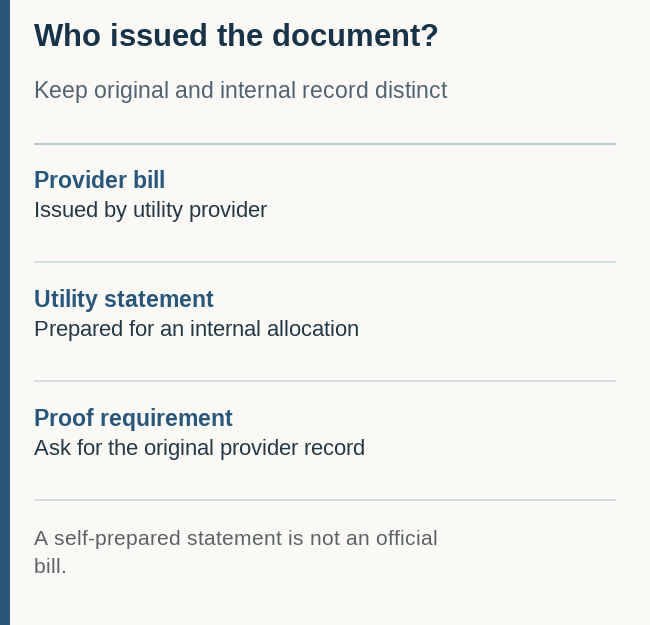
When to use each document
- Use the provider bill for proof of address, service, account status, or an amount due to the provider.
- Use a self-prepared statement for a tenant allocation, bookkeeping note, internal review, or a clear summary of real inputs.
- Use a payment receipt after money is actually received; a statement or bill does not prove payment by itself.
What a transparent statement includes
Include the provider name as a reference, the service period, statement date, account reference when appropriate, line items, taxes or fees, total, allocation rule, and a note identifying the original source. Never copy a provider logo, signature, portal design, or verification language.
The utility bill generator can format a statement for legitimate records. Review every amount against the source bill before sharing it.
A simple review checklist
- Does the period match the source bill?
- Do line items add to the stated total?
- Is the document labeled as a statement rather than a provider-issued bill?
- Is the original bill available if someone needs official proof?
Ready to switch? Start for free — no credit card, no contracts, just faster payments.
Start Free →Frequently Asked Questions
More Posts

How to Resubmit an Invoice Rejected for a Missing PO Number
Resolve a missing purchase order reference, preserve the invoice history, and resubmit one traceable charge with a practical $1,250 example.

How to Invoice an Approved Change Order Without Billing Twice
Turn an approved scope addition into a traceable invoice. Reconcile prior billing with a $1,800 project and $360 change-order example.

How to Resend an Invoice Copy Without Charging Twice
Resend a lost invoice with its original reference, distinguish copies from corrections, and explain payments already received. Includes a $900 example.
Newsletter
Join the community
Subscribe to our newsletter for the latest news and updates