Is Saving 25% Enough for Freelance Taxes?
Separate your tax savings from payments, reconcile collected income and expenses, and use a monthly checklist to compare your reserve with a current estimate.
Putting 25% of every client payment into a tax account is an easy habit to remember. It gives you a place to start when freelance income is new and nobody is withholding tax from your payments. But the amount you save and the amount you need to pay are two different numbers.
Saving 25% does not establish that your taxes are covered. First define what the percentage applies to, keep a reliable income-and-expense record, and compare the money available with a current tax estimate. This guide shows a monthly review you can use to prepare that comparison. It does not calculate your personal tax bill.
Federal sources checked November 3, 2026: 2026 Form 1040-ES, IRS Publication 505 (2026), and the IRS recordkeeping pages linked below. The percentages in the examples are hypothetical savings assumptions, not IRS tax rates. State and local rules require a separate check with the relevant tax authority.
A tax reserve is money saved, not tax paid
Call the money you put aside your tax reserve. Keep a separate record of tax payments actually submitted. A transfer between your own accounts does not, by itself, send money to the IRS.
The IRS estimated-tax guidance explains that federal taxes are paid during the year through withholding, estimated payments, or a combination. Estimated payments can cover income tax and other taxes, including self-employment tax. Keeping enough cash and paying the required amount on time are separate tasks.
A useful planning note has three headings:
- Estimate: the calculation or advice supporting the expected payment, with a date and tax year.
- Reserve: the cash currently available for that purpose.
- Paid: completed payments, including their dates, tax years, and confirmations.
Do not merge those headings into one balance. An old estimate can be out of date, a reserve can be spent accidentally, and a payment can be assigned to the wrong year. A separate line for each makes the discrepancy easier to spot.
Define the base before choosing a percentage
“Save 25%” leaves an important question unanswered: 25% of what?
It could mean the total you invoiced, client payments collected, the amount deposited after processing fees, or the operating result after expenses. Those figures can differ even in a simple business. Write the base beside the percentage so you can apply the same method consistently.
For this worksheet, assume a US sole proprietor with a simple service business. There is no inventory, payroll, sales tax, reimbursement, or foreign income in the example. The owner uses a cash-oriented planning view of collections and paid expenses. Your actual tax reporting must follow your accounting method and applicable rules; this worksheet is not a replacement for your books.
An unpaid invoice belongs on the collection list. It does not put cash into the reserve account. A card settlement, meanwhile, can combine several payments and subtract processing charges. Keep the original payment detail rather than treating the deposit as a complete description of the activity.
The IRS list of supporting records includes invoices, deposit information, receipt books, and other documents showing business receipts. It also describes records supporting expenses. Use those documents to explain the numbers in your worksheet.
Work through one month without inventing a tax bill
Suppose a freelance service business has the following activity. These are invented figures for arithmetic practice, not a customer case or a tax projection.
- Client payments collected before processing charges: $4,800. Keep the individual collections detail.
- Processing charges withheld: $144. Show these separately from the payments.
- Net settlement deposited: $4,656. Match this amount to the bank.
- Other business costs paid: $656. Keep the supporting expense records.
- Total costs in this simplified example: $800. This is $144 plus $656.
- Operating result before reserve transfers: $4,000. This is $4,800 minus $800.
For this example only, assume all $800 of costs are ordinary operating expenses properly included in this planning calculation. Real expenses may need adjustments for mixed use, timing, capitalization, or deductibility. Label anything unresolved for review rather than forcing it into the example's treatment.
If the owner saves a hypothetical 25%:
- Applying it to $4,800 of collections gives a $1,200 transfer.
- Applying it to $4,656 of net deposits gives a $1,164 transfer.
- Applying it to $4,000 of operating result gives a $1,000 transfer.
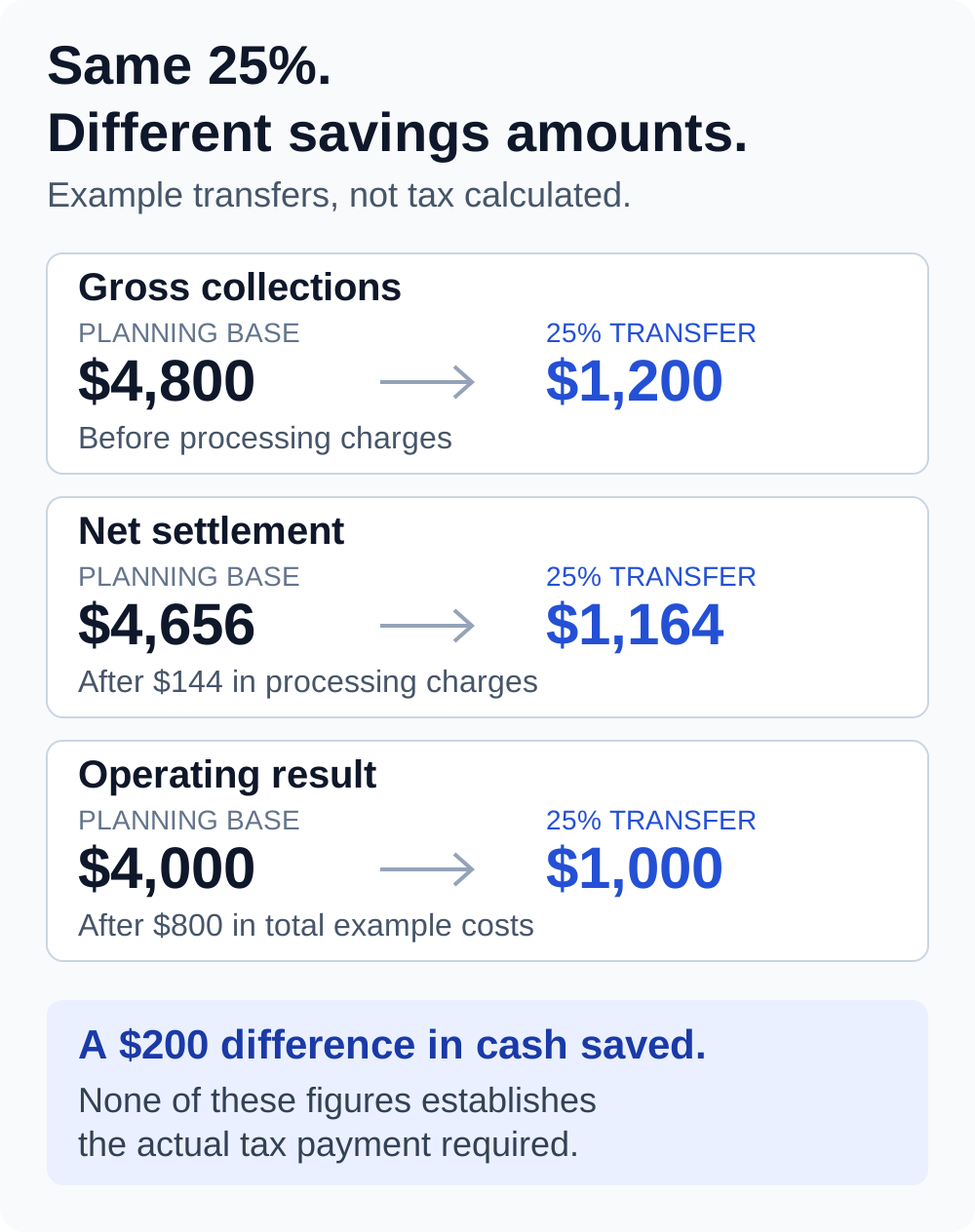
The largest and smallest transfers differ by $200. Nothing in those calculations proves that any of the three transfers equals the owner's tax liability. They demonstrate why the base needs a label.
Also notice the fee reconciliation: $4,800 less $144 equals the $4,656 settlement. If you record both the full client payments and the settlement as additional income, your working total counts the same collection twice. Match the settlement to its payment detail instead of creating an unexplained second entry.
Keep the records that make a review possible
The IRS recordkeeping guidance allows a system suited to the business that clearly shows income and expenses. The useful question is whether you can trace each total back to its source.
For a small service business, start with a simple monthly folder and a matching worksheet:
- Invoice and collection list. Include the invoice number, client reference, amount, payment date, and remaining balance. This explains billed work and actual collections.
- Settlement detail. Include the processor reference, gross payments, fees, and net deposit. This connects payment records to the bank.
- Expense list. Include the date, vendor, amount, business purpose, and receipt reference. This makes the expense total reviewable.
- Reserve log. Include the transfer date, amount, account reference, and planning base. This shows how the reserve was funded.
- Tax-payment log. Include the authority, tax year, payment type, amount, date, and confirmation. This separates completed payments from savings.
- Open questions. Include the item, missing evidence, and person reviewing it. This keeps uncertain entries visible.
These are suggested workflow fields, not an IRS-mandated spreadsheet format. Use references that let you find the underlying document. Avoid placing sensitive client details in a general-purpose worksheet when a project reference will do.
Do not quietly classify a missing receipt, personal purchase, or unexplained transfer as a deductible business cost. Put it on the question list. Keeping a record and deciding its tax treatment are separate steps.
Compare savings with an actual estimate
For US individuals covered by its instructions, 2026 Form 1040-ES provides the worksheet and rules for figuring estimated federal tax. That process considers the broader tax picture. A savings percentage attached to one business's receipts cannot capture all of it.
Prepare the following inputs for your calculation or tax preparer: year-to-date business results, expected income and expenses for the rest of the year, other income, withholding, relevant deductions and credits, your prior-year return, and estimated payments already made. Use the instructions for your situation; this article does not apply the payment thresholds or exceptions for you.
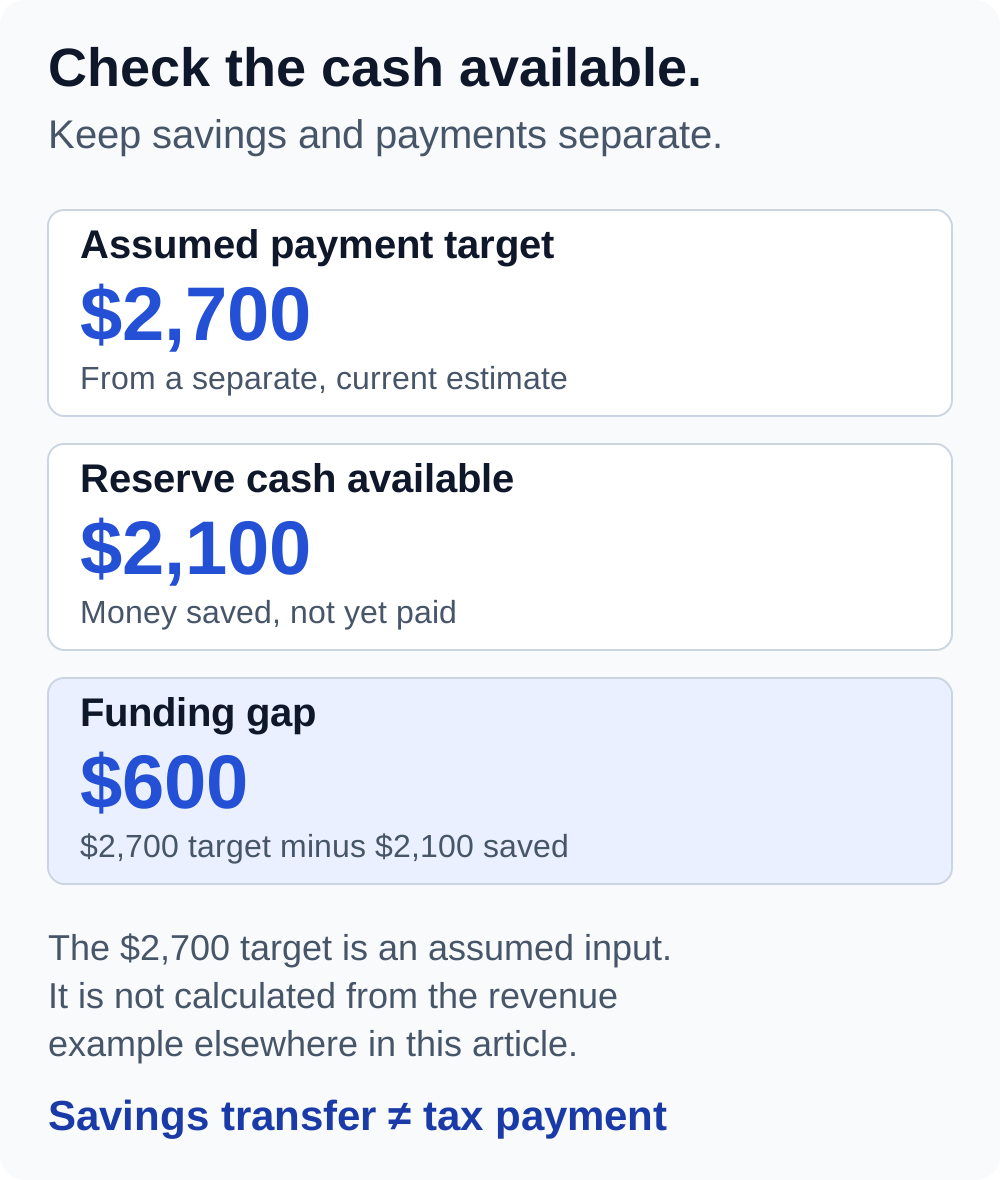
Then compare the next planned payment with available cash. For illustration, assume a separate, current calculation has already established a $2,700 payment target. That target is an input to this cash check, not a tax amount calculated from the monthly example above.
If the reserve account contains $2,100, the funding gap is $600. Keep the target, its due date, the reserve balance, and the gap on the same note. If there is not enough cash to cover the required payment, address the gap promptly with your tax professional and the relevant tax authority; changing the spreadsheet does not change what is owed.
For a general explanation of payment methods, Eonebill's invoice payment methods guide can help organize the client-collection side. Use the IRS calculation for the tax side.
Revisit the plan when the business changes
A reserve method is easier to manage when you know what would trigger a review. Write those triggers down rather than waiting for the account balance to feel too low.
Examples include a large new contract, a slow collection month, a major equipment purchase, a change in other household income or withholding, or a substantial change in expected expenses. These are reasons to revisit the calculation, not instructions to raise or lower your savings percentage automatically.
IRS Publication 505 (2026) explains that changes in income, adjustments, deductions, or credits may require estimated tax to be refigured. It also discusses the annualized income installment method for uneven income. Do not assume that multiplying one good month by twelve, or dividing every revised annual figure into four equal parts, always produces the correct payment schedule.
Keep each revised estimate with its date and assumptions. Leave the old version in the folder as history, clearly marked superseded. That way you can explain why the reserve method changed without treating last month's figures as today's instructions.
Use this monthly review checklist
- Match collected payments to their invoices and settlement reports.
- Reconcile gross collections, processing charges, and net deposits.
- Update supported expenses and flag unresolved items.
- Write down the base and percentage used for reserve transfers.
- Reconcile reserve-account cash separately from completed tax payments.
- Check whether the assumptions behind the current estimate have changed.
- Record the next payment target, its actual due date, and any funding gap.
- Check state and local obligations separately using the relevant authority's current guidance.
Keep this review practical. A short worksheet that you can reconcile is more useful than a complex sheet with unexplained balances. The next reviewer should be able to follow a payment from an invoice to the bank and distinguish the money saved from the money already paid.
Need a clear starting document for client billing? Use Eonebill's free invoice generator to prepare an invoice, then retain it with your payment records. Use the same invoice reference in your collection worksheet so the billing document and payment entry stay connected.
This article provides general educational information for US freelancers and sole proprietors. It is not individual tax, legal, or benefits advice. Use the current instructions for your tax year and circumstances, and seek qualified help when your records, business classification, or tax obligations are uncertain.
Ready to manage invoices, contracts & proposals in one place? Try Eonebill free — no credit card required.
Start Free →Frequently Asked Questions
More Posts

Check Received in December, Deposited in January: Which Tax Year?
Find the tax year for a December customer check deposited in January, then match the bank entry without counting the income twice.

Form 1099-NEC Amount Wrong? How to Reconcile It
Trace a Form 1099-NEC Box 1 mismatch to specific invoices and payments, then send the payer a documented correction request.

How to Reconcile a Stripe Refund in a Later Payout
Trace a Stripe refund into a later payout, match the bank deposit, and link it to the original invoice with a worked two-month example.
Newsletter
Join the community
Subscribe to our newsletter for the latest news and updates