How to Split Utility Costs Between Tenants
A practical way to document shared utility costs between tenants, including meter readings, billing periods, allocation rules, and payment records.

When a property shares one utility account, the most important step is to agree on how the bill will be allocated before recording the amount. A utility statement can document the calculation, but it is not a replacement for the provider's original bill or a lease.
Choose one allocation rule
Use the method required by the lease or local rules. Common methods include:
- Separate meters: assign each tenant the actual reading for the billing period.
- Equal shares: divide the total evenly when the agreement says each unit has the same share.
- Area or occupancy share: use the documented percentage from the lease or property agreement.
- Sub-meter plus common area: allocate private usage first, then state how common usage is divided.
Do not change methods mid-period without recording the reason and notifying the affected tenants.
Record the inputs
Keep the provider name, account or statement reference, service period, statement date, due date, total charge, meter readings, allocation percentage, and each tenant's share. Show the arithmetic so another person can reproduce the result.
Create a reviewable statement
Use the utility bill generator to turn the agreed inputs into a downloadable statement for your records. Label it as a statement or allocation record, not as an official provider bill. Keep the original provider bill with the statement.
Before sending it
Check that the service period matches the provider bill, the shares add up to the allocated total, dates and currency are correct, and any late fee or deposit is described separately. Keep a copy of the calculation and the message that sent it.
Example: divide a USD 120 utility bill
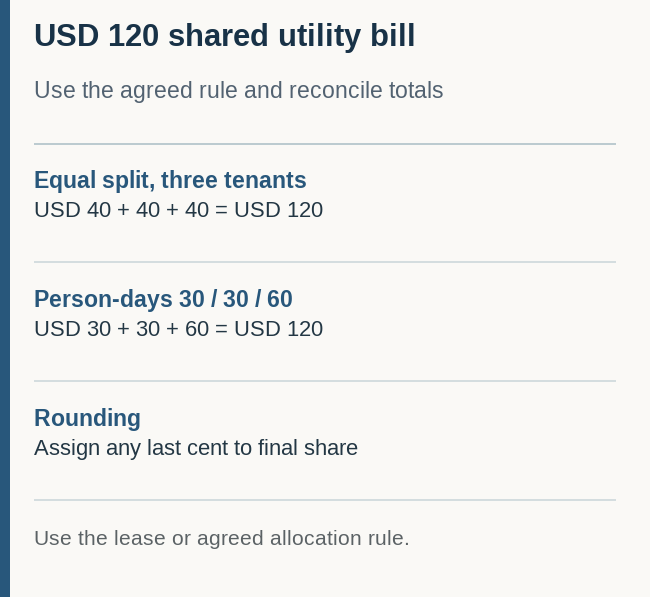
If the lease calls for an equal split among three tenants, each share is USD 40.00. The allocation should reconcile to the original USD 120.00 provider bill.
If the agreement instead uses days of occupancy, count each tenant's days in the billing period and add those counts to get total person-days. Divide each tenant's person-days by the total person-days, then multiply by USD 120.00. For example, shares of 30, 30 and 60 person-days total 120 person-days, so the allocated amounts are USD 30.00, USD 30.00 and USD 60.00. This is an illustration of the formula, not a default lease rule.
Round the first shares to cents, then assign any remaining one-cent difference to the final share so all shares still total USD 120.00. Record the agreed rule, source bill and calculation with the statement.
Create this in 30 seconds — free invoice with Eonebill, no sign-up required.
Create Free Invoice →Frequently Asked Questions
More Posts

How to Prepare a Year-End Bookkeeping Handoff Packet
Organize invoices, payment evidence, receipts, and unresolved questions into a dated packet your bookkeeper can review without guessing.

How to Send a Customer Statement for Multiple Unpaid Invoices
Summarize existing invoices without creating another charge. Separate overdue and not-yet-due balances with a checked $1,650 account example.

How to Resubmit an Invoice Rejected for a Missing PO Number
Resolve a missing purchase order reference, preserve the invoice history, and resubmit one traceable charge with a practical $1,250 example.
Newsletter
Join the community
Subscribe to our newsletter for the latest news and updates