How to Write a Receipt: Complete Guide for Small Business Owners
Learn how to write a professional receipt for any payment. Step-by-step guide covering all receipt fields, common mistakes, and free receipt templates.
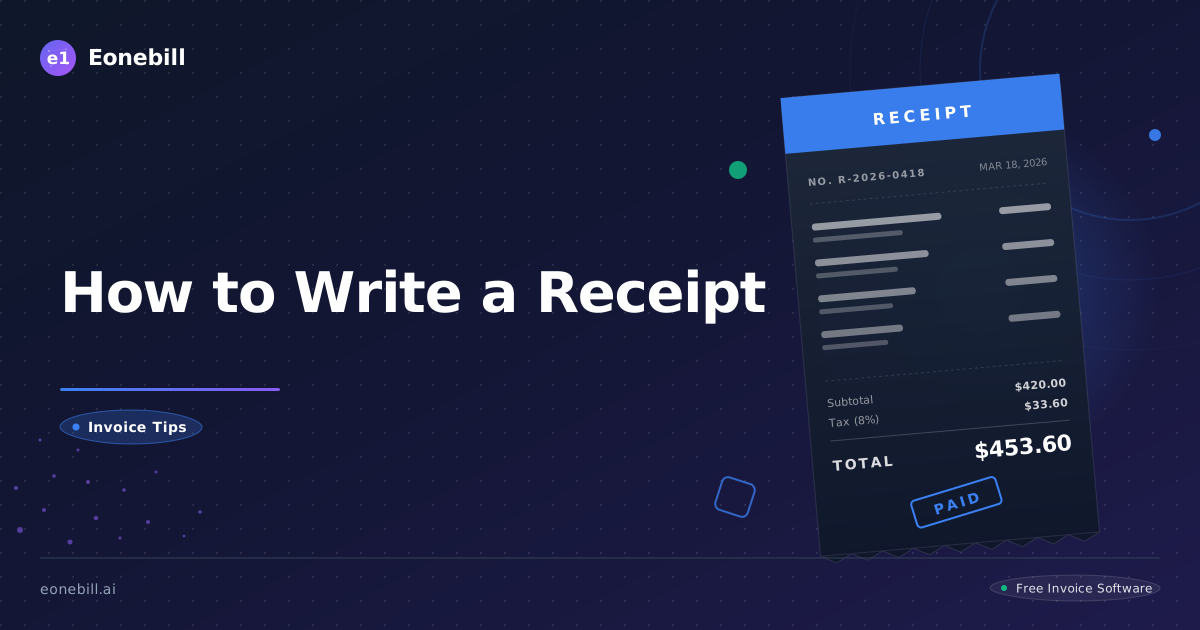
How to Write a Receipt: Complete Guide for Small Business Owners
Introduction
Most small business owners don't think twice about receipts. They're the little slips of paper you hand over after a transaction — or the digital confirmation that flashes on a screen after someone taps their card.
But receipts are far more than transaction confirmations. For freelancers, contractors, and small business owners, a properly written receipt is a legal document, a bookkeeping essential, and your first line of defense in any payment dispute.
This guide covers everything you need to know about writing professional receipts: the required fields, common mistakes, legal requirements, digital alternatives, and how to generate receipts in under 30 seconds with free tools.
By the end, you'll understand exactly what makes a receipt hold up under IRS scrutiny, satisfy your accountant, and protect your business.
What Is a Receipt and What Does It Do?
A receipt is a written acknowledgment that a payment has been received. It documents the transfer of money from a buyer to a seller in exchange for goods or services.
Unlike an invoice (which requests payment), a receipt confirms that payment has already been made. It serves several critical purposes:
- Proof of transaction: Establishes that a purchase occurred
- Legal protection: Documents payment in case of disputes
- Tax compliance: Required by the IRS for business expense deductions
- Bookkeeping: Forms the foundation of accurate financial records
- Customer service: Gives buyers confidence their payment was processed
If you accept payments — whether from clients, customers, or customers — you need to provide receipts. It's that simple.
Receipt vs. Invoice: What's the Difference?
This is the most common point of confusion for new business owners. Here's the direct comparison:
| | Receipt | Invoice |
|---|---|---|
| When issued | After payment is received | Before payment is due |
| Purpose | Proof of completed payment | Request for payment |
| Who issues it | Seller (to buyer) | Seller (to buyer) |
| What it shows | Amount paid, items purchased | Amount owed, payment due date |
| Legal significance | Confirms transaction complete | Establishes debt |
| Used by | Retailers, service providers, freelancers | Freelancers, B2B service providers |
Example: You hire a web developer to build your site. She sends you an invoice for $3,000. You pay it. She then sends you a receipt confirming the $3,000 was received.
You'd use an invoice if you're the one billing a client. You'd use a receipt if you need to prove payment was made (as either the buyer or seller).
Who Needs to Issue Receipts?
If you run any kind of business that accepts payment, you need to issue receipts. This includes:
- Freelancers and contractors receiving payment from clients
- Service-based businesses (photographers, designers, consultants, tutors)
- Retail businesses selling products
- Online businesses processing digital payments
- Any business required to collect sales tax
Even if a client says they don't need a receipt, you should always provide one. The receipt protects you as much as it protects them. The SBA's guide to starting a small business recommends keeping complete financial records — including receipts for all transactions — as a foundational habit from day one.
The 6 Mandatory Fields Every Receipt Must Have
A receipt isn't valid — or useful — without these core elements. Here's what to include every single time:
1. Your Business Information
Your receipt must clearly identify your business:
- Business name (or your full name if sole proprietor)
- Business address
- Phone number or email
- Tax ID / EIN (if applicable in your jurisdiction)
This establishes who received the payment.
2. Customer Information
Who made the payment:
- Customer's name
- Customer's address (for larger transactions)
- Customer's email (optional but helpful for digital receipts)
3. Payment Date
The exact date payment was received. This is critical for:
- Tax year attribution
- Bookkeeping accuracy
- Dispute resolution
Always use a full date format: March 26, 2026 or 2026-03-26.
4. Description of Goods or Services
What was purchased or provided:
- Itemized list of products or services
- Quantities where applicable
- Brief description sufficient to identify the transaction
Bad example: "Services"
Good example: "Logo design package — 3 initial concepts + 2 rounds of revisions"
5. Amount Received
The exact amount paid:
- Subtotal (before tax)
- Tax amount and rate
- Total amount received
- Payment method used (cash, card, check, bank transfer)
For international transactions, clearly state the currency.
6. Unique Receipt Number
A unique identifier for each receipt, which allows you to:
- Track all transactions
- Reference specific receipts in disputes
- Reconcile with bank statements
Format options:
- Sequential:
RCP-001,RCP-002 - Date + sequential:
2026-03-26-001 - Transaction ID (for digital payments)
Optional But Recommended Fields
These aren't mandatory, but they make your receipts more professional and useful:
Payment Method
Knowing whether payment came via cash, credit card, PayPal, or bank transfer matters for your records. Note it on the receipt.
Reference Number (For Card/Online Payments)
If paying by card, include the last four digits of the card or the transaction ID from your payment processor. This links the receipt to the actual payment in your processor's records.
Terms and Conditions
For larger transactions, a brief statement of your refund or service policy can prevent disputes.
Your Signature
For formal or high-value transactions, a signature adds legitimacy. For everyday retail receipts, it's optional.
How to Write a Receipt: Step by Step
Here's the process for creating a professional receipt using Eonebill's free receipt generator.
Step 1: Go to eonebill.ai and Select "Receipt Generator"
Navigate to eonebill.ai and click on the receipt tool. No account required to start.
Step 2: Enter Your Business Details (First Time Only)
Fill in:
- Your business name
- Your business address
- Contact information
These save for future use.
Step 3: Enter the Customer's Information
Fill in:
- Customer's name
- Customer's address (optional for small transactions)
Step 4: Add the Transaction Details
- Date of payment
- Description of what was sold or provided
- Amount received
- Payment method (cash, card, bank transfer, etc.)
- Any applicable tax
Eonebill calculates totals automatically.
Step 5: Preview and Send
Preview the receipt to make sure everything looks correct. Then either:
- Print it for in-person transactions
- Email it directly to the customer
- Download as PDF for your records
Total time: under 30 seconds for a complete, professional receipt.
Receipt Templates: When to Use What
Using a template ensures you never miss a required field. Here's when to use each type:
Simple Receipt Template
Best for: Small cash transactions, tips, minor services
Includes: Business name, customer name, amount, date, description
Itemized Receipt Template
Best for: Retail transactions, multiple products, detailed billing
Includes: Line-by-line breakdown of items, quantities, prices
Service Receipt Template
Best for: Freelancers, consultants, service providers
Includes: Service description, hours or fixed fee, project reference
Rent or Lease Receipt
Best for: Landlords, property managers
Includes: Rent amount, period covered, security deposit info, property address
Tax-Deductible Donation Receipt
Best for: Nonprofits, charitable donations
Includes: Organization info, donation amount, tax-exempt status
All of these templates are available free at eonebill.ai → [/receipt-template]
Digital Receipts vs. Paper Receipts
Paper Receipts
Pros:
- Immediate for in-person transactions
- No technology required
- Some clients still prefer paper
Cons:
- Can be lost, damaged, faded
- Hard to organize and search
- Environmentally wasteful
- Difficult to reconcile with bank statements
Digital Receipts
Pros:
- Instantly emailed or texted to customer
- Cannot be lost or damaged
- Easily searchable
- Automatically organized
- Eco-friendly
- Easier for tax preparation
Cons:
- Requires email or phone number from customer
- Some customers ignore digital receipts
- Need reliable internet connection
Best practice: Offer both. Hand over a paper copy for in-person transactions, and immediately send a digital copy via email. Eonebill does this automatically when you create a receipt.
Common Receipt Mistakes That Cost You
These errors show up in audits, cause disputes, and create bookkeeping nightmares:
Mistake 1: Missing the Date
This is shockingly common. Without a date, you can't prove when a transaction occurred. Always include the full date.
Mistake 2: No Description of Goods or Services
"Payment received" tells no one anything useful. Be specific. "Two hours of business consulting — March 2026" is clear. "Consulting" is not.
Mistake 3: Wrong Amount
Always verify the amount before printing. A receipt showing the wrong total undermines your credibility and creates accounting problems.
Mistake 4: No Receipt Number
Without sequential numbering, you can't track all receipts or prove you issued one if challenged. Always assign a unique number.
Mistake 5: Forgetting Tax Information
If you're collecting sales tax or VAT, the receipt must show the tax rate and amount separately. This is required for customers to claim input tax credits.
Mistake 6: Not Issuing a Receipt at All
This is the biggest mistake. Every payment you receive should produce a receipt — even if the customer says they don't need one. It protects you in disputes and is essential for your tax records.
Mistake 7: Poor Record Keeping
Issuing receipts is only half the battle. You need to store copies of every receipt you issue, organized by date, for at least 7 years (IRS requirement for business records).
How Long Must You Keep Receipts?
The IRS requires businesses to keep records for at least 3 years from the date the return is filed, or 7 years if income is underreported by more than 25% (IRS Publication 583 — Starting a Business and Keeping Records). For state tax purposes, requirements vary by state.
For practical purposes:
- Keep digital copies: Scan paper receipts immediately and store in cloud storage
- Use a bookkeeping system: Link receipts to transactions in QuickBooks, Wave, or Eonebill
- Organize by year: Create folders for each tax year and subfolders by month
Pro tip: Take a photo of every paper receipt immediately. Paper receipts fade over time — especially thermal paper. The IRS has accepted photos of receipts for years.
Receipts for Cash Payments: Special Considerations
Cash transactions deserve extra attention because they're harder to verify after the fact.
Beyond the standard fields, cash receipts should include:
- Payment method clearly marked as "Cash"
- The full amount in both numbers and words (for large amounts)
- A note on whether change was given
- Any cash-handling employee name
The IRS specifically scrutinizes cash businesses. Without proper documentation, you have no proof of income. A well-written cash receipt is your evidence that the money was received and reported.
Keeping Cash Safe
If you regularly accept cash:
- Issue a receipt immediately upon receiving payment
- Reconcile cash on hand daily against receipt records
- Use a point-of-sale system that tracks all transactions
- Never skip issuing a receipt because the amount is small
Receipts for Freelancers: What You Need to Know
As a freelancer, you issue receipts when you receive payment from clients. Here's what to keep in mind:
Always Issue a Receipt Upon Payment
When a client pays your invoice, immediately send a receipt. This:
- Confirms the payment was received
- Provides the client with their proof of payment
- Creates a paper trail for your records
- Closes the loop on the billing cycle
Link Receipts to Invoices
Every receipt should reference the corresponding invoice number. This creates a clear audit trail:
Receipt #RCP-2026-001
Payment received from: Acme Corp
For invoice: INV-2026-0042
Amount: $1,500.00
Payment method: Bank transfer
Date: March 26, 2026
For Partial Payments
If a client pays in installments, issue a separate receipt for each payment and note the remaining balance.
For Retainers
If a client pays a retainer fee, issue a receipt showing:
- Retainer amount paid
- The service period it covers
- Any refund policy if unused
How to Generate Receipts on Your Phone
Modern receipt tools work beautifully on mobile. Here's how:
- Open your browser on your phone
- Go to eonebill.ai
- Click "Receipt Generator"
- Fill in the fields — optimized for mobile layout
- Preview the receipt
- Send via email or text, or download as PDF
The entire process takes under 30 seconds and works on any device. No app download required.
Best Practices for Professional Receipts
Make Them Legible
Use clear fonts, adequate spacing, and professional formatting. A receipt that's hard to read looks unprofessional and is harder to use for bookkeeping.
Be Consistent
Use the same receipt format every time. Inconsistency signals sloppiness and makes reconciliation harder.
Keep Copies
Every receipt you issue should be stored in your records. Eonebill automatically saves all receipts to your account.
Use Professional Language
Even simple receipts should use professional language:
- "Payment received for" instead of "Got paid for"
- "Professional services rendered" instead of "Work done"
- Full dates and proper spelling
Include Contact Information
Give customers a way to reach you if they have questions about the receipt. Include your email and phone number.
Receipt Templates and Tools: Free Options
Eonebill (Recommended)
- Free receipt generator — no signup required
- Multiple receipt templates
- Mobile-optimized
- Auto-saves all receipts
- Direct email and text delivery
- PDF download
Compare Eonebill with other receipt management tools on G2 to see how it stacks up against competitors in usability and features.
Wave
- Free accounting software with receipt creation
- Good for freelancers who need broader accounting features
QuickBooks
- Full-service accounting with receipt management
- Receipt scanning via mobile app
- Paid subscription required
Our recommendation: Use Eonebill's free receipt generator for speed and simplicity. It's faster than any accounting software and produces professional receipts in under 30 seconds.
Conclusion: Receipts Matter More Than You Think
Most business owners treat receipts as an afterthought — a slip of paper to hand over and forget about.
But receipts are foundational to your business:
- They're your proof of income for the IRS
- They protect you in payment disputes
- They form the backbone of accurate bookkeeping
- They project professionalism to your clients
The good news: writing a professional receipt takes under 30 seconds with the right tool. There's no excuse for getting it wrong.
Here's what to do right now:
- Go to eonebill.ai
- Try the free receipt generator → [/free-tools/receipt-generator]
- Download the free receipt template → [/receipt-template]
- Use it for your next transaction
A well-written receipt takes 30 seconds to create and could save you hours of headaches — or thousands of dollars in tax disputes — down the road.
Start creating professional receipts free → [/free-trial]
Create this in 30 seconds — free invoice with Eonebill, no sign-up required.
Create Free Invoice →Frequently Asked Questions
More Posts
Filing Taxes Late: Penalties, Extensions, and How to Catch Up (2026)
Missed the April deadline? Understand the 5 percent failure-to-file vs 0.5 percent failure-to-pay penalty difference, how Form 4868 extensions help, and the four-step protocol for catching up on years of unfiled returns.
Penalties for Not Filing a 1099: What Freelancers and Small Businesses Need to Know (2026)
Failing to file 1099 forms on time triggers escalating IRS penalties from 60 to 660 dollars per form. Learn the four-tier schedule, how to fix a missed filing, and when First-Time Penalty Abatement applies.

How to Write a Gentle Reminder Email (Templates + Examples)
Learn how to write a professional gentle reminder email that gets results. Includes 8 ready-to-use templates for invoices, meetings, deadlines, and more.
Newsletter
Join the community
Subscribe to our newsletter for the latest news and updates
Ready to streamline your freelance workflow?