Contract Templates: The Complete Guide for Freelancers (Free Download)
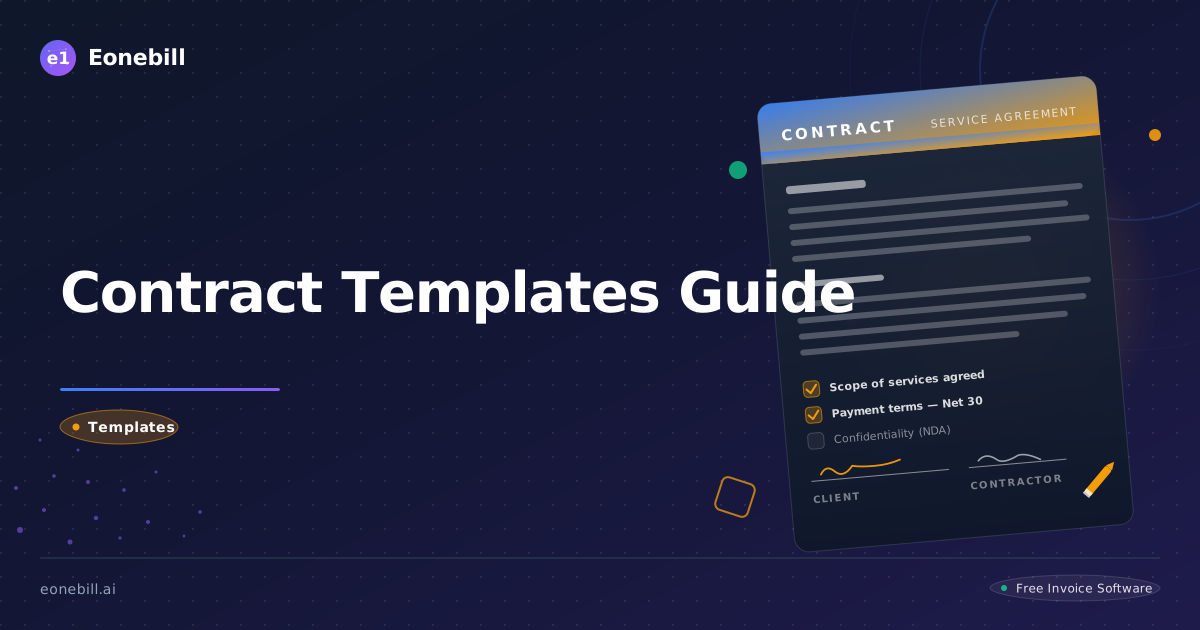
Contract Templates: The Complete Guide for Freelancers (Free Download)
Most freelancers learn about the value of contracts the hard way — after a project goes wrong. A client disappears without paying. A scope-creep dispute turns into an unpaid final invoice. A client uses deliverables without authorization because there was nothing in writing saying they couldn't. These situations are painful, expensive, and almost entirely preventable. A well-written contract template — customized for your specific project and signed by both parties — is the single most effective thing you can do to protect your freelance business.
Yet surveys consistently show that a significant percentage of freelancers work without written contracts, especially on smaller projects. The reasoning is understandable: contracts feel formal, creating them takes time, and on a $500 project, the overhead seems disproportionate. But the math works against that reasoning. The average late-payment or non-payment dispute costs a freelancer far more in time and stress than the 20 minutes it would take to prepare and send a contract. And the cost of an IP dispute — where a former client claims ownership of your work — can run into thousands of dollars in lost licensing revenue or legal fees.
This guide explains everything you need to know about freelance contract templates: the different types available, what every contract must include, how to customize a free template for your specific work, and common mistakes to avoid. You'll also find links to Eonebill's free contract template library at /contract-template, where you can download, customize, and e-sign your contracts at no cost.
Why Every Freelancer Needs a Contract
A contract is the legal foundation of every client relationship. Without one, you're operating on trust — and trust, however warranted in the moment, offers no protection when things go sideways.
Scope creep is the most common reason freelance projects become unprofitable. Without a written scope definition, every new feature request, additional revision, or expanded deliverable is technically within bounds — because "the bounds" were never established. Clients rarely ask for more work maliciously; they simply expand their vision as the project progresses and assume you'll accommodate it. A contract with a clear scope definition and a change order process is what allows you to say "that's outside our agreement" without damaging the relationship.
Late and non-payment is the second most common freelancer problem. According to multiple surveys of independent workers, more than 70% of freelancers have experienced a late payment and more than 30% have experienced non-payment at some point in their careers. A contract with explicit payment terms — including the amount, due date, late fee, and consequences of non-payment — gives you a legal basis for collection. Without it, you have no documented agreement to point to. The term "as agreed" only works if the agreement was written down. Browse your options at the /contract-template hub to find the right starting point.
IP disputes are less common but potentially the most damaging. If a contract doesn't specify who owns the intellectual property in your deliverables — and when that ownership transfers — a client can claim they own your work even before they've paid for it, or argue they have the right to use it without a formal license. A clear IP clause (work-for-hire vs. license, transfer upon final payment) eliminates this ambiguity entirely. You can read more about how IP clauses work in our /glossary/contract.
Types of Contract Templates for Freelancers
Different types of freelance work call for different contract templates. Using the right template for your type of work means you're starting from a structure designed for your specific legal exposures and business needs.
Freelance Contract. The general-purpose agreement for independent contractor relationships between a freelancer and a client. Covers scope of work, payment terms, IP ownership, revision policy, confidentiality, and termination. Suitable for most project-based freelance work across creative, technical, and professional services. This is usually the right starting point for most freelancers. Access it directly at /contract-template/freelance-contract.
Service Contract. Used by service businesses and contractors who provide ongoing or recurring services rather than one-off project deliverables. A service contract typically includes a more robust service level definition, a recurring billing structure, and provisions for service continuity and termination notice. Plumbers, landscapers, virtual assistants, and ongoing retainer relationships often use service contracts. Find the Eonebill template at /contract-template/service-contract.
NDA (Non-Disclosure Agreement). A confidentiality agreement used to protect sensitive information shared between parties. Freelancers often sign NDAs when working with clients on proprietary products, unreleased campaigns, or sensitive business data. You may also want to use an NDA when sharing your own proprietary processes or methodologies with a client. NDAs can be one-way (only one party is bound) or mutual (both parties are bound). Access the template at /contract-template/nda.
Consulting Contract. Designed for management consultants, IT consultants, HR consultants, and other advisory professionals. Consulting contracts differ from standard freelance contracts in that they typically include more detailed provisions for deliverable acceptance, success criteria, expense reimbursement, and multi-phase engagement structure. They also tend to address the consultant's existing methodologies and frameworks as excluded IP. Find the consulting template at /contract-template/consulting-contract.
Independent Contractor Agreement. Specifically designed for 1099 independent contractors working with businesses. An independent contractor agreement emphasizes the contractor's status as an independent business (not an employee), covers the scope of services, tax withholding responsibilities, and often includes non-solicitation provisions. This is especially important in the US because worker misclassification is an active compliance risk for businesses that engage contractors.
Statement of Work. Not technically a contract in itself, but frequently used as a project-specific addendum to a master contract. An SOW defines the scope, deliverables, timeline, and payment for a specific project. For ongoing client relationships, a master freelance contract plus project-specific SOWs is a highly professional and legally sound structure. Start with the SOW template at /statement-of-work-template.
What Every Freelance Contract Template Must Include
Regardless of which contract type you use, eight clauses must be present for the contract to provide meaningful protection.
1. Parties Identification. The full legal names (and ideally the business entity names) of both parties, along with their addresses and contact information. If you operate as an LLC or other business entity, use your entity name, not just your personal name. This determines who is actually bound by the agreement and who can enforce it.
2. Scope of Work. The specific work to be performed — described in enough detail that both parties would arrive at the same understanding reading it independently. Include what is in scope and what is out of scope. A missing scope section means the client can interpret the contract to include anything they consider reasonable.
3. Payment Terms and Schedule. The total fee (or rate), the payment schedule (milestone-based, date-based, or invoice-based), the payment method, and the consequences of late payment (late fee, interest, work suspension). Without explicit payment terms, you have no contractual basis for demanding payment on a specific schedule.
4. Intellectual Property Ownership. Who owns the work product? When does ownership transfer? Is the work created as "work for hire" (client owns it from creation) or under a license (you retain ownership and grant the client rights to use it)? Most freelancers use a license model with transfer of full ownership upon final payment — meaning the client doesn't own the work until the last invoice is paid. This gives you powerful leverage in non-payment situations.
5. Revision and Change Order Process. How many revision rounds are included in the base fee? What is the process for requesting work outside the original scope? What is the rate for out-of-scope work? Without these provisions, every client request — no matter how far outside the original scope — becomes a negotiation you have no leverage in.
6. Confidentiality. An obligation on both parties to keep each other's confidential information private. For the client, this typically covers business information, unreleased products, and client data. For you, it might cover client identity or project details you can't publicize. Confidentiality provisions protect both parties and demonstrate professionalism.
7. Termination Clause. What happens if either party wants to end the engagement early? Specify the notice required, what work has been completed (and must be paid for), and any kill fee for early termination. Without a termination clause, both parties are effectively locked into the agreement with no clean exit mechanism.
8. Governing Law and Jurisdiction. Which state's laws govern the contract, and in which jurisdiction will disputes be resolved? For US freelancers, this is typically the state where you're based. This clause prevents a client in California from dragging you into a court proceeding in their home state when you're based in Texas.
How to Customize a Free Contract Template
A contract template is only the starting point — its value comes from customization. Here's how to do it right.
Step 1: Choose the Right Template Type. Match the template to your type of work. A graphic designer doing one-off logo projects should start with the freelance contract. A developer on a month-long retainer should look at the service contract. An IT consultant doing a system assessment should use the consulting contract. Starting with the right template means 80% of the structure is already correct for your work.
Step 2: Fill In Your Business Name, Client Name, and Jurisdiction. Replace every placeholder in the template with specific, accurate information. Use your full legal name or business entity name. Use the client's full legal name or company name — ask for it explicitly if you're not sure. Your jurisdiction should be the state where your business is based.
Step 3: Define Scope Precisely. The scope section is the most important one to customize — and the one most often left too vague. Replace general scope language with a specific description of what you will deliver for this specific project. Be as concrete as possible: numbers, formats, quantities, revision rounds. Also add an out-of-scope list that explicitly names what you will not be doing.
Step 4: Set Payment Milestones That Tie to Deliverables. Customize the payment section with your actual fee and a milestone-based payment schedule. Tie each payment to the completion of a specific deliverable, not to a calendar date. This creates mutual accountability and gives you leverage if the client delays the project.
Step 5: Sign Digitally Before Any Work Begins. Once your contract is customized, send it for digital signature. Eonebill's free e-signature maker at /free-tools/e-signature-maker lets you send, sign, and store contracts digitally in minutes. Both parties receive a signed copy automatically. Never start work based on a verbal agreement — get the signature first.
Free vs. Paid Contract Templates: Which Should You Use?
This question comes up often, and the answer is more nuanced than "always pay for a lawyer." For most freelance work, a professionally designed free template is entirely sufficient.
Free contract templates are appropriate for: most freelance projects under $10,000, engagements with US-based clients, straightforward scope with one deliverable category, and standard payment terms. Eonebill's free templates are built on legal best practices, cover the eight essential clauses, and have been reviewed to reflect current US contractor law. A thoughtfully customized free template is more protective than a hastily filled-in paid template.
Paid or attorney-reviewed templates are worth considering when: the contract value exceeds $25,000, the engagement involves international clients or cross-border IP considerations, the work involves sensitive data or regulatory compliance (healthcare, finance), or the relationship involves non-standard terms that a generic template won't cover. In these cases, an attorney can customize language to your specific risk profile.
For everything else, Eonebill's free templates at /contract-template will serve you well. Upgrade to Pro at /pricing to access advanced features like unlimited contract storage, e-signature tracking, and automated payment reminders.
The Freelancer's Contract Checklist
Before you send any contract to a client, run through this checklist to make sure it's doing its job.
Scope is specific — every deliverable is named, formatted, and quantified. There is no language that could be interpreted to include unlimited deliverables.
Payment terms are clear — the total fee, payment schedule, payment method, and late-payment consequences are all stated explicitly.
Revision rounds are limited — the number of included revision rounds is specified for each deliverable, and the out-of-scope rate for additional revisions is stated.
IP transfers ONLY after final payment — the IP clause clearly states that ownership transfers to the client only upon receipt of full final payment. No exceptions.
Both parties sign before work begins — not after the first deliverable, not at the end of the project. Before the first day of work.
You keep a signed copy — store every executed contract in a dedicated folder. Use Eonebill's document management to keep them organized and searchable.
Common Contract Mistakes Freelancers Make
Awareness of what goes wrong is the best way to make sure it doesn't happen to you.
Working without a contract. This is the most costly mistake and the most common. Even on small projects, even with clients you've worked with before, even when they seem completely trustworthy. Trust doesn't hold up in a payment dispute. The contract does.
Using a generic template without customizing the scope. A contract with vague scope language is almost as dangerous as no contract at all. If the scope section says "website design and development" without any further specifics, the client has wide latitude to interpret that to include everything they ever wanted. Customize the scope section for every single project.
Not including a kill fee. If a client cancels a project midway through — or simply goes dark — you need a contractual basis for payment for the work you've already completed. A kill fee clause (usually 25–50% of the remaining contract value) gives you that protection. Many freelancers omit this and end up eating the cost of half a project.
Forgetting to specify who owns the IP. The IP clause is the one that bites freelancers most unexpectedly. If your contract doesn't specify IP ownership, the legal default may vary by jurisdiction — and in some cases defaults to a "work for hire" interpretation that benefits the client. Always specify: you retain ownership until final payment is received in full.
Not getting the client to sign before starting work. Starting work before a contract is signed is essentially working on faith. Once you've invested time in a project, your negotiating leverage drops significantly — the client knows you've already started, and you're less likely to walk away. Sign first, work second. Every time.
Frequently Asked Questions
See the FAQ section below for answers to the most common questions about freelance contract templates.
Ready to manage invoices, contracts & proposals in one place? Try Eonebill free — no credit card required.
Start Free →Frequently Asked Questions
More Posts
Filing Taxes Late: Penalties, Extensions, and How to Catch Up (2026)
Missed the April deadline? Understand the 5 percent failure-to-file vs 0.5 percent failure-to-pay penalty difference, how Form 4868 extensions help, and the four-step protocol for catching up on years of unfiled returns.
Penalties for Not Filing a 1099: What Freelancers and Small Businesses Need to Know (2026)
Failing to file 1099 forms on time triggers escalating IRS penalties from 60 to 660 dollars per form. Learn the four-tier schedule, how to fix a missed filing, and when First-Time Penalty Abatement applies.

How to Write a Gentle Reminder Email (Templates + Examples)
Learn how to write a professional gentle reminder email that gets results. Includes 8 ready-to-use templates for invoices, meetings, deadlines, and more.
Newsletter
Join the community
Subscribe to our newsletter for the latest news and updates