Past Due Invoice Email Templates: 5 Proven Scripts for...
Collection emails that work. Use these 5 past due invoice email templates to professionally and firmly collect overdue payments from clients. Includes timing guide and subject lines.
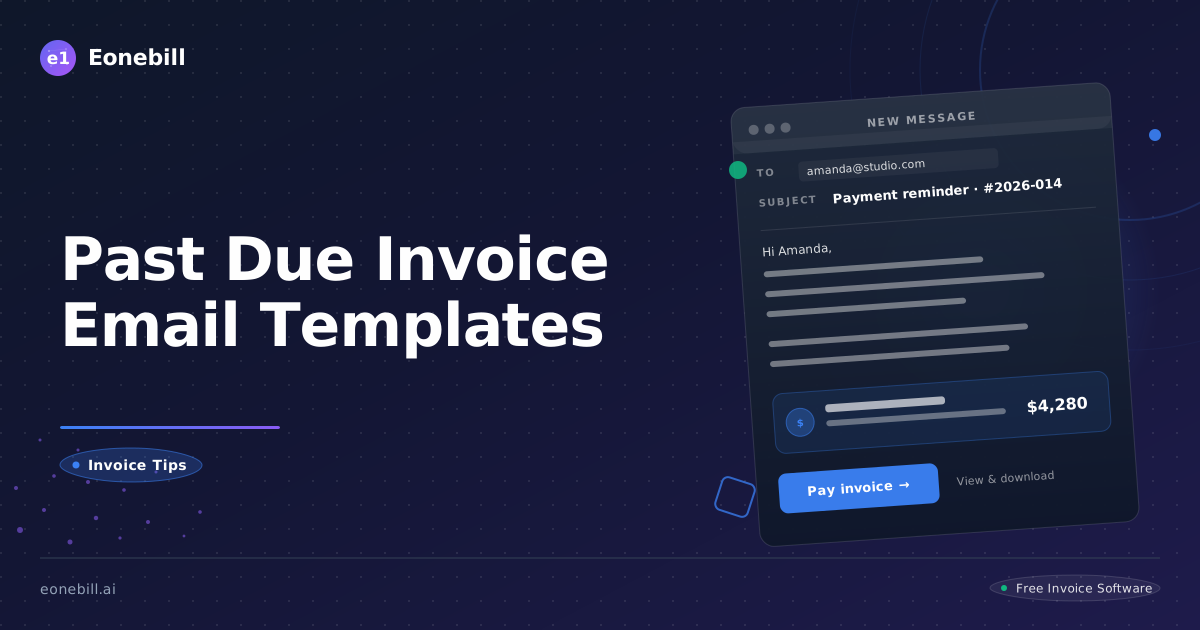
Past Due Invoice Email Templates (Copy-Paste Ready)
You finished the work. You sent the invoice. You waited. And now the due date has come and gone with no payment in sight. If you've ever sat staring at an overdue invoice wondering what to say — and how to say it without burning the relationship — you're in the right place.
This guide gives you five ready-to-use past due invoice email templates for every stage of the follow-up process, plus a complete framework for when to send them, how to personalize them, and what to do when emails alone aren't enough.
Why Clients Pay Late (and What It Means for You)
Before you fire off an angry email, it helps to understand why late payments happen in the first place. Most clients who pay late aren't intentionally ignoring you. The reality is more mundane — and more fixable.
The most common reasons invoices go unpaid:
- The invoice got lost or buried. Email inboxes are chaotic. A client's AP department, assistant, or spouse may have missed the original email entirely.
- Cash flow problems on their end. Small business clients sometimes juggle tight cash flow and pay vendors in a rough priority order. If you haven't followed up, you may simply be at the bottom of the stack.
- Confusion about invoice details. An unclear description, wrong bank details, or missing PO number can stall payment even when a client wants to pay.
- Approval delays. Larger companies often require multiple sign-offs before releasing payment. If one approver is on vacation, your invoice sits.
- Simple forgetfulness. People are busy. Without an automated reminder system, invoices get forgotten.
What it costs you:
Late payments aren't just annoying — they have real financial consequences. According to small business surveys, freelancers and small businesses lose thousands of dollars per year to late or non-payment. Beyond the cash, chasing overdue invoices eats hours you could spend on billable work. It also creates unnecessary stress and can damage client relationships when handled badly.
The good news: a clear, professional follow-up process dramatically improves your collection rate — without drama. The templates below are designed to do exactly that.
The Ideal Follow-Up Timeline for Past Due Invoices
Timing matters. Send a follow-up too soon and you look anxious. Wait too long and you've lost the psychological moment. Here's the timeline that works for most freelancers and small businesses:
| Stage | Timing | Tone |
|---|---|---|
| Friendly first reminder | 3–5 days past due | Warm, assumes oversight |
| Professional follow-up | 7–14 days past due | Direct, cites specific invoice |
| Formal second notice | 2–3 weeks past due | Firm, introduces late fee |
| Final notice | 30+ days past due | Serious, states next steps |
| Payment plan offer | Any time for valued clients | Empathetic, problem-solving |
A few principles to keep in mind as you work through this timeline:
Always reference the specific invoice. Include the invoice number, amount, and original due date in every email. This removes all ambiguity and makes it easy for the client (or their bookkeeper) to act immediately.
Use a consistent subject line format. Clients should be able to scan their inbox and know instantly what the email is about. Subject lines like "Invoice #1042 — Payment Past Due" are boring and effective.
Keep a paper trail. Every email you send creates a record. If you eventually need to escalate — whether to a collections agency, a lawyer, or small claims court — documented follow-ups strengthen your position considerably.
Don't apologize for following up. A phrase like "I'm sorry to bother you" signals that chasing payment is somehow your fault. It isn't. Professional follow-up is a normal, expected part of business.
5 Past Due Invoice Email Templates You Can Use Today
Copy, paste, and personalize. That's it.
Template 1: Friendly First Reminder (3–5 Days Past Due)
This is your low-pressure opening move. Keep it light. Most of the time, this email alone gets the payment.
Subject: Invoice #[INVOICE NUMBER] — Quick Follow-Up

Hi [Client Name],

I hope you're having a great week! I'm just reaching out to follow up on Invoice #[INVOICE NUMBER] for [project/service name], which was due on [due date].

Total due: $[AMOUNT]

I wanted to make sure this didn't get buried in your inbox. If you've already sent payment, please disregard this message and thank you!

If you have any questions about the invoice or need anything from me to process it, I'm happy to help.

Payment can be made via [payment methods — e.g., bank transfer, Stripe, check].

Thanks so much — really enjoyed working with you on this.

[Your Name]
[Your Business Name]
[Contact Info]
Template 2: Professional Follow-Up (7–14 Days Past Due)
The friendly nudge didn't land. Time to be a little more direct while staying completely professional.
Subject: Invoice #[INVOICE NUMBER] — Payment Now 7 Days Past Due

Hi [Client Name],

I'm following up again on Invoice #[INVOICE NUMBER] for $[AMOUNT], which was due on [due date] and is now [X] days past due.

Invoice details:
- Invoice #: [INVOICE NUMBER]
- Services: [brief description]
- Due date: [DUE DATE]
- Amount due: $[AMOUNT]

If there's an issue with the invoice — a missing detail, a question about the work, or an internal approval step I can help move along — please let me know and I'll address it right away.

If you're ready to pay, you can do so here: [payment link]

I'd appreciate hearing from you by [specific date — e.g., Friday, May 23] so we can get this resolved. Thank you for your prompt attention to this.

Best,
[Your Name]
[Your Business Name]
[Contact Info]
Template 3: Formal Second Notice with Late Fee Warning (2–3 Weeks Past Due)
At this stage, you've followed up twice with no resolution. It's time to introduce consequences. If your contract includes a late fee clause (and it should), reference it here.
Subject: SECOND NOTICE — Invoice #[INVOICE NUMBER] — $[AMOUNT] Overdue

Dear [Client Name],

This is a formal second notice regarding Invoice #[INVOICE NUMBER] in the amount of $[AMOUNT], which was due on [due date] and remains unpaid as of today, [today's date].

I have sent two previous reminders with no response or payment. I want to resolve this quickly and amicably, but I do need to bring the following to your attention:

Per our agreement dated [contract date], a late fee of [X]% per month (or $[flat fee]) applies to invoices outstanding beyond [X] days. If payment is not received by [DEADLINE DATE — e.g., 7 days from today], a late fee of $[AMOUNT] will be added to your balance.

Updated amount if paid after [DEADLINE DATE]: $[TOTAL WITH LATE FEE]

To avoid additional charges, please arrange payment by [DEADLINE DATE] using any of the following methods:
- [Payment method 1]
- [Payment method 2]

If there is a dispute about the invoice or you're experiencing a cash flow issue that's causing a delay, please contact me directly at [phone/email] so we can work something out.

I value our working relationship and want to resolve this without further escalation.

Sincerely,
[Your Name]
[Your Business Name]
[Contact Info]
Template 4: Final Notice Before Collections (30+ Days Past Due)
This is your last email before you take formal action. The tone should be calm but serious. No threats — just a clear statement of facts and next steps.
Subject: FINAL NOTICE — Invoice #[INVOICE NUMBER] — Action Required by [DATE]

Dear [Client Name],

This is a final notice regarding Invoice #[INVOICE NUMBER] in the amount of $[AMOUNT] (plus accrued late fees of $[LATE FEE AMOUNT]), which is now [X] days past due.

Despite multiple attempts to resolve this — including reminders sent on [DATE 1], [DATE 2], and [DATE 3] — we have not received payment or a response explaining the delay.

If payment in full is not received by [FINAL DEADLINE — typically 5–7 business days], I will have no choice but to pursue the following options:

1. Refer this matter to a collections agency
2. File a claim in small claims court for the outstanding balance plus any associated costs
3. Report this account to relevant business credit bureaus (if applicable)

I have no desire to take these steps. If you would like to resolve this immediately, payment can be made via [payment link or method]. If you need to discuss a payment arrangement, please contact me at [phone/email] by [DATE].

This is my final communication before I escalate. I hope we can resolve this today.

[Your Name]
[Your Business Name]
[Contact Info]
Template 5: Relationship-Preserving Payment Plan Offer (For Valued Clients)
Sometimes a good client hits a rough patch. This template acknowledges that reality without sacrificing your right to be paid — and often gets results that a hard-line approach would not.
Subject: Invoice #[INVOICE NUMBER] — Let's Find a Solution Together

Hi [Client Name],

I wanted to reach out personally about Invoice #[INVOICE NUMBER] for $[AMOUNT], which has been outstanding since [due date].

I know running a business can be unpredictable, and I don't want one overdue invoice to get in the way of what has been a great working relationship. I'd genuinely like to find a solution that works for both of us.

A few options I'm happy to consider:

Option A — Partial payment now: If you can send [X]% of the balance ($[PARTIAL AMOUNT]) by [DATE], I can give you until [EXTENDED DATE] for the remainder.

Option B — Payment plan: We split the outstanding balance into [X] equal installments of $[INSTALLMENT AMOUNT], paid on [dates — e.g., the 1st of each month], starting [START DATE].

Option C — Full payment by [DATE]: If cash flow clears up soon, I'm happy to waive the late fee if payment is made in full by [DATE].

All I ask is that we agree on a plan in writing so we're both on the same page. Please reply to this email or call me at [phone number] and we can sort this out quickly.

I look forward to continuing to work together.

Warm regards,
[Your Name]
[Your Business Name]
[Contact Info]
How to Personalize These Templates
Templates are a starting point, not a final product. The more you tailor each message, the better your results will be. Here's how to make these emails feel like you wrote them from scratch every time.
Use the client's actual name. Not "Hi there" or "Dear Client." People respond to their own name. It signals that this is not a mass email blast.
Reference the specific project. Instead of "services rendered," say "the brand identity package we completed in March" or "the three-month social media retainer." Specificity reduces any excuse for confusion.
Match the tone to the relationship. A five-year client who has always paid on time deserves a different tone than a one-time project client you barely know. The templates above give you a range — use your judgment about where to start.
Include a direct payment link. Every email should make it effortless to pay. If you use an invoicing tool like Eonebill, you can include a direct pay link so clients can settle the invoice in seconds, no login required.
Set a specific deadline. "Please pay at your earliest convenience" is too soft. "Please send payment by Friday, May 23" creates a concrete expectation and makes follow-up easier if the deadline passes.
Send from your business email. Gmail and Outlook are fine; a random third-party service with a generic domain is not. Your professional email address adds legitimacy.
When Emails Stop Working: Escalation Options
Sometimes email simply isn't enough. If you've sent three or more follow-ups over 30+ days with zero response or payment, it's time to escalate. Here are your options, roughly in order of escalation:
Phone call. Before any formal action, try picking up the phone. A brief, calm call often breaks a logjam that emails couldn't. It's harder to ignore a real voice, and you may learn something useful — like the invoice went to the wrong department or the client is going through a crisis.
Certified or registered letter. A physical letter sent via certified mail carries more legal weight than an email. It also proves delivery. Use this alongside (not instead of) your email trail.
Late fees and interest. If your contract allows, apply any contractual late fees. State the updated balance clearly and in writing.
Collections agency. Third-party collections agencies specialize in recovering overdue debts. They typically take a percentage of what they collect (often 25–50% for smaller debts). It's not a perfect solution, but recovering 60 cents on the dollar beats recovering nothing.
Small claims court. For amounts typically under $10,000–$25,000 (limits vary by state), small claims court is accessible, inexpensive, and often effective. You don't need a lawyer. A judge reviews the evidence — your contract, invoices, and email trail — and issues a judgment. A documented follow-up sequence is invaluable here.
Attorney demand letter. A letter from an attorney often prompts immediate payment even when your own letters haven't. Many attorneys will write a demand letter for a flat fee. The cost is often worth it for invoices over $2,000–$3,000.
Dispute via credit card processor. If the client paid a retainer by credit card and you're disputing the remainder, this isn't typically applicable — but if there's an erroneous chargeback situation, knowing your processor's dispute process matters.
Terminate the relationship. If a client consistently pays late or you've had to escalate multiple times, it may be time to part ways. Protecting your time and cash flow is not unprofessional — it's essential.
Preventing Late Payments Before They Start
The best time to handle a late payment is before the invoice is ever overdue. Here are the most effective practices for reducing the frequency of past due invoices in the first place.
Require a deposit upfront. For new clients or large projects, a 25–50% deposit is standard and reasonable. It immediately filters out clients who weren't serious and gives you a financial cushion if payment becomes difficult later.
Set clear payment terms in your contract. "Net 30" is common but may be longer than you need. Many freelancers have shifted to "Net 15" or even "Net 7" for smaller engagements. Whatever you choose, put it in writing and have the client acknowledge it before work begins.
Invoice promptly. The longer you wait to send an invoice after completing work, the longer you wait to get paid. Send invoices the same day or the next business day after milestone completion or month end.
Set up automated reminders. Tools like Eonebill allow you to configure automatic payment reminders before and after the due date — so follow-ups go out on schedule without you having to remember. This alone can cut your late payment rate significantly.
Make it easy to pay. The more payment options you offer — ACH, credit card, digital wallet — the fewer friction points stand between your client and a completed payment. A direct pay link in every invoice email removes a surprising number of barriers.
Build a late fee clause into every contract. Even if you never enforce it, the existence of a late fee clause creates a psychological incentive for on-time payment. Most clients would rather pay on time than deal with a fee — even a small one.
Review your client roster. If certain clients consistently pay late, factor that into your pricing and terms. Chronically late payers cost you more in admin time and cash flow stress than they may be worth.
Send a payment confirmation request. After sending an invoice, follow up within 24–48 hours with a brief note: "Just wanted to make sure Invoice #[X] came through — please let me know if you need anything to process it." This proactive step catches routing problems before they become overdue invoices.
Getting paid on time is not a luxury — it's the foundation of a sustainable business. A clear, consistent follow-up process using the right words at the right time makes an enormous difference. Use these templates as your starting point, adapt them to fit your voice and your client relationships, and don't hesitate to escalate when the situation calls for it.
Your work has value. Getting paid for it — on time and in full — is entirely reasonable to expect.
Ready to manage invoices, contracts & proposals in one place? Try Eonebill free — no credit card required.
Start Free →Frequently Asked Questions
More Posts
Filing Taxes Late: Penalties, Extensions, and How to Catch Up (2026)
Missed the April deadline? Understand the 5 percent failure-to-file vs 0.5 percent failure-to-pay penalty difference, how Form 4868 extensions help, and the four-step protocol for catching up on years of unfiled returns.
Penalties for Not Filing a 1099: What Freelancers and Small Businesses Need to Know (2026)
Failing to file 1099 forms on time triggers escalating IRS penalties from 60 to 660 dollars per form. Learn the four-tier schedule, how to fix a missed filing, and when First-Time Penalty Abatement applies.
How to Write a Gentle Reminder Email (Templates + Examples)
Learn how to write a professional gentle reminder email that gets results. Includes 8 ready-to-use templates for invoices, meetings, deadlines, and more.
Newsletter
Join the community
Subscribe to our newsletter for the latest news and updates
Ready to streamline your freelance workflow?