How to Create an Invoice in 2026 — Free Step-by-Step Guide
Learn how to create a professional invoice in seconds. Free templates, AI generator, and expert tips for freelancers and small businesses in 2026.
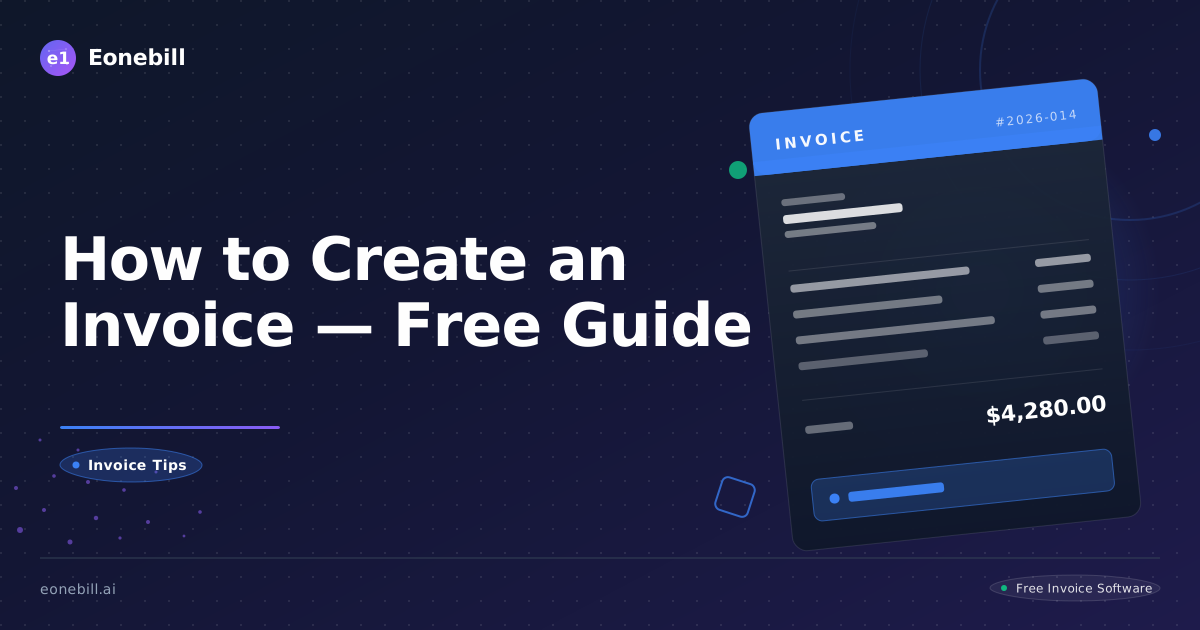
Invoicing sounds simple. Then you actually sit down to write one — and suddenly you're staring at a blank document wondering whether you're supposed to put your logo on the left or the right, whether "RE: Services Rendered" is still a thing, and whether you need to include your business license number.
Here's the good news: creating a professional invoice in 2026 is easier than it's ever been. You can do it manually with a free template, or you can let AI do it in 10 seconds. Either way, this guide covers everything you need to know — step by step.
TL;DR
- A professional invoice requires 8 key pieces of information
- The fastest way to invoice in 2026 is AI generation — describe it, get it done
- Free templates work fine for one-off invoices; AI tools save hours over time
- Always include clear payment terms and a Stripe/payment link
- Eonebill's free plan gives you 6 AI-generated invoices per month
Step 1: Gather Your Business and Client Information
Before you open any template or tool, collect the raw materials. An invoice is only as good as the information you put into it, and missing or incorrect details are the #1 reason invoices get sent back — delaying your payment.
Your business information:
- Business name (or your full legal name if you're a sole proprietor)
- Business address
- Phone number and email
- EIN or Social Security Number (required on 1099 invoices)
- Logo (optional but recommended for brand consistency)
- Website
Your client's information:
- Client's full name or business name
- Client's address
- Client's email
- Any purchase order number or reference code they've given you
Pro tip: If you're working with a new client, confirm their billing address before you send anything. A surprising number of payment delays start with "we need to update our billing address."
Step 2: Assign a Unique Invoice Number
Every invoice needs a unique identifier. This is how you, your client, and the IRS (if applicable) track the transaction. There's no IRS-mandated format — but consistency matters.
Common formats:
INV-001,INV-002(sequential)2026-001(year + sequential)CLIENT-001-INV(client-specific with sequential number)
The key rule: never reuse an invoice number. Even if a client hasn't paid an old invoice, don't reassign that number — create a new one.
If you're using Eonebill, invoice numbers are auto-generated and never duplicated. If you're using a manual template, keep a running list.
Step 3: Choose Your Line Item Structure
The body of your invoice is your itemized list of what you're charging for. Each line item should include:
- Description — What did you deliver? Be specific: "Logo design (3 concepts, 2 rounds of revisions)" not just "Design work."
- Quantity — Number of hours, units, or items
- Rate — Your price per unit or hourly rate
- Amount — Quantity × Rate (most templates calculate this automatically)
Common structures:
Hourly billing:
| Description | Hours | Rate | Amount |
|---|---|---|---|
| Web development | 12 | $150 | $1,800 |
| Content writing | 5 | $75 | $375 |
| Total | | | $2,175 |
Project fixed fee:
| Description | Amount |
|---|---|
| Landing page design + development | $3,500 |
| Total | $3,500 |
Retainer:
| Description | Amount |
|---|---|
| March 2026 marketing retainer | $2,000 |
| Total | $2,000 |
If you offered a discount or the client has a credit from a previous overpayment, add a line for that before the final total.
Step 4: Set Payment Terms and Due Date
Payment terms are where most freelancers get vague — and that's when things go wrong. Ambiguous terms lead to late payments, awkward follow-ups, and cash flow gaps.
Key terms to specify:
- Due date: When does the client need to pay by? Most common: Net 15 or Net 30.
- Accepted payment methods: ACH bank transfer, credit card, check, or all of the above.
- Late payment policy: Are you charging interest on overdue invoices? (e.g., "1.5% per month on overdue balances.")
- Payment instructions: Bank routing/account number, or a Stripe/payment link.
Standard payment terms for different client types:
| Client Type | Recommended Terms |
|---|---|
| New client | Payment upfront or Net 15 |
| Established client | Net 30 |
| Large corporate client | Net 30–Net 45 |
| Recurring retainer | Due on receipt |
For a full breakdown of what Net 30 means and whether it's right for you, read our Net 30 payment terms guide.
Step 5: Add Supporting Information
Depending on your business type and local regulations, you may need to include:
Tax information:
- For US freelancers: If you received $600+ from a client, you'll issue them a 1099-NEC. Note this on your invoice if relevant.
- Add your EIN or SSN in the footer if required for 1099 purposes.
Notes or terms:
- A short note like "Thank you for your business!" adds a human touch.
- Reference any prior discussions: "As discussed in our call on March 3rd."
- Specify whether the invoice is "final" or if revisions are pending.
Your signature:
- Digital or electronic signature is fine. Eonebill supports e-signatures natively, which is especially useful for contracts delivered alongside invoices.
What to Include: The Complete Invoice Checklist
Here's a checklist of every element a professional invoice should have:
- [ ] Your business name and contact details
- [ ] Client's name and billing address
- [ ] Unique invoice number
- [ ] Invoice issue date
- [ ] Description of goods or services
- [ ] Quantity and rate for each line item
- [ ] Subtotal, discounts (if any), and total amount due
- [ ] Payment terms and due date
- [ ] Accepted payment methods
- [ ] Your payment details (bank info or Stripe link)
- [ ] Tax ID (EIN or SSN) if applicable for 1099
- [ ] Your logo and branding (optional but recommended)
- [ ] Notes field (optional)
Industry-Specific Tips
Freelance Creative Services (Design, Writing, Marketing)
- Always reference the agreed scope of work. "Services as defined in the contract dated [date]" protects you if the client disputes the scope.
- If the project had change orders or scope expansions, list them separately so the invoice is transparent.
- Consider adding a "Kill Fee" line for projects cancelled mid-delivery.
Consulting and Professional Services
- Break billable hours into granular tasks, not just "Consulting services."
- If you're billing expenses separately (travel, software, sub-contractors), create a separate expense line.
- Corporate clients often have procurement requirements — note the PO number if provided.
IT and Software Development
- Break fixed-price projects into milestones (e.g., "Milestone 2 of 4: Backend API — complete") so the client can see progress.
- If you use a time-tracking tool, include the hours log as supporting documentation.
- Note any third-party software costs being passed through.
Construction and Trades
- Include a detailed scope of work — materials + labor separately.
- Note any permits, inspections, or approvals that are the client's responsibility.
- Many construction contracts are progress billing — break the invoice into completion percentages.
Healthcare and Professional Services
- Verify insurance and billing codes before invoicing.
- Include the service date(s) for each line item.
- If billing through insurance, note the claim number.
Or Let AI Do It in 10 Seconds
Here's the honest truth: if you're invoicing more than twice a month, manually filling out invoice templates is a waste of your time. Every hour you spend formatting an invoice is an hour you're not billing.
Eonebill's AI invoice generator changes the equation. Instead of navigating a template, you describe what you need in plain English:
> "Invoice Sarah Park for 10 hours of UX design consulting at $125/hr, due in 30 days via ACH."
That's it. The AI generates the complete, formatted invoice — pulls the client from your saved contacts, applies your branding, adds payment terms, and gives you a Stripe payment link. Ready to send in under 20 seconds.
Try it free — no credit card, no setup fee. Generate your first AI invoice →
How to Send Your Invoice
Creating the invoice is half the battle. Getting it delivered so it actually gets paid requires a little strategy:
Email delivery:
- Send the invoice as a PDF attachment (not just a body email) so it looks professional and can't be altered.
- Include a short, friendly message: "Hi [Name], attached is invoice [#] for [service]. Payment is due [date]. Let me know if you have any questions."
- Send to both the person you're working with and their accounts payable department if you know it.
Online delivery:
- Eonebill sends a professional payment link alongside every invoice. The client can pay with a credit card or ACH without needing to download anything.
- Online delivery creates a timestamp proving the invoice was delivered — useful if disputes arise.
Follow-up timing:
- If payment is overdue by 1–3 days: A gentle email reminder is appropriate. "Hi [Name], just a friendly reminder that invoice [#] was due [date]. No action needed if payment is en route."
- If overdue by 7+ days: Send a second, more direct follow-up.
- If overdue by 30+ days: Send a final notice and consider pausing services until resolved.
Common Invoice Mistakes to Avoid
Mistake #1: Not specifying payment terms
If you don't tell the client when you expect to be paid, they'll assume "whenever." Always include a due date.
Mistake #2: Vague line item descriptions
"Design work" on an invoice is useless if there's a dispute. "Logo design — 3 concepts, 2 revision rounds" is defensible and professional.
Mistake #3: Forgetting a payment link
If the client has to figure out how to pay you, some of them won't. Always include a Stripe or ACH payment link.
Mistake #4: Wrong client address
Always confirm the billing address, especially with corporate clients who may have different addresses for procurement, accounts payable, and legal.
Mistake #5: Not tracking invoice status
An invoice isn't done when you send it — it's done when you're paid. Log the status of every invoice (sent, viewed, paid, overdue) and follow up accordingly.
Related Resources
Create this in 30 seconds — free invoice with Eonebill, no sign-up required.
Create Free Invoice →Frequently Asked Questions
More Posts
Filing Taxes Late: Penalties, Extensions, and How to Catch Up (2026)
Missed the April deadline? Understand the 5 percent failure-to-file vs 0.5 percent failure-to-pay penalty difference, how Form 4868 extensions help, and the four-step protocol for catching up on years of unfiled returns.
Penalties for Not Filing a 1099: What Freelancers and Small Businesses Need to Know (2026)
Failing to file 1099 forms on time triggers escalating IRS penalties from 60 to 660 dollars per form. Learn the four-tier schedule, how to fix a missed filing, and when First-Time Penalty Abatement applies.
How to Write a Gentle Reminder Email (Templates + Examples)
Learn how to write a professional gentle reminder email that gets results. Includes 8 ready-to-use templates for invoices, meetings, deadlines, and more.
Newsletter
Join the community
Subscribe to our newsletter for the latest news and updates