Free Receipt Generator — Create Professional Receipts Online
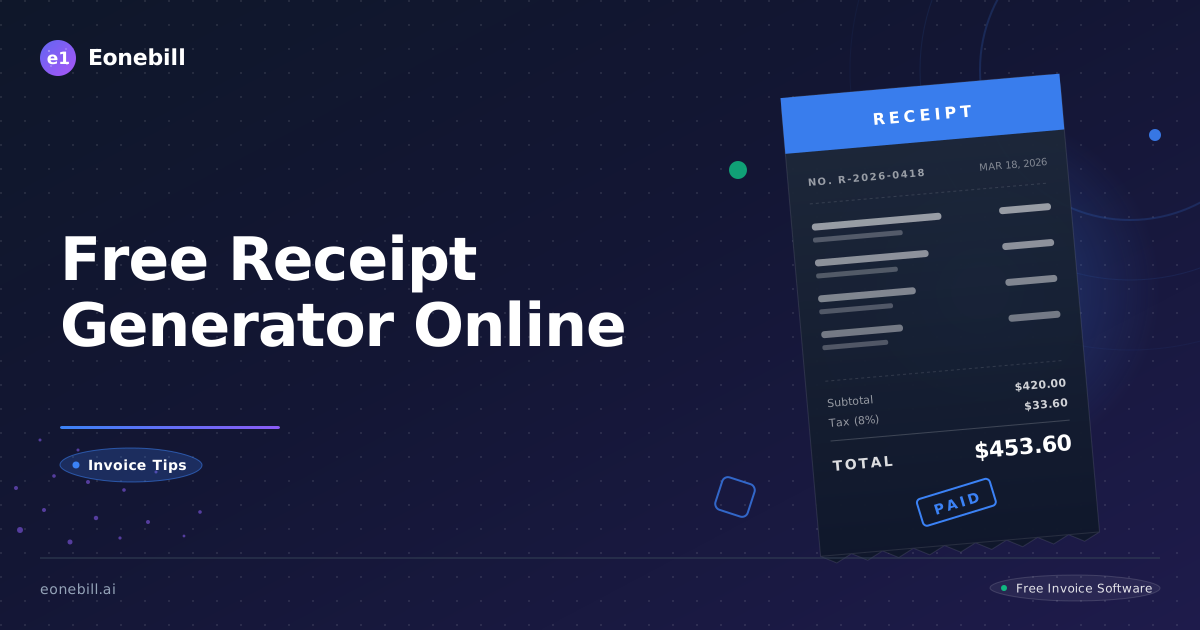
A receipt generator turns the worst part of running a business — proving people paid you — into a 30-second task. Instead of hand-writing or rebuilding a Word template every time, you fill in a few fields and download a polished PDF. This guide covers what a great receipt generator does, how to use one for different business scenarios, and when to upgrade to a full receipt management system.
What an Online Receipt Generator Should Do
At minimum, a useful receipt generator should:
- Run entirely in your browser (no signup, no data uploaded)
- Produce a professional PDF that opens on any device
- Auto-calculate subtotal, tax, and total
- Support US currency, dates, and state sales tax
- Allow logo upload
- Generate sequential receipt numbers
- Handle multiple payment methods
- Be mobile-friendly so you can issue receipts from a phone
The difference between a great generator and a basic one usually shows up in the small details: does the math handle a 6.25% tax rate on a $1,250 subtotal correctly ($78.13, not $78.12 or $78.00)? Does the PDF stay under 500KB so it does not bounce from corporate spam filters? Does the layout work in both portrait and landscape printing?
Our free receipt generator handles all of this without an account. You can issue your first receipt in under 90 seconds.
The Step-by-Step Process: Generating a Receipt in Under 90 Seconds
Let us walk through a typical scenario. You are a freelance personal trainer in Denver, CO, and a client just paid $150 for a 3-session package.
Step 1 — Open the Generator (5 seconds)
Go to Eonebill.ai's receipt generator. The page should load immediately without a signup wall.
Step 2 — Fill in Business Info (20 seconds, first time only)
- Business: Mile High Strength LLC
- Address: 1422 Larimer St, Denver CO 80202
- Email: jamie@milehighstrength.com
- Phone: (303) 555-0188
- Logo: PNG with transparent background
Most browsers will remember this for the next receipt.
Step 3 — Add Customer (15 seconds)
- Customer: Alex Park
- Email: alex.park@email.com (for digital receipt delivery)
Step 4 — Add Line Items (20 seconds)
- "3-session personal training package" — 1 unit at $150 = $150
Step 5 — Set Payment Details (20 seconds)
- Receipt #: 2026-0142 (auto-incremented if your tool supports it)
- Date: May 17, 2026
- Payment method: Zelle (alex.park@email.com → jamie@milehighstrength.com)
- Confirmation: ZL-2026-0517-8842
- Subtotal: $150
- CO sales tax does not apply to personal training services: $0
- Total: $150
Step 6 — Download and Send (10 seconds)
Click "Download PDF." Email the receipt to alex.park@email.com with subject "Receipt #2026-0142 from Mile High Strength." Done.
Total time: about 90 seconds for the first receipt, dropping to 45 seconds for subsequent receipts once your business profile is cached.
When You Need a Receipt vs. an Invoice
Receipts and invoices are different documents, even though they look similar. Use this decision guide:
| Scenario | Use This Document |
| -------- | ----------------- |
| Customer paid at time of service | Receipt |
| Customer will pay later (Net 15, Net 30) | Invoice |
| Customer prepaid for a future service | Receipt (now) + Invoice/Statement (after service) |
| Recurring monthly retainer | Invoice (sent monthly) |
| Cash transaction | Receipt (always — your audit trail) |
| Online sale on your website | Receipt (auto-generated by Stripe/Shopify) |
| Refund issued | Refund Receipt (separate from sale receipt) |
| Deposit collected for future project | Receipt (now) + Final Invoice (later) |
A common mistake is sending an invoice after the customer paid — confusing. The correct sequence is: send invoice (if not paid yet) → customer pays → send receipt as proof of payment.
Receipt Numbering Systems That Actually Work
Receipt numbers matter for taxes, audits, customer service, and basic professionalism. The best system is year-prefix sequential:
- 2026-0001 (first receipt of the year)
- 2026-0002
- 2026-0003
- ...resets to 0001 on January 1, 2027
Avoid these common mistakes:
- Date-only numbers (20260517): create duplicates if you issue more than one receipt per day
- Random numbers: look unprofessional and hard to audit
- Skipping numbers: raises audit questions ("why is there no receipt 0042?")
- Customer-prefixed numbers: break if you rename or merge customers
If you use a real generator, the numbering is automatic. If you are tracking manually, keep a simple log of the last number used.
Sales Tax on Receipts: The Trickiest Part
Receipts trip up small businesses on sales tax in three specific ways:
Mistake 1: Charging Tax You Do Not Owe
If you sell only services in a state that does not tax services (Texas, California, Florida, NY for most services), you should not collect sales tax. Charging tax you do not remit is illegal in every state.
Mistake 2: Forgetting Tax You Do Owe
If you sell taxable products, you must collect tax even if the customer does not ask. Forgetting means you owe the state out-of-pocket later.
Mistake 3: Wrong Rate
Most states are destination-based: you charge the tax rate of the buyer's location, not your own. Selling a product from Texas to a California buyer means California's rate. The rate has state + county + city + special district components, often combining to 7-10%.
A good receipt generator handles the math but cannot tell you what is taxable in your jurisdiction. When in doubt:
- For services: assume non-taxable unless you have explicit confirmation from your state
- For physical products: assume taxable at destination rate
- For digital products and SaaS: check your state's specific rules
A $150 mistake on tax handling, repeated across 100 sales, is a $15,000 tax liability. Worth the 15-minute CPA call to get right.
Payment Method Documentation on Receipts
The payment method field on a receipt is more important than most businesses realize. Specifically capture:
For cash: "Cash. Amount tendered: $20. Change given: $4.62." The tender/change detail prevents disputes.
For credit cards: "Visa ending in 4421. Approval code: 042871." Last-4 only — never store full card numbers (PCI compliance).
For Zelle/Venmo: "Zelle. From alex.park@email.com to jamie@milehighstrength.com. Confirmation: ZL-2026-0517-8842."
For check: "Check #4421, dated 5/17/2026, drawn on Wells Fargo." If the check bounces, you have all the info you need.
For ACH: "ACH from account ending 8821. Reference: ACH-2026-0517-RV12."
For wire transfer: "Wire from Wells Fargo, reference WT-2026-0517-9921."
This level of detail takes 10 extra seconds per receipt and saves you 10 hours of dispute resolution per year.
When a Generator Stops Being Enough
A free receipt generator handles 80% of small business receipt needs. Signs you have outgrown it:
- You are issuing 30+ receipts a month
- You want receipts to auto-generate when payment hits your account
- You need to link receipts to invoices in one system
- You want a customer portal where customers can re-download past receipts
- You need to print thermal-printer receipts at a physical location
- Multiple staff members need to issue receipts
- You want receipts integrated with your accounting software
When 2+ of these apply, upgrade. The big options:
- POS systems (Square, Toast, Clover, Lightspeed) for physical retail/service
- E-commerce platforms (Shopify, WooCommerce) for online sales
- Invoicing platforms with receipt features (Eonebill.ai, Wave, FreshBooks) for service businesses
Eonebill.ai's plans include automatic receipt generation when invoices get paid, customer portals where clients can re-download receipts, and tax-time export. For service businesses that already invoice through Eonebill.ai, receipts are essentially free — they auto-generate when payment hits.
Until you cross those thresholds, the free receipt generator is more than enough. Issue your first one today, build the habit of issuing a receipt for every payment received, and you will have cleaner books, happier customers, and an audit-defensible record going forward.
Receipt Generation for Subscription and Recurring Customers
Subscription businesses (SaaS, membership, recurring services) issue receipts on every billing cycle. The format adapts:
Subscription receipt fields:
- Subscription name and tier
- Billing period ("May 2026, Month 7 of annual subscription")
- Auto-renewal date
- Customer portal link for managing subscription
- Cancellation policy
- Plan features included
For SaaS businesses, automated receipt generation through Stripe, Paddle, or Lemon Squeezy is standard — these processors handle receipt emails automatically when the recurring charge succeeds. The receipt template can be customized through the processor's settings.
For service-based recurring businesses (cleaning, lawn care, IT support retainers), you may need a separate receipt for each billing cycle. A real invoicing platform with recurring invoices auto-generates these receipts when payment succeeds. Manual generation across many recurring clients becomes unmanageable past 10-15 subscriptions.
Receipt Issuance Best Practices for Customer Service
The way you handle receipts affects customer satisfaction more than most businesses realize. Specific practices:
Offer digital and paper. About 60% of US consumers prefer digital, 40% want paper. Asking is faster than assuming.
Send immediately. Within 60 seconds of payment for in-person, within 5 minutes for online. Delayed receipts get forgotten.
Use clear subject lines. "Receipt #2026-0142 from [Business] — $87.45" beats "Your receipt."
Include the customer's name. Personalization signals you care.
Make it easy to re-download. For digital receipts, a customer portal where they can pull past receipts saves your time and improves their experience.
Handle reprints gracefully. When a customer requests a duplicate, say yes and reissue without questions. The 30 seconds builds loyalty.
Use the receipt for a soft thank-you. "Thanks for choosing us — we appreciate your business" at the bottom is warm without being spammy.
Include next steps if relevant. "Your next service is scheduled for June 17, 2026" reduces missed appointments.
Receipt Generator Limits and Workarounds
Even good receipt generators have limits. Common ones and how to handle them:
Limit: Cannot handle very complex tax scenarios.
Most free generators handle one tax rate per receipt. For mixed taxable/non-taxable items, or multi-jurisdiction tax (state + county + city), they may not split correctly. Workaround: enter manually-calculated tax, or upgrade to a generator with line-item tax controls.
Limit: No customer database.
Free generators do not remember customers between sessions. Workaround: keep a simple spreadsheet of repeat customers, or upgrade to a paid tool with CRM features.
Limit: No integration with payment processor.
Free generators create receipts manually after payment. Workaround: for high-volume businesses, use a payment processor (Stripe, Square) that issues receipts automatically.
Limit: Cannot batch-generate.
If you need to issue receipts for 50 customers at once (e.g., year-end statements), most free generators require one-at-a-time entry. Workaround: paid tools support batch issuance.
Limit: No multi-language support.
For businesses with international customers, free generators are usually English-only. Workaround: paid tools or custom templates in target languages.
Know the limits before depending on a tool for critical operations. For mission-critical receipt issuance (regulated industries, high-volume retail), invest in a tool that meets all your needs from day one.
Building a Sustainable Receipt Workflow
Issuing receipts consistently requires a workflow, not just a tool. The components:
Trigger event: When does receipt issuance happen? At point of sale, when payment hits, end of day, weekly?
Tool: Which generator or POS produces the receipt?
Sender: Who actually issues the receipt? You, an employee, the POS automatically?
Delivery: How does the receipt reach the customer? Print, email, text, app notification?
Storage: Where does your copy go? Folder, cloud, accounting software?
Verification: How do you confirm the receipt was issued? Reconciliation check, customer confirmation?
For a small service business, the workflow might be:
- Customer pays at end of service
- Open free generator on phone
- Fill in fields (60 seconds)
- Email PDF to customer's email
- Auto-save copy to Google Drive folder
- End of week: reconcile receipts against bank deposits
For a retail business with employees, the workflow might be:
- Cashier rings up sale on POS
- POS prints receipt automatically
- Customer chooses paper or email
- POS sends to chosen delivery channel
- Sale logged in POS sales record
- End of day: manager reconciles cash drawer to POS records
The specifics vary. The principle is the same: receipts happen automatically because the workflow makes them automatic. Without workflow, receipts get forgotten.
Ready to manage invoices, contracts & proposals in one place? Try Eonebill free — no credit card required.
Start Free →Frequently Asked Questions
More Posts
Filing Taxes Late: Penalties, Extensions, and How to Catch Up (2026)
Missed the April deadline? Understand the 5 percent failure-to-file vs 0.5 percent failure-to-pay penalty difference, how Form 4868 extensions help, and the four-step protocol for catching up on years of unfiled returns.
Penalties for Not Filing a 1099: What Freelancers and Small Businesses Need to Know (2026)
Failing to file 1099 forms on time triggers escalating IRS penalties from 60 to 660 dollars per form. Learn the four-tier schedule, how to fix a missed filing, and when First-Time Penalty Abatement applies.

How to Write a Gentle Reminder Email (Templates + Examples)
Learn how to write a professional gentle reminder email that gets results. Includes 8 ready-to-use templates for invoices, meetings, deadlines, and more.
Newsletter
Join the community
Subscribe to our newsletter for the latest news and updates