QuickBooks Too Expensive? Best Alternatives 2026
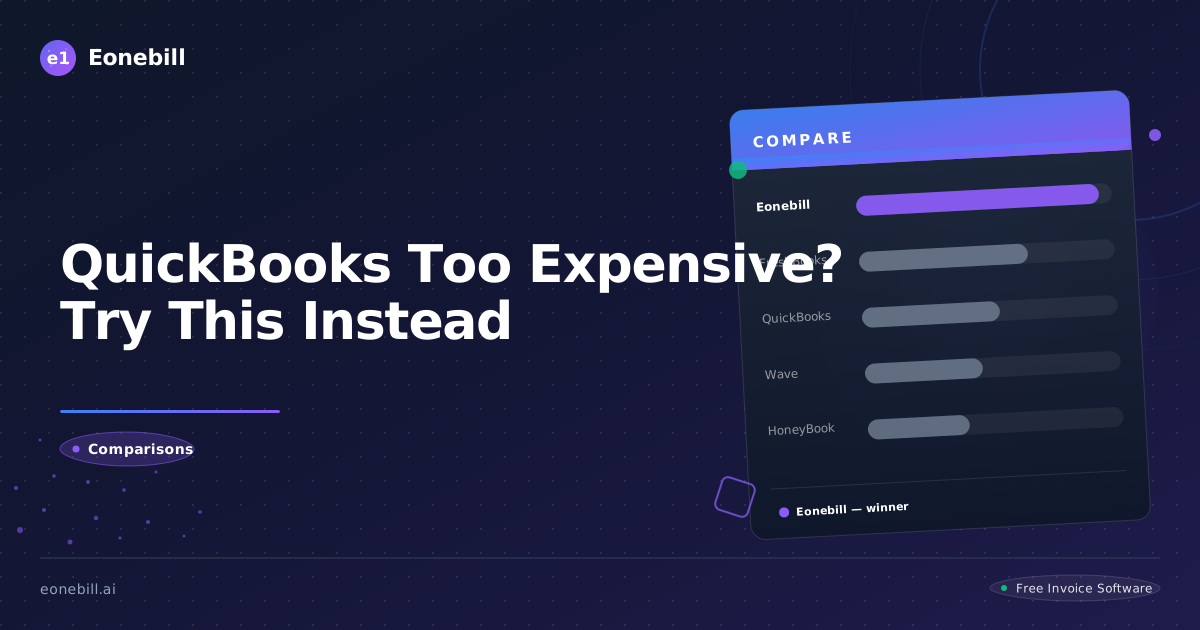
QuickBooks Too Expensive? Best Alternatives 2026
Intuit's QuickBooks Online has steadily raised prices for years. In 2026, Simple Start runs about $35/month, Essentials about $65, Plus about $99, and Advanced reaches $235/month. Promotional discounts soften the blow for new customers, but renewal pricing hits sticker. For solo freelancers and small business owners watching every dollar, that's $420-$2,820 per year just for accounting software. Many users are openly asking: is QuickBooks really worth this much, and what are the alternatives?
This guide objectively compares QuickBooks's value to the leading alternatives, identifies who actually needs QuickBooks's full feature set, and helps you choose the right tool for your stage of business.
Why QuickBooks Got So Expensive
QuickBooks's pricing reflects its position as the default accounting platform for US small businesses. Intuit invests heavily in the product, supports a massive integration ecosystem, and serves businesses of all sizes from solo freelancers to multi-million-dollar operations. The premium price funds active development, deep features, accountant tooling, and customer support.
For an established small business with employees, inventory, multi-state operations, or complex integrations, QuickBooks's price is reasonable. The platform genuinely saves time and integrates with the accountants and payroll providers small businesses depend on.
The trade-off is that QuickBooks's value proposition doesn't scale gracefully down to solo freelancers. A sole proprietor who sends 5-10 invoices a month and files a single Schedule C is paying for features they'll never use. The 80/20 rule applies brutally here: many freelancers use 10% of QuickBooks's feature set and pay 100% of its price.
QuickBooks Self-Employed is Intuit's stripped-down freelancer-focused version at around $20/month. It's better priced but still costs $240/year, and many users find its features underwhelming compared to either full QuickBooks Online or modern free alternatives.
The Free and Cheap Alternatives
Let's look at what's available below QuickBooks's price point.
Eonebill.ai is the AI-first invoicing platform for US freelancers with a free tier covering solo volumes. AI invoice drafting, payment tracking, automatic reminders, and Schedule C exports replace QuickBooks's most-used features for invoicing-focused freelancers. The trade-off: no full general ledger, no inventory, no payroll. For solo freelancers who don't need those, Eonebill is a faster, cheaper, more modern fit.
Wave is the long-standing free option. Full double-entry accounting plus invoicing on the free tier. Trade-offs: dated UI, slow support, limited AI.
Zoho Books is the most direct full-accounting QuickBooks alternative. Pricing starts free for businesses under $50K annual revenue (US plan) and scales to roughly $20-$70/month for higher revenue tiers — significantly less than QuickBooks. Strong feature set, modern UI, good mobile.
Xero is QuickBooks's main accounting competitor. $15-$78/month. Comparable feature depth to QuickBooks. Modern UI, strong API, accountant-friendly.
FreshBooks at $19-$60/month leans more toward service business invoicing than full accounting. Strong for freelancers who don't need deep accounting.
FreeAgent is a UK-origin platform with US support starting around $20/month. Solid for service businesses, strong project tracking.
Manager.io is a free desktop accounting platform (cloud version paid). Comparable feature depth to QuickBooks for solo use, just runs locally on your computer.
Side-by-Side Cost Comparison
Let's compare annual costs for typical solo-freelancer use.
QuickBooks Online Simple Start: ~$420/year ($35/month).
QuickBooks Self-Employed: ~$240/year ($20/month).
FreshBooks Lite: ~$228/year ($19/month).
Xero Starter: ~$180/year ($15/month).
Zoho Books Free (under $50K revenue): $0.
Wave (free): $0.
Eonebill.ai (free tier): $0.
Manager.io desktop: $0.
For a solo freelancer at $50K-$100K revenue, the annual savings from switching off QuickBooks Online are $180-$420. Over a 10-year freelance career, that's $1,800-$4,200. Real money.
For businesses at $250K+ annual revenue with employees and inventory, QuickBooks's depth often justifies the cost. The math changes.
What You Actually Lose by Switching
Let's be honest about what's lost when you switch off QuickBooks.
Accountant fluency. QuickBooks is the industry standard. If your accountant is fluent in QuickBooks, switching means either retraining them or paying them more for the time they spend on a less-familiar platform. For a freelancer paying $300/year in CPA fees, an extra hour at the CPA's $150/hour rate could cost more than the QuickBooks subscription saved.
Integration ecosystem. The QuickBooks app store has thousands of integrations — payroll, time tracking, e-commerce, payment processors. Free and cheap alternatives have much smaller ecosystems. If you depend on five integrations, switching breaks them.
Payroll. If you have W-2 employees, QuickBooks Payroll is mature and well-integrated. Free alternatives generally don't include payroll. Pairing a free invoicing tool with a separate payroll service (Gusto, OnPay, etc.) is the typical workaround.
Inventory and COGS. QuickBooks Plus and Advanced handle inventory tracking well. Free alternatives typically don't. Service businesses don't care; product businesses do.
Reports. QuickBooks's reporting library is extensive. Free alternatives have simpler reporting. For solo freelancers, simple is fine. For businesses preparing investor pitches or detailed financial reviews, QuickBooks's reports save time.
Multi-entity. If you run multiple businesses under one umbrella, QuickBooks Advanced supports multi-entity consolidation. Free alternatives don't.
If none of these matter to your workflow, the savings from switching are pure win. If any do, factor the trade-offs.
A Decision Framework
Here's how to decide.
If you're a solo freelancer with no employees, no inventory, and simple Schedule C filing — use Eonebill.ai's free tier for invoicing, pair with a free expense tracker, and you're done. Annual cost: $0-$200 including tax software at filing.
If you're a small service business with 1-2 employees but no inventory — Zoho Books or Xero is the sweet spot. Real accounting features at $15-$25/month, half QuickBooks's price. Pair with Gusto for payroll.
If you have inventory, complex multi-state operations, or 5+ employees — QuickBooks Online Plus or Advanced earns its price. The depth and accountant fluency saves time at scale.
If you primarily need invoicing and want the most modern AI-assisted workflow — Eonebill.ai. The free tier handles solo invoicing; paid tiers scale to higher volume.
If you need full free accounting with double-entry GL — Wave is unmatched.
If you want a paid-but-cheaper QuickBooks competitor — Xero or Zoho Books.
Migrating Off QuickBooks
Migration off QuickBooks requires planning but isn't impossible.
Step 1 — Export your data. QuickBooks supports CSV export of clients, vendors, invoices, transactions, and reports. Download everything as a baseline.
Step 2 — Decide what to import vs. archive. For most freelancers, importing the client list into the new tool is essential. Importing every historical transaction is not — keep QuickBooks data as an archive for tax records and audit defense.
Step 3 — Set up the new tool. Configure your business details, chart of accounts (if applicable), and recurring invoice schedules. Test with one or two invoices before committing.
Step 4 — Run parallel for one month. Send new invoices from the replacement tool while QuickBooks plays out final recurring invoices and processes any outstanding items.
Step 5 — Cut over and notify clients. Update payment links sent to clients. Confirm bank-feed connections in the new tool. Cancel the QuickBooks subscription at the end of the current billing period (don't lose unused time you've already paid for).
Step 6 — Inform your accountant. Send them a sample export from the new tool so they know what to expect. If they're highly skeptical, schedule a 30-minute walkthrough.
For a quick comparison of what your invoicing flow would look like, try the free invoice generator at /free-tools/invoice-generator. For Eonebill.ai's paid tiers if you outgrow the free plan, see /pricing.
When QuickBooks Is Worth the Money. Despite the price, QuickBooks remains the right answer in specific situations.
You have W-2 employees and value payroll integration. The full QuickBooks Online + Payroll stack is mature and well-supported.
You have inventory and need COGS tracking. QuickBooks Plus and above handle inventory properly.
You have a CPA or bookkeeper who insists on QuickBooks. Their time is more expensive than the subscription. Forcing them onto a less-familiar tool typically costs more than QuickBooks does.
You run a multi-entity business. QuickBooks Advanced handles consolidation. Free alternatives don't.
You depend on an extensive integration ecosystem. The QuickBooks app store has more integrations than any competitor.
If one of these applies, pay for QuickBooks and don't feel bad about it. If none applies, you're almost certainly overpaying. Switch to a tool that fits your actual workflow.
Bottom line: QuickBooks is excellent software but priced for established small businesses with full accounting needs. For solo freelancers and very small service businesses, free or low-cost alternatives like Eonebill.ai, Wave, Zoho Books, and Xero deliver most of QuickBooks's value at a fraction of the price. Match the tool to your stage of business, and switch as your needs evolve.
When QuickBooks Is Worth the Money. Despite the price, QuickBooks remains the right answer in specific situations. You have W-2 employees and value payroll integration — the full QuickBooks Online plus Payroll stack is mature and well-supported. You have inventory and need COGS tracking — QuickBooks Plus and above handle inventory properly while free alternatives generally don't. You have a CPA or bookkeeper who insists on QuickBooks — their time is more expensive than the subscription, and forcing them onto a less-familiar tool typically costs more than QuickBooks does. You run a multi-entity business — QuickBooks Advanced handles consolidation while free alternatives don't. You depend on an extensive integration ecosystem — the QuickBooks app store has more integrations than any competitor, and depending on five or more integrations means switching breaks them all. If one of these applies, pay for QuickBooks and don't feel bad about it. If none applies, you're almost certainly overpaying. Switch to a tool that fits your actual workflow. The savings can fund marketing, professional development, retirement contributions, or just better quality of life. Many freelancers spend years paying for QuickBooks because they assume it's required, when in reality their actual usage pattern would be perfectly served by Eonebill.ai's free tier or a similar modern alternative. The honest question is what features you actively use today, not what features might be useful someday. Bottom line: QuickBooks is excellent software but priced for established small businesses with full accounting needs. For solo freelancers and very small service businesses, free or low-cost alternatives like Eonebill.ai, Wave, Zoho Books, and Xero deliver most of QuickBooks's value at a fraction of the price. Match the tool to your stage of business, and switch as your needs evolve.
One more practical note: QuickBooks sometimes runs aggressive promotional pricing for new customers (50% off for the first year is common). If you're committed to QuickBooks regardless, time your subscription start with a promotional period. After the introductory year, the renewal price is the real cost — factor that into your decision. Some freelancers cycle through trial accounts to maximize discounts, but this is unsustainable long-term and Intuit's customer-recognition systems are catching up. The honest path is to choose a tool whose full-price cost you can absorb sustainably. For most solo freelancers, that means a free or low-cost alternative rather than QuickBooks at $35-$235/month.
Final thought on the QuickBooks question: many freelancers stick with QuickBooks out of habit or perceived professional necessity rather than actual need. If you're paying $35-$235/month and using a small fraction of the features, that's a signal to evaluate alternatives seriously. Run the math on annual cost vs. annual value: how many minutes of admin does the tool actually save you per month, multiplied by your effective billing rate? For many solo freelancers, the answer is that the savings would buy a CPA consultation and a marketing course every year. The right tool is the one that pays for itself in saved time at your specific volume. QuickBooks earns that test for larger businesses; free alternatives often earn it better for solo freelancers.
Ready to manage invoices, contracts & proposals in one place? Try Eonebill free — no credit card required.
Start Free →Frequently Asked Questions
More Posts
Filing Taxes Late: Penalties, Extensions, and How to Catch Up (2026)
Missed the April deadline? Understand the 5 percent failure-to-file vs 0.5 percent failure-to-pay penalty difference, how Form 4868 extensions help, and the four-step protocol for catching up on years of unfiled returns.
Penalties for Not Filing a 1099: What Freelancers and Small Businesses Need to Know (2026)
Failing to file 1099 forms on time triggers escalating IRS penalties from 60 to 660 dollars per form. Learn the four-tier schedule, how to fix a missed filing, and when First-Time Penalty Abatement applies.
How to Write a Gentle Reminder Email (Templates + Examples)
Learn how to write a professional gentle reminder email that gets results. Includes 8 ready-to-use templates for invoices, meetings, deadlines, and more.
Newsletter
Join the community
Subscribe to our newsletter for the latest news and updates