How to Create a Partial Payment Invoice
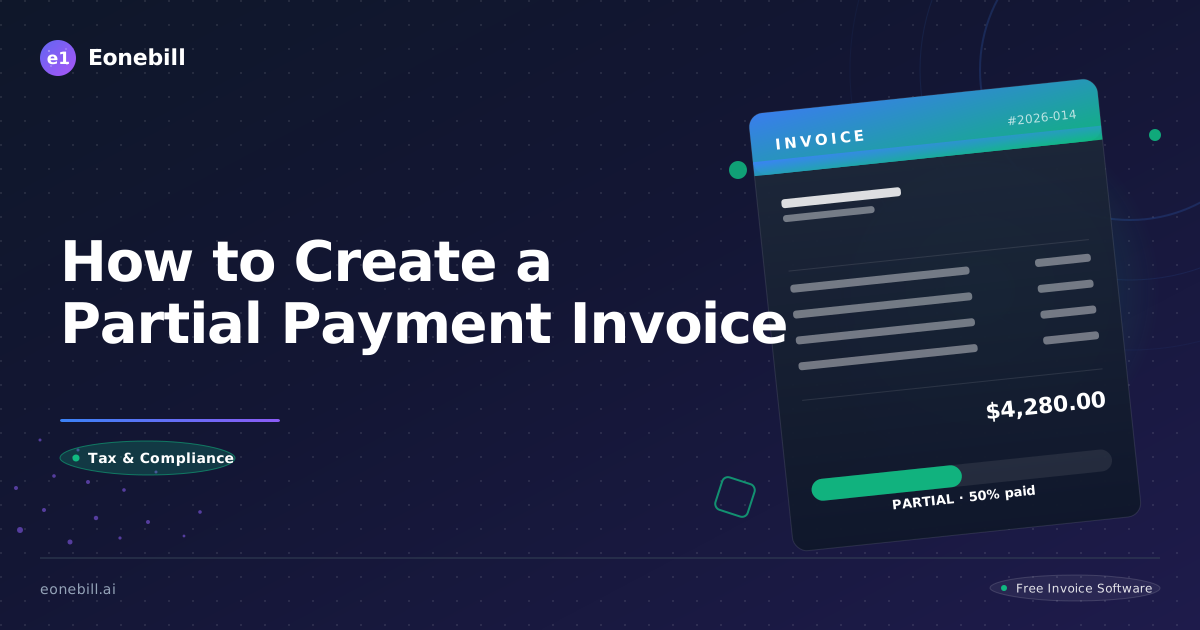
Sometimes a client cannot pay the full invoice amount in one shot. Sometimes a project is billed in stages. Sometimes you simply want to accept what the client can pay now and bill the rest later. In all of these scenarios, you need a partial payment invoice: a document that accepts a portion of the total owed and clearly documents the remaining balance.
This guide walks you through how to create a partial payment invoice that is accountant-friendly, legally clean, and easy for clients to understand. You will learn when partial payments are appropriate, how to structure the invoice and the payment plan, what to include in the document, and how to handle the bookkeeping and tax treatment. By the end you will be able to offer flexible payment options to clients without losing track of what is owed.
When Partial Payments Make Sense
Partial payments are appropriate in five common scenarios. Pick the one that matches your situation.
Scenario one: client cash flow challenges. A client wants to pay you but cannot pay the full amount this month. Rather than waiting indefinitely (and risking the relationship), you accept a partial payment now and structure a plan for the balance. This preserves cash flow on both sides.
Scenario two: planned milestone payments. The original project plan included milestone payments. The 'partial' payments are actually scheduled installments, not exceptions. Each milestone invoice is technically a partial invoice against the total project.
Scenario three: large invoice on a long timeline. A $20,000 invoice for a 4-month project is often paid in installments of $5,000 per month rather than $20,000 upfront. Each installment is a partial payment.
Scenario four: disputed line items. A client agrees to pay the undisputed portion of an invoice while a specific line item is being investigated. The partial payment acknowledges what is not in dispute and isolates the contested portion for separate resolution.
Scenario five: ongoing retainer with overage. A monthly retainer covers $3,000 of work, but the client used $4,200 this month. They pay the standard $3,000 retainer (partial payment of the full $4,200 owed) and a separate overage invoice covers the $1,200 difference.
In each scenario, the key is clear documentation: how much was owed, how much was paid, how much remains, and when the balance is due.
Partial Payment vs Payment Plan: What's the Difference?
A partial payment is a single payment that covers less than the full invoice amount. The remaining balance is still owed, but the timing for that balance may not yet be defined.
A payment plan is a structured agreement that breaks the total into multiple defined installments with specific due dates. Each installment is its own partial payment, but the structure is agreed upfront.
The distinction matters for documentation. For a one-time partial payment, you record what was paid and note the balance. For a payment plan, you create a schedule that both parties sign, then issue invoices or receipts at each installment.
For recurring partial payment scenarios (e.g., clients who routinely pay 50 percent on time and 50 percent two weeks later), formalize as a payment plan to remove ambiguity. For occasional partial payments due to one-off cash flow issues, treat as exceptions and resolve quickly.
Structuring the Partial Payment Invoice
A partial payment invoice can take two forms: a modified original invoice showing partial payment received, or a separate balance-due invoice referencing the partial payment.
Approach one: modify the original invoice. Reissue the original invoice with a 'Payment Received' line showing the partial amount and a 'Balance Due' line showing the remaining. Example:
Original invoice INV-2026-0142 - Total: $3,000.00
- Payment received March 18, 2026 (ACH ref 12345): ($1,500.00)
- Balance due: $1,500.00
- New due date: April 1, 2026
This approach keeps everything on one document, which is clean for the client and for your records. It works well when the original invoice and the partial payment are recent.
Approach two: issue a separate balance-due invoice. The original invoice stays as issued, marked partially paid in your records. You create a new balance-due invoice (e.g., INV-2026-0142B) that references the original and shows only the remaining balance. Example:
New invoice INV-2026-0142B - Balance due on INV-2026-0142
- Original total: $3,000.00
- Less payment received March 18, 2026 (Receipt RCP-2026-0042): ($1,500.00)
- Balance due: $1,500.00
- Due date: April 1, 2026
This approach is cleaner when the original invoice is old or when the partial payment scenario is unusual. It creates two related documents (original plus balance) which some accountants prefer for audit clarity.
Whichever approach you use, the key elements are: the original invoice number, the payment received with date and reference, the balance due, and the new due date for the balance.
The Free Partial Payment Invoice Template
Here is a complete partial payment invoice structure you can copy. Open the free invoice generator at /free-tools/invoice-generator and adapt the fields.
Header: [Your Business Name], [Address], [Phone], [Email]
Bill To: [Client Company], [Address]
Invoice Details: Invoice INV-2026-0142B (Balance Due), Issue Date April 1, 2026, Due Date April 15, 2026, Reference Original Invoice INV-2026-0142 dated March 1, 2026.
Line Items (single section showing the math):
- Original invoice total (INV-2026-0142, March 2026 retainer services) - $3,000.00
- Less: Payment received March 18, 2026 via ACH reference 12345 (Receipt RCP-2026-0042) - ($1,500.00)
- Balance Due - $1,500.00
Total Due: $1,500.00
Payment Terms: Balance due April 15, 2026 (Net 14 from this invoice issue date). Late fees of 1.5 percent per month apply to balances past due.
Payment Methods: ACH bank transfer (preferred, free), credit card via Stripe (link below, 2.9 percent surcharge applies), check payable to [Your Business].
Reference: Per engagement letter signed January 15, 2026.
Notes: Thank you for the partial payment on March 18. This invoice covers the remaining balance and completes settlement of INV-2026-0142. Please contact me at [email] with any questions.
Thank-you and contact info: standard close.
The document is approximately 200 words, fits on one page, and contains all the information accounting needs.
Bookkeeping and Tax Treatment
Partial payments require careful bookkeeping to avoid double-counting or under-reporting income. Here is how to handle them correctly.
For cash-basis taxpayers (most freelancers and small businesses): you recognize income when payment is received, regardless of when the invoice was issued. A $1,500 partial payment received in March is $1,500 of March income. The remaining $1,500 balance is not income until it is actually paid.
For accrual-basis taxpayers: the full invoice amount is recognized as income when issued, with the receivable on your balance sheet. Partial payments reduce the receivable but do not change the income figure. If the balance becomes uncollectible, you write it off as a bad debt expense.
In your accounting software (QuickBooks, Wave, Xero, or Eonebill.ai's integrated bookkeeping), record the partial payment against the original invoice. Most tools handle this automatically: you mark the original invoice as 'partially paid' and the system tracks the remaining balance. Avoid creating duplicate income entries; the original invoice plus the partial payment record is sufficient.
Sales tax treatment: if you charged sales tax on the original invoice, the partial payment generally includes a proportional share of the sales tax. For example, if the original was $3,000 plus $240 sales tax (in a state that taxes services at 8 percent), and the partial payment is $1,500, then $1,388.89 is the service portion and $111.11 is sales tax. Sales tax remittance follows your state's rules (typically the proportional sales tax is remitted in the period the payment was received).
1099 reporting: if a client pays multiple partial payments across a tax year, the 1099-NEC they issue you reflects the total paid during the year. If payments span tax years, each year's 1099 captures that year's amount.
Common Pitfalls and How to Avoid Them
Pitfall one: losing track of partial balances. Without a clear system, partial payments can be forgotten. Use accounting software that tracks paid status per invoice. Manually update a spreadsheet ledger if you do not use software. Audit quarterly to catch unpaid balances.
Pitfall two: not setting a clear due date for the balance. 'Balance due eventually' is bad. 'Balance of $1,500 due April 15, 2026' is good. Always set a specific date for the balance to remove ambiguity.
Pitfall three: forgetting late fees on the balance. Late fees apply to the remaining balance from the new due date, not from the original due date (unless the engagement letter says otherwise). State this on the balance-due invoice.
Pitfall four: applying partial payments inconsistently. If a client owes you $5,000 across three invoices and pays $2,000 in one shot, decide and document which invoice the payment applies to (oldest first is the common default). Otherwise the client and your records can drift apart.
Pitfall five: treating partial payments as full settlement. A client paying $2,500 on a $3,000 invoice does not settle the invoice unless you have agreed in writing to accept the partial as full settlement. Document any settlement agreement explicitly.
Pitfall six: not communicating with the client. If a partial payment arrives unexpectedly, send a confirmation email acknowledging the partial and stating the remaining balance. This sets a clear expectation.
Pitfall seven: not adjusting projections. If your cash flow projections assumed full payment on the original due date, a partial payment delays cash. Update your projections so you do not overspend based on stale assumptions.
Best Practices for Partial Payment Workflows
Practice one: communicate proactively. When a client signals they cannot pay in full, respond quickly and constructively. 'Thanks for the heads up. Can you pay $1,500 by March 18 and the balance by April 1? If yes, I'll send a revised payment schedule.' Offer structure, not silence.
Practice two: get partial payment agreements in writing. Even a short email exchange is enough. 'Confirming our call: you'll pay $1,500 by March 18 and the remaining $1,500 by April 1. Late fees of 1.5 percent per month apply to balances unpaid after April 1.' Save the email.
Practice three: be wary of repeat partial-payers. If a client routinely pays late or partial, the relationship may be deteriorating. Consider requiring deposits for future work, ACH auto-pay, or stricter terms. One-time cash flow issues are fine; chronic ones are warning signs.
Practice four: offer payment plans proactively for large invoices. For invoices over $5,000, proactively offer a 2- or 3-installment plan if it makes sense. Clients appreciate flexibility, and you secure the engagement with reduced risk of total non-payment.
Practice five: automate where possible. Eonebill.ai supports partial payment tracking, automated balance-due reminders, and payment plan invoicing. You set up the schedule once, the system handles the rest.
Practice six: maintain professional language regardless of frustration. A late partial-payer can be frustrating, but emotional or accusatory communication damages the relationship and creates evidence that hurts you in any later dispute. Keep all communication factual and neutral.
Ready to handle partial payments cleanly? Try the free invoice generator at /free-tools/invoice-generator for one-off partial payment invoices, and upgrade at /pricing for full partial payment tracking, payment plan management, and automated balance reminders. Eonebill.ai turns flexible payment arrangements into clean, professional workflows.
For freelancers who deal frequently with partial payments, consider standardizing into a formal payment plan offering. Instead of partial payments as exceptions, market them as a feature: 'Flexible payment plans available on engagements over $5,000. Pay in 2, 3, or 4 installments at no extra cost.' This positions your business as accommodating and modern while ensuring you always have structured, documented payment timelines.
Track the operational impact of partial payments. How many invoices in the past 12 months became partial? What was the average days from first payment to final settlement? How often did partials lead to disputes or non-payment? These metrics reveal whether your client mix supports partial payment offerings or whether you need to tighten upfront screening. Some businesses find that partial payments shift cash flow risk meaningfully and decide to add a 3 to 5 percent premium for installment plans.
Finally, do not let partial payments become a substitute for difficult conversations. A client who consistently pays partial is signaling something about their finances or their relationship with your work. Have the conversation: 'I have noticed the last three invoices were paid in two parts. I want to make sure the engagement is still working for both of us. Should we adjust the scope, the rate, or the schedule?' Most of the time the conversation surfaces a fixable issue. Occasionally it surfaces that the relationship is no longer healthy. Either outcome beats letting the pattern continue silently.
Ready to manage invoices, contracts & proposals in one place? Try Eonebill free — no credit card required.
Start Free →Frequently Asked Questions
More Posts
Filing Taxes Late: Penalties, Extensions, and How to Catch Up (2026)
Missed the April deadline? Understand the 5 percent failure-to-file vs 0.5 percent failure-to-pay penalty difference, how Form 4868 extensions help, and the four-step protocol for catching up on years of unfiled returns.
Penalties for Not Filing a 1099: What Freelancers and Small Businesses Need to Know (2026)
Failing to file 1099 forms on time triggers escalating IRS penalties from 60 to 660 dollars per form. Learn the four-tier schedule, how to fix a missed filing, and when First-Time Penalty Abatement applies.

How to Write a Gentle Reminder Email (Templates + Examples)
Learn how to write a professional gentle reminder email that gets results. Includes 8 ready-to-use templates for invoices, meetings, deadlines, and more.
Newsletter
Join the community
Subscribe to our newsletter for the latest news and updates