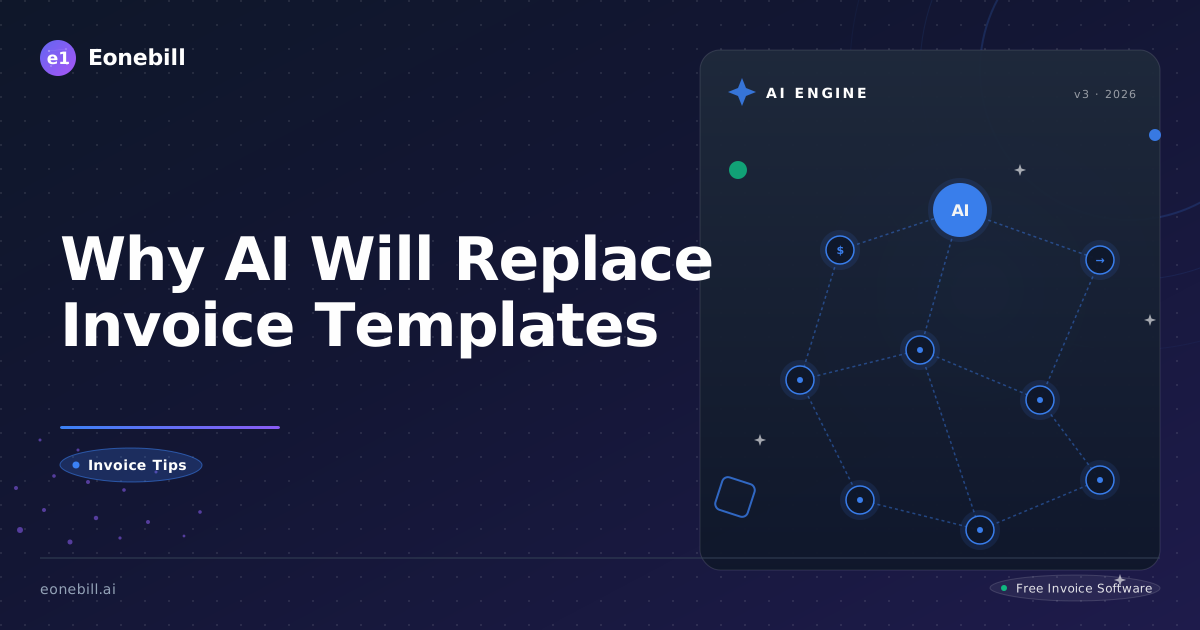
Why AI Will Replace Invoice Templates by 2027
Invoice templates served us well for decades. But in 2026, they're showing their age. Here's why AI-generated invoices will make static templates obsolete within two years.
For years, the advice to new freelancers was the same: find a good invoice template. Download it. Customize it with your logo. Send it. Repeat.
It worked. Until it didn't.
The Template Promise Was Always Limited
Invoice templates solve one problem: format. They give you rows for line items, a spot for your address, a place for the client's address. Professional-looking output, zero creative effort.
But templates don't solve the actual hard parts of invoicing:
- What do I write in the description field? (Templates give you a blank box.)
- Is this rate reasonable for my industry? (No idea.)
- How do I word a late payment follow-up? (Copy-paste from a forum post, I guess.)
- Did I forget to include anything legally required? (🤷)
These are knowledge problems. Templates can't fix knowledge problems. They're just formatting.
Enter AI — The Knowledge Layer Invoicing Never Had
AI invoice generators like Eonebill are doing something fundamentally different. Instead of asking you to fill in blanks, they reason about your specific situation.
Here's a concrete example:
The Template Experience:
> You're a freelance graphic designer. You just finished a logo project. You open your invoice template, stare at the blank "Description" field, and type: "Logo design."
>
> Your client, a month later, disputes the invoice: "What logo? Which concepts? What exactly did I pay for?"
>
> You can't answer. Because "Logo design" doesn't mean anything six months later.
The AI Experience:
> You describe your project to Eonebill: "Logo redesign for a boutique coffee shop in Austin. Three concepts, two rounds of revisions, delivered as SVG and PNG."
>
> Eonebill auto-generates line items:
> - Logo concept development (3 original concepts): $600
> - Revision rounds (2 iterations): $200
> - File delivery (SVG + PNG, web + print formats): $100
> - Total: $900
>
> Each line item is specific, verifiable, and professional. The client knows exactly what they paid for.
That's not a template. That's a thinking partner.
Three Forces Driving the Replacement
1. Accuracy Over Ambiguity
Vague invoices lead to payment disputes. Payment disputes lead to delayed cash flow. Delayed cash flow kills freelancers.
AI-generated invoices create paper trails that actually mean something. When a line item says "UI/UX design — mobile app, 5 screens, prototype delivery" instead of "design work," there's nothing to dispute.
2. Speed
The average freelancer spends 15–20 minutes creating an invoice from scratch (even with a template). With AI, that drops to under 2 minutes — describe the project, review AI suggestions, send.
Over a year, that's 6–8 hours saved. For someone billing $100/hour, that's $600–$800 in recovered billable time.
3. Personalization at Scale
Templates are one-size-fits-all. AI invoices adapt to:
- Your industry (legal, creative, tech, consulting each have different norms)
- Your client's payment history (known slow-payers get earlier due dates)
- Your tax jurisdiction (1099 requirements, state-specific compliance)
- The project's complexity (flat fee vs. hourly vs. milestone-based)
A freelancer working with 8 different clients can have 8 completely different invoicing approaches — without learning anything new.
The Numbers Are Staggering
According to a 2025 Freelancer Earnings Report:
- 62% of freelancers report spending 2+ hours per week on administrative tasks (invoicing, follow-ups, bookkeeping)
- 41% say payment disputes stem from vague invoice descriptions
- Only 18% use any kind of automated invoice follow-up
These are fixable problems. And AI is fixing them.
What Template Apps Are Doing Now (And Why It's Not Enough)
Most template-based invoicing tools have added "AI features" in the past 12 months. Usually, this means:
- AI-written invoice descriptions (with you still providing the raw input)
- AI-suggested amounts (based on industry averages)
- AI-generated follow-up emails (you pick from a dropdown)
This is AI as a feature, not AI as a paradigm shift. The underlying workflow — you input data, you format the output — remains unchanged.
Real AI invoicing means the system knows your business, understands your client relationship, and generates the invoice with minimal friction.
The 2027 Prediction
By 2027, I expect:
- Static invoice templates will be seen as outdated — like using WordArt for resumes
- AI-generated invoices will be the default for any freelancer billing over $5,000/month
- Template tools will either pivot or fade — those that add real AI will survive; those that add AI-as-a-gimmick won't
- Invoice quality will become a competitive differentiator — clients will notice the difference between a professional AI-generated invoice and a generic template
The Freelancer's Choice
The transition is already happening. The question isn't whether to use AI invoicing — it's when.
If you're still using a template you downloaded in 2019, now is the time to evaluate what's changed. The tools are better. The pricing is cheaper. The results are measurably better.
Eonebill is free to start. No credit card required. AI-powered invoice generation built for freelancers who value their time.
👉 Try Eonebill free at eonebill.ai
Originally published at Eonebill — AI-powered invoice generator for freelancers and small businesses.
Ready to manage invoices, contracts & proposals in one place? Try Eonebill free — no credit card required.
Start Free →More Posts
Filing Taxes Late: Penalties, Extensions, and How to Catch Up (2026)
Missed the April deadline? Understand the 5 percent failure-to-file vs 0.5 percent failure-to-pay penalty difference, how Form 4868 extensions help, and the four-step protocol for catching up on years of unfiled returns.
Penalties for Not Filing a 1099: What Freelancers and Small Businesses Need to Know (2026)
Failing to file 1099 forms on time triggers escalating IRS penalties from 60 to 660 dollars per form. Learn the four-tier schedule, how to fix a missed filing, and when First-Time Penalty Abatement applies.
How to Write a Gentle Reminder Email (Templates + Examples)
Learn how to write a professional gentle reminder email that gets results. Includes 8 ready-to-use templates for invoices, meetings, deadlines, and more.
Newsletter
Join the community
Subscribe to our newsletter for the latest news and updates