LLP vs LLC: Key Differences for Freelancers and Small Businesses
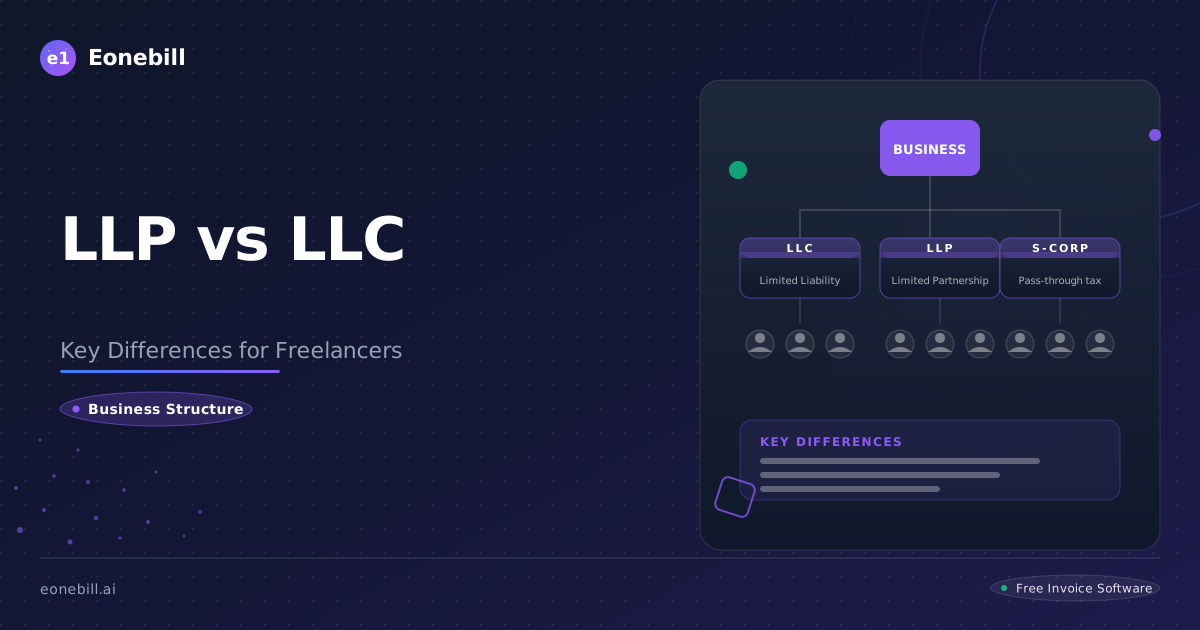
Choosing the right business structure is one of the most important decisions you will make as a freelancer or small business owner. The legal entity you pick affects how much you pay in taxes, how much personal liability you carry, how you bring in partners, and how much paperwork you deal with every year. Two structures that often get compared are the Limited Liability Partnership (LLP) and the Limited Liability Company (LLC). On the surface they sound similar -- both offer liability protection and pass-through taxation -- but they are quite different in terms of who can use them, which states support them, and how they work day to day. This guide breaks down the llp vs llc difference in plain language so you can make a confident, informed decision.
What Is an LLC?
A Limited Liability Company, or LLC, is a flexible business structure that combines the liability protection of a corporation with the tax simplicity of a partnership or sole proprietorship. It is by far the most popular entity choice for freelancers and small business owners in the United States.
Core features of an LLC:
- Limited liability. The owners of an LLC are called members. As a member, your personal assets -- your home, car, and savings -- are generally shielded from business debts and lawsuits. If a client sues your business and wins, they can go after the LLC's assets, not your personal bank account.
- Pass-through taxation by default. The IRS does not tax the LLC itself. Instead, profits and losses pass through to each member's personal tax return. A single-member LLC is taxed like a sole proprietorship; a multi-member LLC is taxed like a general partnership. You can also elect to be taxed as an S-Corp or C-Corp if that saves money.
- Flexible management. An LLC can be managed by its members (member-managed) or by appointed managers (manager-managed). There is no requirement for a board of directors or formal officer titles.
- Available in all 50 states. Every US state and the District of Columbia allows the formation of an LLC. Requirements vary -- some states charge higher filing fees or require annual reports -- but the entity type is universally available.
- Single-member option. You can form an LLC with just one person, making it a natural fit for solo freelancers and solopreneurs.
Forming an LLC typically involves filing Articles of Organization with your state's Secretary of State office, paying a filing fee (usually $50 to $500 depending on the state), and drafting an Operating Agreement. The Operating Agreement is an internal document that outlines member rights, profit splits, and management rules. Most states do not require you to file it publicly.
Once formed, you should open a dedicated business bank account, obtain any required local licenses, and get an EIN (Employer Identification Number) from the IRS -- which is free and takes minutes online. Keeping your business finances separate from your personal finances is critical to maintaining the liability shield an LLC provides.
What Is an LLP?
A Limited Liability Partnership, or LLP, is a business structure designed primarily for two or more partners who want liability protection from each other's mistakes and malpractice. It is widely used by licensed professionals such as attorneys, accountants, architects, and doctors.
Core features of an LLP:
- Partner-level liability protection. In a standard general partnership, every partner is personally liable for the debts and actions of every other partner. An LLP changes that. In most states, a partner in an LLP is not personally liable for negligent acts or misconduct committed by another partner. Each partner's personal assets are shielded from the malpractice of their co-partners.
- Pass-through taxation. Like an LLC, an LLP is a pass-through entity. The partnership files an informational return (Form 1065), but the entity itself does not pay federal income tax. Each partner receives a Schedule K-1 and reports their share of income on their personal return.
- Requires at least two partners. An LLP cannot be formed by a single individual. You need at least two partners. This is one of the fundamental llp vs llc differences.
- Limited state availability. Not all states allow LLPs for general business use. Many states restrict LLP registration to licensed professionals -- lawyers, CPAs, medical professionals, and similar regulated occupations. A handful of states, including California, impose significant restrictions on LLPs that make them impractical for most businesses.
- Formal partnership agreement. Partners should always have a written partnership agreement that spells out capital contributions, profit and loss sharing, decision-making authority, and what happens when a partner wants to leave.
To form an LLP, you file a Registration of Limited Liability Partnership (or similarly named document) with the state agency that handles business filings, usually the Secretary of State. Filing fees are comparable to LLC fees in most states. Many states also require LLPs to carry minimum amounts of professional liability insurance as a condition of registration.
Unlike an LLC, an LLP generally does not have the option to elect corporate tax treatment. It is taxed as a partnership, period. This simplicity can be a feature or a limitation depending on your goals.
LLP vs LLC: Key Differences
Understanding what is llp vs llc on paper is useful, but seeing the differences side by side makes the choice clearer. Here is a comparison across the most important dimensions:
Ownership and membership:
- LLC: Can be formed by one person (single-member) or multiple members. Members do not need any professional license.
- LLP: Requires at least two partners. In many states, all partners must hold the same type of professional license.
Personal liability protection:
- LLC: Members are protected from both business debts and the malpractice or negligence of other members.
- LLP: Partners are protected from each other's malpractice and negligence, but may still be personally liable for the partnership's general contractual debts in some states, depending on the specific state statute.
State availability:
- LLC: Available in all 50 states and DC.
- LLP: Available in most states, but many restrict LLPs to licensed professionals. California is a notable example where LLPs are only available to lawyers, architects, and accountants.
Management structure:
- LLC: Very flexible. Choose member-managed or manager-managed. No mandatory formalities beyond the operating agreement.
- LLP: Managed by the partners. Governance is determined by the partnership agreement. Less flexible in terms of management customization.
Tax treatment:
- LLC: Default pass-through taxation. Option to elect S-Corp or C-Corp status if beneficial.
- LLP: Pass-through taxation only. No corporate tax election available.
Formation documents:
- LLC: Articles of Organization + Operating Agreement.
- LLP: Partnership Registration + Partnership Agreement. Some states also require proof of professional liability insurance.
Conversion and exit:
- LLC: Operating agreement can define buy-out provisions and membership transfers.
- LLP: Partnership agreement governs partner exits. Some states have specific rules about what happens when one partner leaves a two-partner LLP.
The bottom line on the llp vs llc difference is this: LLCs are more flexible, more universally available, and suited to a broader range of businesses and individuals. LLPs are specifically designed for professional partnerships where partners share a practice and need protection from each other's professional errors.
Which Is Better for Freelancers?
For most US freelancers and solopreneurs, the LLC wins the llp vs llc comparison decisively. Here is why.
You can form an LLC alone. Freelancers work independently. You do not need a partner to form an LLC. The single-member LLC is the most common entity structure among self-employed workers in the US for exactly this reason. An LLP requires at least two partners, which immediately disqualifies it for solo freelancers.
LLCs are available everywhere. Whether you live in Texas, California, New York, or Wyoming, you can form an LLC. LLPs are restricted in several states and often limited to licensed professionals. If you are a graphic designer, copywriter, web developer, or marketing consultant, you almost certainly cannot form an LLP in most states.
LLCs offer more tax flexibility. A freelancer who earns a solid income can elect S-Corp status for their LLC and potentially save thousands of dollars per year in self-employment taxes by splitting income between a reasonable salary and distributions. An LLP does not offer this option.
LLCs are easier to maintain. Most states have simple annual report requirements for LLCs, and the paperwork is manageable. LLPs often have additional requirements, including proof of professional liability coverage.
When might an LLP make sense for a small business? Consider an LLP if:
- You are a licensed professional (attorney, CPA, architect) forming a practice with one or more licensed partners in a state where LLPs are common for your profession.
- Your state's laws specifically favor LLPs for your industry.
- You and your partner want a structure that explicitly separates each partner's liability from the other's professional mistakes.
Outside of those scenarios, the LLC is almost always the better choice for freelancers, consultants, and general small business owners. The flexibility, universal availability, and tax options make it the dominant entity for independent workers.
Once you have your LLC in place, the next step is making sure your business operations look professional. That means sending properly branded invoices, contracts, and receipts. Eonebill's free invoice generator lets you create professional invoices in minutes -- no accounting software required. It is designed specifically for freelancers and small business owners who need to look polished without paying for complex tools.
Tax Implications: LLP vs LLC
Both LLPs and LLCs are pass-through entities, meaning the business itself does not pay federal income tax at the entity level. However, the tax experience for owners of each structure differs in important ways.
Self-employment tax:
Freelancers and small business owners often overlook self-employment tax when they compare entity types. In 2025, self-employment tax is 15.3% on the first $176,100 of net earnings (12.4% for Social Security, 2.9% for Medicare), plus an additional 0.9% Medicare surtax on earnings above $200,000 for single filers.
- Single-member LLC (default, taxed as sole proprietor): All net profit is subject to self-employment tax.
- Multi-member LLC (default, taxed as partnership): Active members pay self-employment tax on their distributive share of income.
- LLP partners: Active partners generally pay self-employment tax on their share of partnership income.
The S-Corp election advantage for LLCs:
This is where the LLC's tax flexibility stands out. An LLC with sufficient net income can elect to be treated as an S-Corp for federal tax purposes. Under this structure, the owner becomes both a shareholder and an employee. The business pays the owner a reasonable salary (which is subject to payroll taxes), and remaining profits are distributed as dividends (which are not subject to self-employment tax).
Example: A freelancer earns $150,000 per year through their LLC. Without an S-Corp election, roughly $150,000 is subject to self-employment tax. With an S-Corp election, the owner might pay themselves a $70,000 salary and take $80,000 as a distribution. Self-employment tax applies only to the salary, potentially saving $10,000 or more annually. LLPs cannot make this election.
Deductible business expenses:
Both LLC members and LLP partners can deduct legitimate business expenses from their taxable income. Common deductions for freelancers include:
- Home office deduction (if you use a dedicated space for work)
- Business equipment -- computers, cameras, software
- Professional subscriptions and memberships
- Health insurance premiums (self-employed individuals can deduct 100% of premiums)
- Retirement contributions (SEP-IRA, Solo 401k)
- Business travel, meals (subject to limitations), and vehicle use
- Professional development and education
State taxes:
State tax treatment of LLCs and LLPs varies widely. California, for example, charges LLCs an $800 minimum annual franchise tax plus an additional fee based on gross receipts. Some states have no income tax at all. Always check your specific state's rules and consult a CPA if your tax situation is complex.
Quarterly estimated taxes:
Both LLC owners and LLP partners who expect to owe at least $1,000 in federal tax for the year must make quarterly estimated tax payments. Missing these payments can result in underpayment penalties. Set aside 25% to 30% of every payment you receive into a separate savings account to cover your tax obligations.
How to Choose the Right Structure for Your Business
Deciding between an LLP and an LLC comes down to a few clear questions. Work through this decision framework to find your answer.
Step 1: Are you forming the business alone?
If yes, your answer is an LLC. LLPs require at least two partners. There is no single-person LLP option in any US state.
Step 2: Are you a licensed professional forming a practice with partners?
If yes, check your state's rules. If your state allows LLPs for your profession and your partners agree on the structure, an LLP could be appropriate. Common professions that use LLPs include law firms, CPA firms, architectural firms, and medical practices.
Step 3: Do you need multi-state flexibility?
If you plan to do business in multiple states, an LLC is more portable and predictable. LLP rules vary significantly from state to state, and a few states (like California) have very restrictive LLP statutes that can complicate operations for businesses organized as LLPs elsewhere.
Step 4: Do you want tax optimization options?
If you want the option to elect S-Corp treatment in the future to reduce self-employment taxes, you need an LLC. LLPs do not have this option.
Step 5: What are your liability concerns?
Both structures protect you from personal liability for business debts. If your primary concern is protecting yourself from a co-owner's professional mistakes -- think a law partner or an accounting partner who commits malpractice -- an LLP is specifically designed for that scenario. For general liability protection in a solo or general small business context, an LLC covers you just as well.
After you choose your structure:
Once your entity is set up, your next priorities are: open a dedicated business bank account, get your EIN, update your contracts and invoices to reflect your business name, and set up a simple bookkeeping system.
Eonebill.ai makes the invoicing and document side of running your business simple and professional. Our platform is built specifically for US freelancers and small business owners who need to create invoices, contracts, proposals, and receipts quickly -- without a steep learning curve. From custom-branded invoices to automated payment reminders, we handle the paperwork so you can focus on the work.
Ready to see what Eonebill.ai can do for your business? Start for free with Eonebill's free invoice generator or explore our full suite of features at Eonebill pricing -- with plans starting at $0 and growing as your business does.
The right business structure sets the foundation. The right tools keep your cash flow moving. Together, they give you the professional edge every freelancer and small business owner needs.
Ready to switch? Start for free — no credit card, no contracts, just faster payments.
Start Free →Frequently Asked Questions
More Posts

Filing Taxes Late: Penalties, Extensions, and How to Catch Up (2026)
Missed the April deadline? Understand the 5 percent failure-to-file vs 0.5 percent failure-to-pay penalty difference, how Form 4868 extensions help, and the four-step protocol for catching up on years of unfiled returns.

Penalties for Not Filing a 1099: What Freelancers and Small Businesses Need to Know (2026)
Failing to file 1099 forms on time triggers escalating IRS penalties from 60 to 660 dollars per form. Learn the four-tier schedule, how to fix a missed filing, and when First-Time Penalty Abatement applies.

How to Write a Gentle Reminder Email (Templates + Examples)
Learn how to write a professional gentle reminder email that gets results. Includes 8 ready-to-use templates for invoices, meetings, deadlines, and more.
Newsletter
Join the community
Subscribe to our newsletter for the latest news and updates