Free Invoice Template: Download PDF, Word & Excel
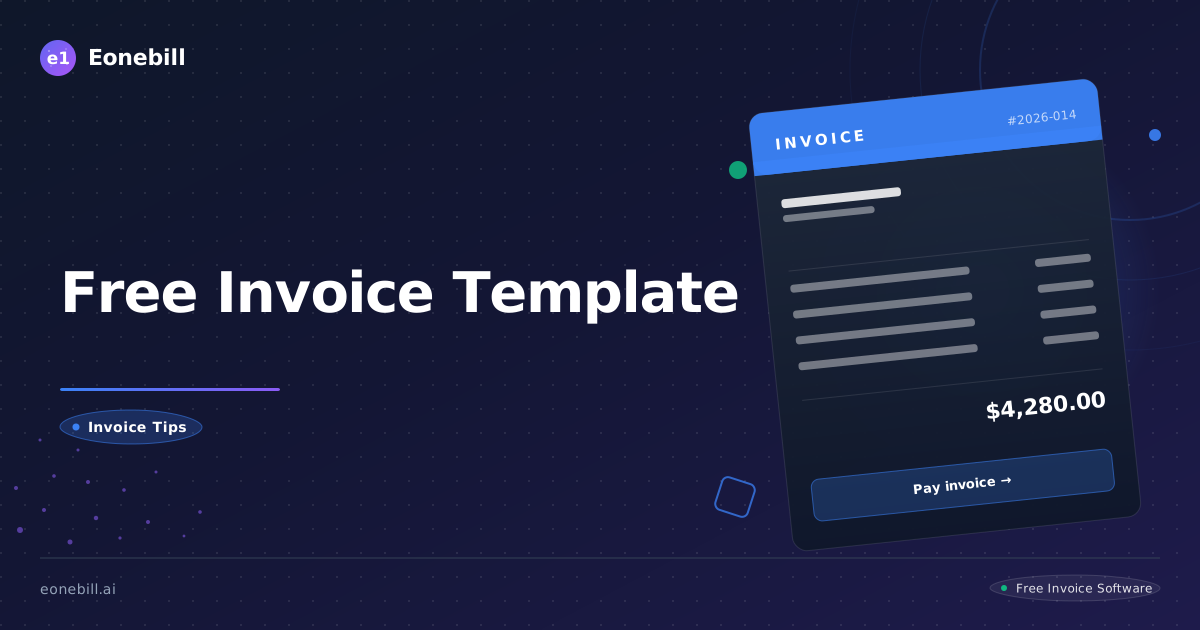
Getting paid on time starts with a clean, professional invoice. Whether you bill clients $250 for a logo or $25,000 for a quarterly retainer, the right template removes friction and tells your client exactly what to pay, when, and how. This guide walks you through the best free invoice template formats for US freelancers and small businesses, what fields to include, and how to pick the right file type for your workflow.
Why Your Invoice Template Matters More Than You Think
A badly formatted invoice is the number one reason small businesses get paid late. According to a 2025 QuickBooks survey, 49% of US small business owners reported at least one invoice paid 30+ days late in the last year, and the most common reason cited by clients was "unclear payment terms or missing information." A clean template solves most of that on day one.
A good invoice template does four things at once:
- Establishes you as a real, credit-worthy business (not a hobbyist).
- Makes it impossible for the client's AP team to claim "missing info" as a delay tactic.
- Creates a paper trail for taxes, audits, and disputes.
- Saves you 15 to 30 minutes per invoice once it is set up.
If you bill even four clients a month, that is two hours back in your week. Over a year, that is a full working week recovered just from not rebuilding the same document over and over.
What to Include on a US Invoice (Required vs. Optional Fields)
The US has no federal invoice format law (unlike the EU's strict VAT rules), but a complete invoice still needs specific fields if you want fast payment and clean books. Here is the standard checklist:
Required for every US invoice:
- Your business name, address, phone, and email
- The word "Invoice" clearly at the top
- A unique invoice number (e.g., 2026-0142)
- Invoice date and due date
- Client name and billing address
- Line items: description, quantity, unit price, line total
- Subtotal, sales tax (if applicable), and grand total
- Payment terms (Net 15, Net 30, Due on Receipt)
- Accepted payment methods
Strongly recommended:
- Your EIN or SSN (only if the client needs a W-9 on file)
- Late fee policy (e.g., 1.5% per month after due date)
- PO number or project reference, if the client uses one
- A short thank-you line
Optional but professional:
- Logo and brand colors
- Notes section for project context
- QR code for instant payment
If you sell physical products and ship across state lines, you may also need to collect and itemize sales tax based on the destination state's economic nexus rules. As of 2026, 45 states plus DC have economic nexus thresholds, typically $100,000 in sales or 200 transactions per year.
PDF vs. Word vs. Excel: Which Format Should You Use?
Each file type has a job it does best. Picking the wrong one creates real headaches.
PDF — Best for Sending to Clients
PDF is the gold standard for final invoices. The layout is locked, fonts render the same on every device, and the file cannot be edited accidentally. If a client claims they "never got the invoice" or "it looked wrong," a PDF settles it. Always send the final invoice as a PDF, even if you drafted it in Word or Excel.
Word (.docx) — Best for Service Businesses That Customize Every Invoice
If your invoices have lots of narrative text ("Phase 2 deliverables included..."), Word is forgiving. You can resize text boxes, add headers, and change layouts per client. Downside: math is manual, so a $1,250 line item with a 6.25% sales tax will not auto-calculate. Use Word when each invoice is a custom document.
Excel / Google Sheets — Best for High-Volume Billing
If you send 20+ invoices a month, Excel saves time. Formulas auto-calculate subtotals, tax, and totals. You can duplicate a tab, change three fields, and have a new invoice in 90 seconds. Downside: layouts can drift, and clients sometimes get spreadsheets that look unprofessional. Always export to PDF before sending.
| Format | Best For | Auto-Math | Send Directly? |
| ------ | -------- | --------- | -------------- |
| PDF | Final delivery to client | No (locked) | Yes |
| Word | Custom, narrative invoices | No | Convert to PDF first |
| Excel | High volume, repeated billing | Yes | Convert to PDF first |
Step-by-Step: Filling Out the Template Correctly
Let us walk through a real example. You are a freelance web developer in Austin, TX, billing a client in Denver for a 30-hour project.
- Header: Drop in your logo (top-left), and the word "INVOICE" in 24-28pt type (top-right).
- From / To blocks: Put your business info on the left, the client's billing contact on the right. Always confirm the AP email, not just the project manager.
- Invoice number and dates: Use a system you can sustain. "2026-0001" is better than "Invoice for Sarah Project 2." Set the due date based on your terms — Net 15 from May 17, 2026, is June 1, 2026.
- Line items: Be specific. "30 hours of front-end development at $95/hour" beats "Website work." Specificity reduces disputes.
- Subtotal, tax, total: A 30-hour project at $95/hour = $2,850. If the client is in Texas and you owe sales tax on services (Texas does not tax most professional services, but check your state), itemize it. Otherwise, subtotal equals total.
- Payment terms: State clearly: "Net 15. A 1.5% monthly late fee applies after the due date. Payable by ACH, check, or credit card."
- Footer: Thank-you line, your contact email, and your remit-to address.
Double-check the math, the client's address, and the invoice number before sending. One transposed digit can route your payment to nowhere.
Avoiding the Five Most Common Invoice Mistakes
Even with a great template, small errors create big delays. Watch for these:
- No invoice number. Without a unique ID, the client's AP system may reject the file outright. Modern AP automation tools require a number.
- Vague descriptions. "Consulting services" is a red flag. "Strategy consulting, May 1-15, 2026, 12 hours at $150/hour" gets approved faster.
- Wrong due date. "Due upon receipt" sounds urgent but is unenforceable in most states without a written agreement. Use a specific date.
- Missing remit-to info. If you accept checks, where do they go? If ACH, what is the routing number? List it.
- No follow-up plan. Set a calendar reminder for day 3 after the due date. Most late invoices get paid after one polite nudge.
If you find yourself fixing the same issues every month, that is a signal you have outgrown manual templates. A tool like Eonebill.ai handles numbering, due dates, late fees, and reminders automatically so you can focus on the work that earns you money.
Moving From Templates to Automated Invoicing
Free templates are a perfect starting point, especially for your first 10-20 invoices. They cost nothing, work offline, and force you to learn what belongs on a professional invoice. But there is a tipping point — usually around invoice number 30 or 40 — where the manual work starts costing more than it saves.
Signs you have hit that point:
- You spend more than 30 minutes per week chasing payments.
- You have ever sent an invoice with the wrong client name or amount.
- You cannot answer "how much did I bill in Q1?" in under 60 seconds.
- You do not know which invoices are 30+ days late right now.
- Tax season feels like archaeology.
When any two of these apply, upgrade. Use our free invoice generator to create polished invoices in under 60 seconds, then move to a paid plan when you need recurring invoices, automatic reminders, and payment tracking. Browse pricing options when you are ready.
The best invoice template is the one you actually use consistently. Start with a free PDF or Excel template today, send your next invoice within an hour, and refine the format as you learn what your clients respond to. Your future self — and your bank account — will thank you.
Adapting Templates Across Different Service Types
The right template structure changes based on what you sell. For hourly services, your template should emphasize time tracking — a column for date, hours, description, and rate creates a clear audit trail and reduces "what did you do that day?" follow-up questions from clients. For flat-fee projects, simplify to one or two line items but expand the description to cover all deliverables. For product-based businesses, include SKU codes, unit weights for shipping, and clearly broken-out shipping costs.
Many freelancers underestimate how much template adaptation matters. A graphic designer's invoice should look fundamentally different from an HVAC contractor's invoice — same core structure, but different emphasis. The designer needs space for thumbnail descriptions of deliverables. The contractor needs license numbers, warranty info, and parts/labor breakdown.
When you start out, build one master template, then make 2-3 variants for your most common project types. Save them in a folder labeled with the project type so you can grab the right one in 5 seconds. Over time, your variants will stabilize into 2-3 templates you use 90% of the time.
Branded Invoices Build Trust Faster
A branded invoice — with your logo, brand color, and consistent typography — communicates that you have systems in place. Studies of B2B payment behavior consistently show that branded invoices get approved 15-20% faster than generic ones, all else equal. The mechanism is simple: AP teams see the branded invoice and assume it comes from a real, established business. Generic Word-doc invoices look like they could be from anyone, including a scam.
If you do not have a logo yet, a clean text-only header with your business name in a quality typeface like Inter, Montserrat, or Playfair Display looks more professional than a bad logo. Spend $15-30 on Fiverr for a clean wordmark if you cannot DIY one in Canva. The cost pays itself back the first time an AP team approves your invoice faster because you look like a real business.
Brand colors should appear sparingly on invoices — accent only, never as a full background. A colored band along the top, a colored line under the header, or a colored grand total amount are all tasteful. Full-page colored backgrounds make invoices look like marketing flyers and slow processing.
Storage and Retrieval: The Underrated Part of Templates
The second-most-important thing about a template, after the design, is how you store and find filled-in invoices later. A great template that produces invoices you cannot find in 6 months is barely better than no template at all.
The storage system that works for most US small businesses: a top-level "Invoices" folder, with subfolders by year, then month. Inside each month, name files with your business name, the invoice number, and the date. Example: Invoices/2026/05-May/AcmeStudios-Inv-2026-0142-2026-05-17.pdf. This naming convention sorts alphabetically by date and is searchable by client name or invoice number.
Backup is non-negotiable. Cloud sync via Google Drive, Dropbox, OneDrive, or iCloud is the minimum. If your laptop dies tonight and you cannot recover your invoice records, that is a real business-existential event. Pay $2-5/month for cloud storage if you are not already. Make sure your invoice folder is included in the sync.
Common Questions Clients Ask About Invoices
Even with a great template, clients sometimes have questions. Be ready for these:
Why is the invoice number not sequential with my other vendor invoices?
Your invoice numbers reset each year and reflect your own sequence, not theirs. This is standard. Explain briefly and move on.
Why is there a late fee mentioned?
Late fees are industry standard for B2B and protect you from chronic slow-pay. Most clients never trigger them. Most who do pay on the first reminder.
Can you change the bill-to name?
Sometimes clients want the invoice billed to a different entity than the one that hired you. Confirm in writing before changing — billing the wrong entity creates AP confusion.
Can you remove the EIN?
No legitimate reason exists to remove your tax ID. If a client insists, that is a red flag.
Can you predate the invoice?
No. Backdating invoices is fraud and creates audit risk for both parties. Decline politely.
Can we pay in installments?
Negotiate based on the relationship and invoice size. For large invoices, 50/50 splits are reasonable. For small invoices, push for full payment. Always document installment agreements in writing.
Having prepared answers for these common questions reduces friction and builds your reputation as a competent professional.
Ready to manage invoices, contracts & proposals in one place? Try Eonebill free — no credit card required.
Start Free →Frequently Asked Questions
More Posts
Filing Taxes Late: Penalties, Extensions, and How to Catch Up (2026)
Missed the April deadline? Understand the 5 percent failure-to-file vs 0.5 percent failure-to-pay penalty difference, how Form 4868 extensions help, and the four-step protocol for catching up on years of unfiled returns.
Penalties for Not Filing a 1099: What Freelancers and Small Businesses Need to Know (2026)
Failing to file 1099 forms on time triggers escalating IRS penalties from 60 to 660 dollars per form. Learn the four-tier schedule, how to fix a missed filing, and when First-Time Penalty Abatement applies.
How to Write a Gentle Reminder Email (Templates + Examples)
Learn how to write a professional gentle reminder email that gets results. Includes 8 ready-to-use templates for invoices, meetings, deadlines, and more.
Newsletter
Join the community
Subscribe to our newsletter for the latest news and updates