Free Invoice Generator — Create Professional Invoices in Seconds
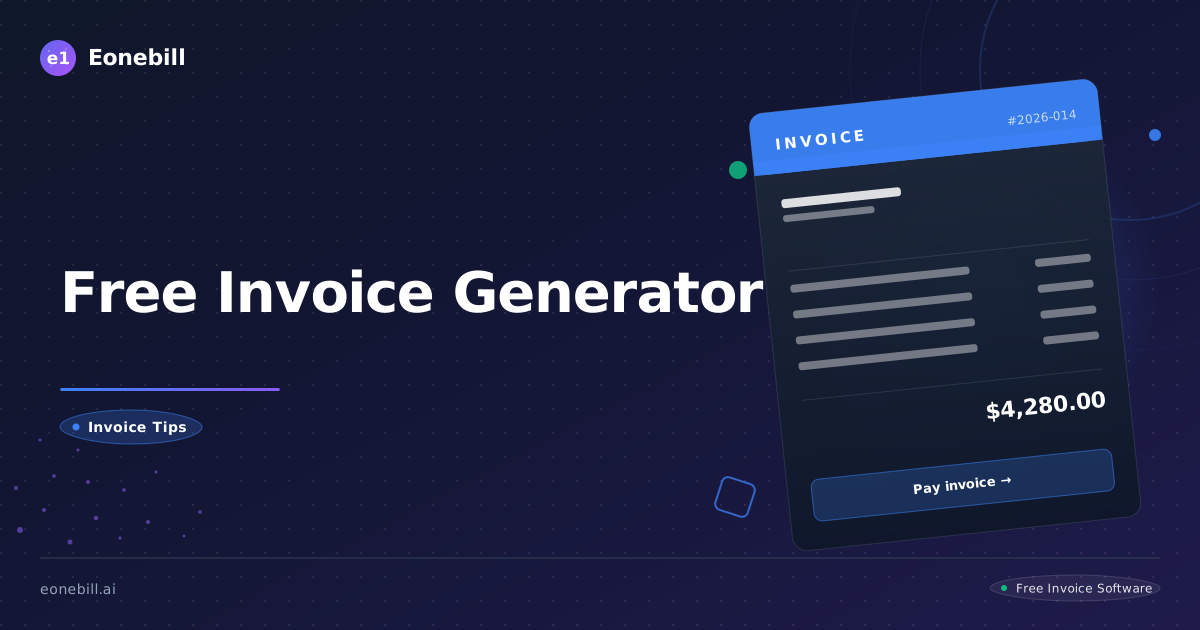
Sending an invoice should take 60 seconds, not 60 minutes. A modern invoice generator turns a half-hour of formatting into a few clicks, gives you a polished PDF that rivals any $30/month tool, and lets you focus on the work that actually earns money. This guide breaks down what a great invoice generator does, how to use one effectively, and how to scale beyond it when your business grows.
What an Invoice Generator Actually Does Under the Hood
At its simplest, an invoice generator is a smart template engine. You enter your business info, client info, line items, and terms, and the tool outputs a professional PDF. Under the hood, a good generator does five things you do not have to think about:
- Auto-calculates subtotal, sales tax, and total as you type
- Formats US currency, dates, and numbers correctly (no "$1,250.00 USD USD" mistakes)
- Generates a unique, valid invoice PDF that opens on any device
- Embeds your logo at the right resolution
- Handles long descriptions, page breaks, and multi-page layouts gracefully
The difference between a great generator and a basic one usually comes down to the small details: does the PDF look like it came from a Fortune 500 firm or a high school project? Does the math handle weird edge cases like 0% tax, multiple tax rates, or discount percentages? Does the file size stay reasonable (under 500KB) so it does not bounce from corporate spam filters?
Our free invoice generator handles all of this without an account, so you can create your first invoice in under two minutes.
The Anatomy of a Professional Invoice in 2026
Clients in 2026 expect invoices to look modern, mobile-friendly, and easy to pay. Here is the layout that converts fastest:
Header Block (top 20% of page)
Logo on the left, the word "INVOICE" in 28pt on the right. Below the logo: your business name, address, email, and phone. Below "INVOICE": invoice number, date, and due date.
Bill-To Block (next 10%)
The client's full name, company, billing address, and AP email. If they use PO numbers, include the PO number here.
Line Items Table (middle 50%)
Four columns work best: Description, Quantity, Unit Price, Line Total. Use 11-12pt body text, generous row spacing, and bold totals. Avoid more than 4 columns — extra columns make the invoice feel cluttered.
Totals Block (right-aligned, below table)
Subtotal, sales tax (with rate shown), discount (if any), and Grand Total in bold, 16pt or larger.
Payment Instructions (bottom 15%)
Accepted methods, account info, late fee policy, and a brief thank-you. If you accept credit cards through a payment link, put a clear "Pay Now" button or URL here.
Footer (bottom 5%)
Your business name, invoice number, and page count ("Page 1 of 1"). This is for AP teams that staple or scan invoices.
Real Example: Generating an Invoice for a Freelance Web Developer
Let us run through an actual scenario. You are a freelance web developer in Seattle, WA, billing a SaaS client in San Francisco for a 40-hour API integration project.
Step 1 — Open the generator and fill business info:
- Business: Nova Code Studio LLC
- EIN: 87-1234567
- Address: 1422 Westlake Ave N, Seattle, WA 98109
- Email: billing@novacode.studio
- Logo: 600x180 PNG with transparent background
Step 2 — Add the client:
- Bill To: Cascade SaaS, Inc.
- AP Email: ap@cascadesaas.com
- Address: 535 Mission St, Suite 1400, San Francisco, CA 94105
- PO Number: CSC-2026-0418
Step 3 — Build line items:
| Description | Qty | Unit Price | Total |
| ----------- | --- | ---------- | ----- |
| API integration development (Stripe + HubSpot), May 1-15 2026 | 32 hrs | $145 | $4,640 |
| QA testing and bug fixes | 6 hrs | $145 | $870 |
| Project management and client calls | 2 hrs | $145 | $290 |
Step 4 — Apply terms:
- Subtotal: $5,800
- WA service tax (not applicable for B2B services to CA): $0
- Total: $5,800
- Terms: Net 15, due June 1, 2026
- Late fee: 1.5% per month after due date
- Payment: ACH preferred. Routing 125000024, Account ending in 4421
Download the PDF, name it "Nova-Code-Invoice-2026-0287.pdf," and email it to ap@cascadesaas.com. Total time: 3 to 4 minutes from open to send.
Common Mistakes That Make Invoices Look Amateur
Clients judge your professionalism by your invoice before they judge it by your work. Avoid these eight invoice tells:
- Comic Sans, Papyrus, or Brush Script anywhere on the page. Stick to Inter, Helvetica, Arial, or your brand font.
- All-caps section headers. "BILL TO" looks dated. Use "Bill To" or "Billed To."
- Logos with white rectangles. Always use transparent PNG logos, never JPGs with a visible background box.
- Pixelated logos. Upload at least 600px wide. If your only logo file is a 200x60 JPG from 2019, get a vector version.
- Inconsistent currency formatting. Pick one: "$1,250.00" or "USD 1,250.00" — never mix.
- No invoice number. Modern AP systems reject invoices without unique IDs.
- Vague descriptions. "Consulting" gets disputed. "Marketing strategy consulting, 8 hours" gets paid.
- Wrong tax math. A 6.25% tax on $1,000 is $62.50, not $62.00. Round to two decimals correctly.
A good invoice generator prevents 7 of these 8 automatically. The one it cannot prevent is bad logo quality, which is on you.
How to Get Paid Faster With Your Generated Invoices
Generating the invoice is half the job. Getting paid is the other half. These tactics consistently shave days off payment cycles for US freelancers:
- Invoice immediately. Send the invoice within 24-48 hours of finishing the work. Memory of value fades fast.
- Use Net 15, not Net 30. Net 15 sounds reasonable to clients but gets you paid two weeks earlier.
- Send to the AP email, not just the project manager. PM is your buddy. AP cuts the check.
- Include payment links. A clickable Stripe or Square link inside the invoice gets paid 3x faster than "mail a check."
- Set up a 3-step follow-up. Day +3 after due date: friendly reminder. Day +7: "Just confirming you got this." Day +14: "Per the terms, a 1.5% late fee applies."
- Make ACH free, charge for cards. Many freelancers eat the 2.9% + 30 cent Stripe fee. You do not have to. Pass it through as a 3% convenience fee on card payments.
- Thank promptly-paying clients. A short "thank you, payment received" email reinforces good behavior.
These tactics together can cut your average days-to-payment from 38 to 17. That is a massive cash-flow improvement for a solo business.
When to Move Beyond a Free Generator
A free invoice generator is the right tool for the first 20-30 invoices of your business. After that, the math shifts. Signs you have outgrown a basic generator:
- You send the same invoice to the same client every month (you need recurring billing).
- You spend more than 30 minutes a week on invoice admin.
- You cannot tell which invoices are unpaid right now.
- You want clients to pay by credit card inside the invoice.
- You want automated reminders to go out without you doing anything.
- Your accountant asks for a billing report and you panic.
When any three of these apply, the $9 to $19 monthly cost of a real invoicing platform pays for itself in under a week. Eonebill.ai's plans include recurring invoices, automated reminders, payment links, and a real dashboard showing exactly who owes you what.
Until then, use the free invoice generator for every project. It is faster than a template, cleaner than a Word doc, and gets you paid without forcing you into a contract or trial. Send your next invoice today.
Customizing the Output for Your Industry
Every industry has slightly different invoice expectations. A clean default template works for most freelancers, but small adjustments make your invoice fit your industry's norms.
For creative professionals (designers, writers, photographers, videographers), emphasize the deliverables. List specific outputs by name ("Final logo files: AI, SVG, PNG, JPG") rather than time spent. Clients in creative industries pay for outcomes, not hours, so make the outcomes the centerpiece.
For technical consultants (developers, IT, engineers), emphasize the project scope and milestones. Reference the statement of work or contract by date. List phases or milestones as separate line items. Technical AP teams need to map invoices to specific deliverables in their project management systems.
For service trades (HVAC, plumbing, electrical, contracting), include license numbers, parts breakdowns, and warranty info. Customers in this space want to see exactly what was done, what parts were used, and what their recourse is if something goes wrong. Detailed invoices reduce service call disputes by 40-60% according to industry trade groups.
For coaches and consultants, include session counts, dates, and engagement type. "3 strategy sessions, May 1-15, 2026" is more useful than "Coaching services."
For product-based businesses, include SKUs, unit counts, shipping costs separately, and any restocking fees or terms.
The Speed-vs-Polish Tradeoff in Generators
There is a real tradeoff between how fast a generator works and how polished the output is. The fastest generators (under 60 seconds open-to-PDF) typically have minimal customization. The most customizable generators (full brand control, multiple templates, conditional fields) take longer to use.
For most freelancers, speed wins. A clean default template generated in 60 seconds beats a perfectly customized template that takes 10 minutes. The opportunity cost of those 9 extra minutes — repeated across 30 invoices a year — is 4.5 hours of admin you could have spent earning.
The exception is your first invoice with a new client, or invoices for very large projects (over $25K). For those, spending an extra few minutes on polish, custom notes, and detailed descriptions is worth it. The first invoice sets the tone for the relationship; large invoices justify the extra care.
Common Generator Bugs and Workarounds
Even good generators have quirks. Watch for these and know the workarounds:
Bug: Logo appears too large or distorted. Workaround: resize your logo to exactly 600x180 pixels with a transparent background before upload. Most generators do not auto-scale well.
Bug: Long line item descriptions break the table layout. Workaround: keep descriptions to 1-2 lines. For complex descriptions, use a separate "Notes" section below the line items.
Bug: Sales tax math rounds incorrectly on uneven amounts. Workaround: verify the math manually for tax calculations. A 7% tax on $142.85 should be $9.9995, which rounds to $10.00. Some generators round to $9.99 or $10.99 incorrectly.
Bug: PDF file size is huge (5MB+) and bounces from corporate spam filters. Workaround: compress your logo before upload. Use a PNG that is under 100KB. The resulting PDF should be under 500KB.
Bug: Currency formatting inconsistent (USD, $, dollars all mixed). Workaround: stick to one format. "$1,250.00" is the US standard. Avoid "USD 1,250" or "1,250 dollars."
Generator Tips for First-Time Users
If this is your first invoice ever, a few tips smooth the experience:
Pick your invoice number system first. Year-prefix sequential (2026-0001) is the easiest to maintain. Decide once and never change.
Save your business profile. Even free tools usually let you fill in your business info once and save to local storage. Take 2 extra minutes the first time so future invoices take 2 minutes total instead of 5.
Test with a draft invoice to yourself. Generate an invoice, email it to your own address, and review on both desktop and phone. This catches layout issues before a client sees one.
Have your payment info handy. ACH routing/account, Stripe payment link, Venmo handle, PayPal address — copy these into a notes app for easy reference.
Use a real business email. Send invoices from yourbusiness@yourdomain.com, not yourname@gmail.com. The domain email signals professionalism. Google Workspace costs $7/month for this if you do not have it.
Set your standard terms in writing. Decide Net 15 or Net 30, late fee percentage, accepted payment methods. Then apply consistently across every invoice.
Photograph your physical signature. If your invoice format includes a signature line, scan or photograph your signature once and reuse the image. Saves time on every invoice.
First-invoice habits compound into long-term professionalism. Take the extra 15 minutes now to set up correctly.
Ready to manage invoices, contracts & proposals in one place? Try Eonebill free — no credit card required.
Start Free →Frequently Asked Questions
More Posts
Filing Taxes Late: Penalties, Extensions, and How to Catch Up (2026)
Missed the April deadline? Understand the 5 percent failure-to-file vs 0.5 percent failure-to-pay penalty difference, how Form 4868 extensions help, and the four-step protocol for catching up on years of unfiled returns.
Penalties for Not Filing a 1099: What Freelancers and Small Businesses Need to Know (2026)
Failing to file 1099 forms on time triggers escalating IRS penalties from 60 to 660 dollars per form. Learn the four-tier schedule, how to fix a missed filing, and when First-Time Penalty Abatement applies.
How to Write a Gentle Reminder Email (Templates + Examples)
Learn how to write a professional gentle reminder email that gets results. Includes 8 ready-to-use templates for invoices, meetings, deadlines, and more.
Newsletter
Join the community
Subscribe to our newsletter for the latest news and updates