Invoice Format Guide: What to Include & Free Template
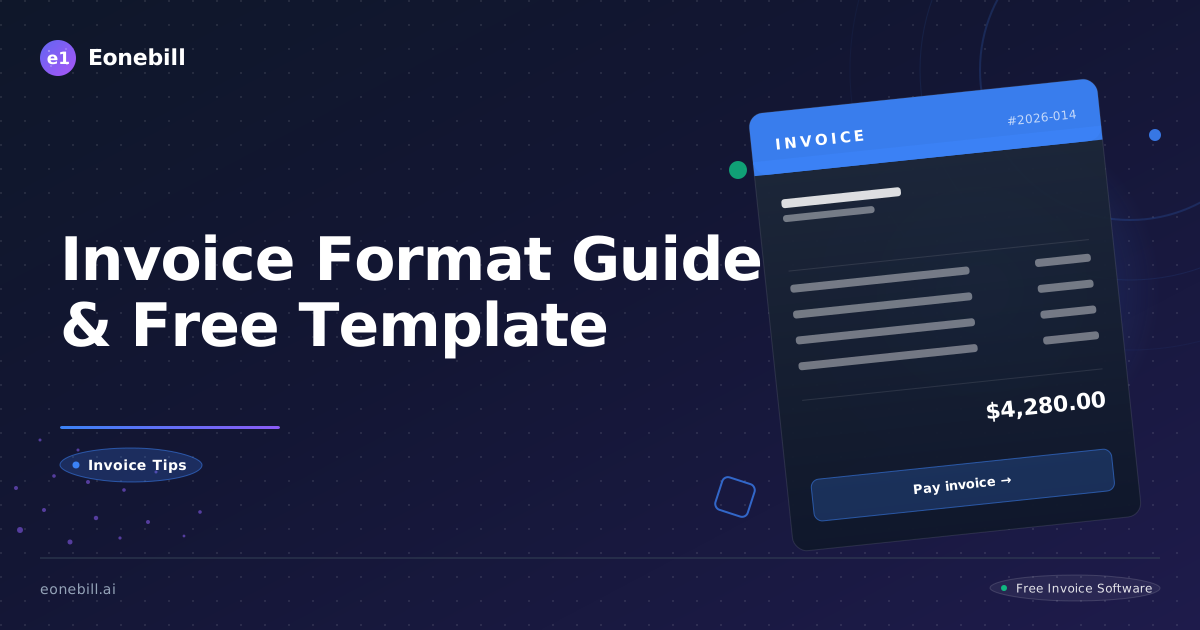
Invoice format is one of those topics that seems simple until you actually try to design one. Get it right and clients pay quickly, your books stay clean, and tax season is painless. Get it wrong and you face delayed payments, AP rejection, and confused clients. This guide covers exactly what to include in a professional US invoice format, with examples of correct vs. incorrect formats and a free template recommendation at the end.
The Anatomy of a Standard US Invoice Format
A proper invoice has six sections, in this order, from top to bottom:
- Header — "INVOICE" label and your business identity
- Parties — who is billing whom
- Identifiers — invoice number, dates, references
- Line items — what is being billed
- Totals — subtotal, tax, total
- Terms and footer — payment instructions, late fees, thank-you
This structure is the standard across US business invoicing. AP teams scan invoices in this order. Deviating from the structure — putting line items above the header, hiding the total, omitting the invoice number — slows processing.
What Must Be Included by Law (and What Is Strongly Recommended)
The US does not have strict federal invoice format laws like the EU does for VAT. But several elements are required by industry custom and by most AP automation tools:
Required for fast processing:
- Word "INVOICE" clearly visible
- Your business name and address
- Client business name and address
- Unique invoice number
- Invoice date and due date
- Itemized list of goods/services
- Subtotal, tax (if any), grand total
- Payment terms
Required for tax compliance:
- Sales tax line item if you collected sales tax
- Your EIN if reported on a 1099 (or the client will request a W-9)
- Adequate description for IRS audit defense (vague descriptions get disallowed)
Strongly recommended:
- Late fee policy
- Accepted payment methods with instructions
- Project or PO reference
- Logo
- Page count if multi-page
Optional but classy:
- QR code linking to payment page
- Embedded payment button (only works on web-hosted invoices)
- Thank-you line
- Tagline or business statement
If you omit anything in the first two lists, expect delays, disputes, or audit problems. Everything else is style and brand polish.
Correct vs. Incorrect Invoice Format: Side-by-Side
Incorrect format example:
Hey John, here is what you owe for the project.
Logo design: $1,500
Venmo me at @sarahdesigns
Thanks!
Problems: no invoice number, no date, no due date, no business address, no client billing info, no terms, no tax handling, no professional language.
Correct format example:
[Sarah Designs Logo]                              INVOICE
245 7th Ave, Brooklyn NY 11215                    #: 2026-0089
hello@sarahdesigns.co | (718) 555-0114            Date: May 17, 2026
EIN: 87-1234567                                   Due: June 1, 2026

Bill To:
Acme Software Inc.
Attn: Accounts Payable
88 Causeway St, Boston MA 02114
ap@acmesoftware.com

--------------------------------------------------------
Description                            Qty  Rate    Total
Logo design + 2 revisions (Final)       1   $1,500  $1,500
Brand color palette (3 variations)      1   $300    $300

                                          Subtotal: $1,800
                                          Tax:           $0
                                          Total:    $1,800

Terms: Net 15. Late fee 1.5%/mo after due date.
Pay by: ACH (Routing 026013673, Account ending 8821) or Stripe link below.
Pay by card: https://buy.stripe.com/sarahdesigns-2026-0089 (3% fee)

Thank you for the project!

— Sarah Designs LLC | Invoice 2026-0089 | Page 1 of 1
The second version is everything the first is not: complete, professional, payable, traceable. Total typing time: under 5 minutes once your business profile is set.
Sales Tax Formatting Done Right
Sales tax on US invoices is where most freelancers get the format wrong. The rules:
- Always show the rate. "Sales tax: $25" raises questions. "VA sales tax (5.3%): $26.50" does not.
- Apply to taxable items only. If you sell a $500 design service (not taxable) and a $200 print package (taxable), tax only the $200. Show this clearly: "Subtotal: $700. VA sales tax (5.3% on $200 in taxable products): $10.60. Total: $710.60."
- Use destination tax, not origin. If you are in Virginia and ship to North Carolina, charge NC's rate (typically 4.75% + local).
- Itemize if you have multiple tax rates. Mixed-location invoices might have state + local + special district tax. Show each one separately.
- Mark non-taxable items. Some states require you to label non-taxable items: "Non-taxable service."
If you sell across state lines and have economic nexus in multiple states, an invoicing tool that automatically calculates the right tax saves hours of error-prone manual work. Eonebill.ai's paid plans integrate with TaxJar for automatic destination-based tax calculation.
International Invoice Format Considerations
Billing international clients adds a few format requirements:
For invoices to EU clients:
- VAT number (yours or the client's, depending on the reverse charge rules)
- "Reverse charge applies — no VAT charged" if invoicing B2B inside the EU as a US business
- Invoice in EUR or your contract currency, with USD equivalent if helpful
- IBAN for bank transfers (not just routing/account)
For invoices to UK clients:
- Similar to EU, plus UK-specific HMRC requirements if you cross VAT thresholds
- GBP currency
- IBAN + SWIFT for international wires
For invoices to Canadian clients:
- CAD or USD per contract
- GST/HST handling depending on province
- Your business number if registered for GST
For other international clients:
- Wire transfer info: SWIFT code, IBAN, beneficiary address
- Intermediary bank info if applicable
- Currency explicitly stated
- Conversion date/rate if billing in USD but paid in local currency
For most US freelancers, international clients pay 5-15% of the time. Set up international invoice formats once, save as a template, reuse.
Free Invoice Template: What to Look For
A solid free invoice template should:
- Follow the six-section structure above
- Be available in PDF, Word, and Excel for flexibility
- Have auto-math built into the Excel version
- Include placeholder examples (not blank fields) so you understand what goes where
- Be editable without watermarks or paywalls
- Be US-formatted by default (USD, MM/DD/YYYY)
Our recommendation: start with the free invoice generator for an instant, professional output without any setup. If you need a downloadable template you can edit offline, look for one that comes in all three formats (PDF, Word, Excel) and that already has the section structure correct.
Avoid templates that:
- Have watermarks or "Made with X" branding on the output
- Use Comic Sans or other novelty fonts
- Lack a sales tax field
- Lack a due date field
- Default to non-US format (DD/MM/YYYY, EUR currency)
A good template is the bottom of a long staircase. It gets you started, but you will outgrow it. Plan to graduate to a real invoicing tool once you cross 10 invoices a month — the time savings will pay for the upgrade many times over. Until then, use the free template, follow the format rules above, and your invoices will look as professional as those of any established business in your industry.
Finally, remember that invoice format is just the visible 10% of getting paid. The other 90% is timely sending, polite follow-up, and easy payment options. Get the format right, then build the habits around it. Your next invoice — sent today, formatted correctly, with clear terms and a payment link — is the simplest cash-flow improvement available to your business.
Format Differences for Service vs. Product Invoices
The basic invoice structure is the same, but service and product businesses emphasize different fields.
Service invoice emphasis:
- Time period of service ("May 1-15, 2026")
- Hours and rate (or flat fee with description)
- Project or engagement name
- Deliverables completed
- Sales tax usually $0 (most services non-taxable)
- Payment terms more flexible (Net 15 to Net 30)
Product invoice emphasis:
- SKU or product codes
- Quantity sold
- Unit price
- Shipping costs separate line
- Sales tax (almost always applicable, destination-based)
- Payment usually upfront or Due on Receipt
- Returns/refund policy
A service business invoicing a product (a designer selling a print package along with the design service) needs a hybrid invoice with clear sections separating taxable products from non-taxable services. The tax calculation should be on products only, not the full subtotal.
Format Adaptations for Recurring Billing
Monthly retainer or subscription invoices have different format needs than one-off project invoices.
Specific recurring invoice fields:
- Billing period clearly stated ("May 2026, Month 2 of 6")
- Subscription or retainer scope reference
- Next invoice date preview ("Next invoice: June 1, 2026")
- Cumulative engagement reference ("Contract signed 4/1/2026")
- Auto-payment status ("Auto-pay on file" or "Manual payment required")
Recurring invoices benefit from a slightly different visual treatment: subtle text like "Recurring Monthly" near the invoice number signals "this is part of an ongoing engagement" and reduces the AP team's tendency to question the line item.
For recurring billing at scale, automation is essential. Manually generating 20 recurring invoices a month introduces error rate that grows over time. A real invoicing platform with recurring schedules eliminates this.
Tax Format Across State Lines
For businesses billing across state lines, tax format becomes complex. Each state has its own rules.
The destination-based default (most states):
You charge the buyer's state tax rate. For a Texas business shipping a product to California, you charge California rates. Show on the invoice: "CA Sales Tax (7.25% state + 1.5% county): 8.75%, $87.50."
The origin-based exception (5 states):
Arizona, Illinois, Mississippi, Missouri, and partial California use origin-based for intrastate sales. For a Phoenix business selling to a Tucson buyer, you charge Phoenix rates.
Multi-state nexus:
If you have economic nexus in multiple states ($100K+ in sales or 200+ transactions per state in most cases), you must register in each, collect that state's tax, and remit. The invoice should show the appropriate state tax based on the buyer's location.
International:
For international clients (EU, UK, Canada), VAT/GST/HST rules apply. Often the US business does not collect ("reverse charge applies"), but the invoice must note this. Get specific guidance from a CPA familiar with international rules.
Getting tax format wrong is expensive. Under-collecting means you owe out of pocket. Over-collecting means refunds and customer complaints. A sales tax automation tool (TaxJar, Avalara) plus quarterly CPA review is worth the cost once you cross multiple states.
Format for Disputes and Amendments
Sometimes an invoice needs to be amended or disputed. The format for these:
Corrected invoice (when you made an error):
- New invoice number
- Note: "This invoice supersedes Invoice 2026-0142 dated 5/17/2026"
- Same client and project info
- Corrected line items and totals
- Send to client with brief explanation email
Credit memo (when client returns something or is owed a refund):
- Label as "CREDIT MEMO" or "REFUND INVOICE"
- Reference original invoice number
- Show negative amount being credited
- Apply to a specific future invoice or issue refund
Disputed invoice handling:
- Keep original invoice on file (do not delete)
- Issue new corrected invoice with new number
- Document the dispute and resolution
- Update accounting records to match the corrected version
Never modify a sent invoice. Always issue corrections as new documents with clear references to the original. This audit trail protects you in disputes and IRS reviews.
Format Evolution as Your Business Grows
Your invoice format should evolve with your business. The progression most successful freelancers follow:
Year 1: Basic template. Word doc or free generator. Simple format. Focus on consistency and getting paid.
Year 2: Branded template. Logo, brand color, custom font. Looks professional. Still manually generated per invoice.
Year 3: Tool-based with saved profile. Free tool with your business info saved. 2-3 minutes per invoice. Track payments manually.
Year 4: Paid invoicing platform. Real tool with recurring invoices, automatic reminders, payment links. Sub-minute per invoice for repeat clients.
Year 5+: Integrated business platform. Invoicing + accounting + CRM in one or two tools. Reports drive decisions. Tax season is a 1-hour task.
Each stage has different format implications:
- Year 1 format prioritizes simplicity and speed of learning.
- Year 2 format prioritizes professional appearance.
- Year 3 format prioritizes consistency at scale.
- Year 4 format prioritizes automation.
- Year 5+ format prioritizes data and integration.
Upgrading too fast wastes money. Upgrading too slow wastes time. Match your tool stage to your business stage, and revisit the question every 6-12 months.
Ready to manage invoices, contracts & proposals in one place? Try Eonebill free — no credit card required.
Start Free →Frequently Asked Questions
More Posts
Filing Taxes Late: Penalties, Extensions, and How to Catch Up (2026)
Missed the April deadline? Understand the 5 percent failure-to-file vs 0.5 percent failure-to-pay penalty difference, how Form 4868 extensions help, and the four-step protocol for catching up on years of unfiled returns.

Penalties for Not Filing a 1099: What Freelancers and Small Businesses Need to Know (2026)
Failing to file 1099 forms on time triggers escalating IRS penalties from 60 to 660 dollars per form. Learn the four-tier schedule, how to fix a missed filing, and when First-Time Penalty Abatement applies.

How to Write a Gentle Reminder Email (Templates + Examples)
Learn how to write a professional gentle reminder email that gets results. Includes 8 ready-to-use templates for invoices, meetings, deadlines, and more.
Newsletter
Join the community
Subscribe to our newsletter for the latest news and updates