How to Write Payment Terms on an Invoice
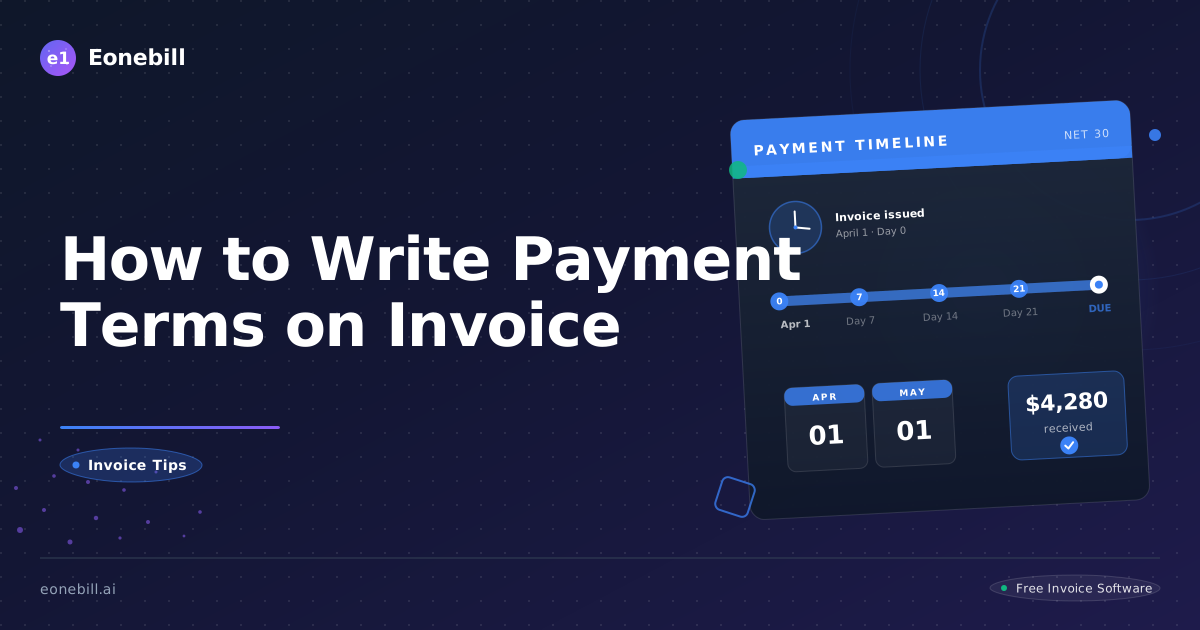
Payment terms are the fine print that determines when you get paid, how much late fees accrue, and what happens if a client disputes a charge. Most freelancers spend hours perfecting the line items and 30 seconds copying terms from an old invoice. That is backwards. The terms section is where most cash flow problems are won or lost.
This guide walks through every component of payment terms on a US invoice: due dates, late fees, accepted payment methods, deposits, partial payment rules, refund policies, and dispute mechanisms. By the end you will have a complete payment terms section you can drop into any invoice and adapt to your business model.
Why Payment Terms Matter
Payment terms are a mini-contract embedded in the invoice. They tell the client (and the client's accounts payable system) exactly when payment is expected, how to pay, what happens if payment is late, and what recourse you have if there is a dispute. They also create a legal record of what was agreed.
Vague or missing terms are the single biggest cause of late payments in small business. A study by Fundbox showed that small businesses with explicit late fee policies are paid an average of 11 days sooner than those without. Clarity speeds money.
Good terms also signal professionalism. A client receiving a freelance invoice with bullet-pointed terms, a specific due date, an explicit late fee, and clear payment instructions perceives you as established and serious. The unconscious signal is: this person knows how to run a business and expects to be treated like one.
Finally, payment terms on the invoice (combined with the signed engagement letter referencing them) form the legal basis for any small claims or collection action later. Without terms, you have less to enforce. With them, you have a strong position.
The Six Elements of Complete Payment Terms
Every US invoice should include six payment terms elements. Here they are, with example language you can copy.
Element one: due date. State the due date as a specific calendar day, not just 'Net 30.' Bad: 'Net 30.' Good: 'Payment due April 15, 2026 (Net 30 from issue date March 16, 2026).' Specific dates remove all calculation ambiguity. AP systems can process specific dates without conversion.
Element two: payment terms classification. The standard formats: Due on Receipt (payment expected within 5-10 days), Net 15, Net 30, Net 45, Net 60, or 2/10 Net 30 (2 percent discount if paid within 10 days, otherwise full amount due in 30). Choose terms based on your cash flow needs, client size, and industry norms. Default to Net 15 for small business clients and Net 30 for enterprise clients.
Element three: late fee policy. State the fee clearly and reference how it accrues. Example: 'Past due balances accrue interest at 1.5 percent per month (18 percent APR), calculated daily, beginning the day after the due date.' This rate is industry standard and enforceable in every US state when stated on the invoice.
Element four: accepted payment methods. List each method with any client-side fees disclosed. Example: 'Payment accepted via ACH bank transfer (free), credit card via Stripe (2.9 percent surcharge applied), PayPal (3.49 percent surcharge applied), or check payable to [Your Business]. Wire transfer instructions available on request.' Surcharging credit card fees is legal in most US states but check your state if you choose to do so.
Element five: deposit and partial payment rules. If you take deposits, state when balance is due. Example: 'Deposit of 50 percent due upon engagement signing. Balance of 50 percent due upon project completion. Partial payments accepted; remaining balance accrues late fees per Section 3 if past final due date.'
Element six: dispute and refund policy. Brief is best. Example: 'Disputes must be submitted in writing within 14 days of invoice date. Refunds, if applicable, processed within 10 business days to original payment method. Engagement letter governs refund eligibility.' This sets a clear window during which clients can raise concerns and prevents indefinite renegotiation.
Together, these six elements form a complete terms section that takes about 5 to 7 lines on the invoice. It is the most professional 7 lines you will ever write.
Choosing the Right Due Date
The due date you choose affects your cash flow and your client relationships. Pick deliberately.
Due on Receipt: payment expected within 5 to 10 business days. Best for one-time work, new clients, or clients with a history of late payment. Be aware that many AP teams treat 'Due on Receipt' as 'pay within 10 days' in practice, so do not expect literal same-day payment.
Net 15: payment due within 15 days. Best for small invoices, ongoing service relationships, and freelancers who need quick cash. Sets the expectation of prompt payment without being aggressive.
Net 30: the US business standard. Most corporate AP systems are built around 30-day cycles. If your client is a Fortune 1000 company, expect Net 30 or even Net 45 as the minimum. Net 30 is also the default in many contracts where terms are not explicitly negotiated.
Net 45 and Net 60: common for enterprise clients in industries like construction, government, healthcare, and large retail. Sometimes negotiable down to Net 30 if you push, but often non-negotiable for very large clients. Build buffer into your cash flow planning if you accept these terms.
2/10 Net 30: an early payment discount. The client gets a 2 percent discount if they pay within 10 days; otherwise the full amount is due in 30. Example: invoice $5,000. Pay by day 10 and pay $4,900. Pay between day 11 and day 30 and pay the full $5,000. The discount is worth about 36 percent annualized (2 percent saved for 20 fewer days of credit), which is a great deal for clients with cash on hand and a great deal for you in faster cash conversion.
Progressive terms: some businesses use a sliding due date scale. 'Net 15 for first 3 months, Net 30 for subsequent invoices once payment history is established.' This is a soft way to test new clients without alienating them.
Whatever you choose, be consistent across invoices for the same client and reference the engagement letter where terms were originally agreed.
Writing Effective Late Fee Language
Late fees are the most contested part of payment terms, but they are also the most powerful tool for getting paid on time. The mere presence of a clearly stated late fee reduces late payments by 15 to 25 percent in our data.
The key is to write the late fee in language that is both legally enforceable and not intimidating. Here is template language to use.
'Past due balances accrue interest at 1.5 percent per month (18 percent APR), calculated daily, beginning the day after the due date. Late fees are added to the outstanding balance and compound monthly until paid in full.'
Key components: state the rate clearly (1.5 percent monthly is standard), state when it starts accruing (day after due date), and state how it accrues (daily calculation, monthly compounding). The 18 percent APR equivalent is helpful because it puts the rate in terms most people recognize.
Legal enforceability: 1.5 percent monthly is below the usury cap in every US state for commercial debt. Some states have lower caps for consumer debt, but most freelance and small business invoices are B2B and not subject to consumer protection caps. State your late fee on the invoice and reference it in the engagement letter to make enforcement clean.
For industries where late fees are uncommon or culturally inappropriate (some nonprofits, government, certain rural markets), you can soften the language: 'A late fee of 1.5 percent per month may be applied to balances more than 14 days past due.' The word 'may' creates discretion and is gentler.
For industries where late fees are aggressive (construction, manufacturing, B2B services), you can be more direct: 'A late fee of 1.5 percent per month is added to all past due balances effective the first day after the due date. Late fees compound monthly.'
Always enforce late fees once stated. Waiving them on a first offense teaches the client that the policy is decorative. Apply the fee, then optionally choose to forgive it in a specific conversation: 'I have applied the late fee per our agreement. As a one-time accommodation, I'm willing to waive it this time given the circumstances.' This preserves the precedent while showing goodwill.
Sample Payment Terms Block (Copy and Use)
Here is a complete payment terms block you can drop onto any invoice. Customize the bracketed sections.
'Payment Terms
Due Date: [April 15, 2026] (Net 30 from issue date [March 16, 2026]).
Accepted Methods: ACH bank transfer (free), credit card via Stripe ([note any surcharge]), PayPal ([note any surcharge]), or check payable to [Your Business Name]. ACH details: [routing number, account number] or use the Stripe link below.
Late Fees: Past due balances accrue interest at 1.5 percent per month (18 percent APR), calculated daily, beginning the day after the due date. Late fees compound monthly.
Disputes: Any dispute must be submitted in writing within 14 days of the invoice issue date. Undisputed line items remain payable on the original due date.
Deposit and Balance (if applicable): Deposit of [50 percent] paid on [date]. Balance of [50 percent] due upon delivery of [milestone or final deliverable].
Reference: Per engagement letter signed [January 15, 2026]. Questions: contact [your email] or [your phone].'
This block is approximately 100 words and fits in the lower third of any invoice. Use it as a template, adjust for your specific situation, and you have professional terms ready in 30 seconds. The free invoice generator at /free-tools/invoice-generator pre-populates terms based on your business profile.
Negotiating Terms With Clients
Clients sometimes push back on payment terms. Handle it with confidence, not capitulation.
For due date pushback: 'Our standard is Net 30; can we do Net 45?' Reasonable response: 'I can offer Net 30 with a 2 percent early-pay discount if paid by day 10. Or Net 45 with a 1.5 percent premium added to reflect the longer financing period.' This gives the client choice without you absorbing the full cost of extended terms.
For late fee pushback: 'We don't pay late fees as a company policy.' Response: 'Understood. In that case, I'd ask for upfront deposits of 50 percent on all engagements and Net 15 terms instead of Net 30, since the late fee is what protects me when payment slips. Does that work?' Trade off one risk control for another.
For deposit pushback: 'We don't do deposits with new vendors.' Response: 'For the first engagement, I can waive the deposit on projects under $2,000 with Net 15 terms. For larger projects, the deposit is standard for me and ensures I can dedicate the time. Happy to provide references if helpful.' Anchor on your standard and offer flexibility within reason.
For surcharge pushback on credit cards: 'We don't accept invoices with credit card surcharges.' Response: 'No problem. I can absorb the credit card fee for invoices under $1,000 and request ACH or check for larger amounts.' This lets you pick your battles based on the fee impact.
For refund window pushback: 'Our procurement policy gives us 60 days to dispute.' Response: 'Understood. I can extend the dispute window to 30 days on this engagement. For 60 days, I'd need a corresponding extension on my refund processing timeline.' Match the timeframes on both sides.
The pattern is: never refuse outright. Always offer a counter that protects your cash flow while accommodating the client's process. Most negotiations resolve in the middle.
Ready to build invoices with professional, enforceable payment terms? Try the free generator at /free-tools/invoice-generator, which includes built-in late fee templates, deposit rules, and US-state-specific surcharge language. For automated late fee accrual, reminder sequences, and dispute tracking, upgrade at /pricing. Eonebill.ai turns payment terms from an afterthought into a competitive advantage.
One final perspective: payment terms are not just legal protection; they are an expression of how you run your business. A freelancer with clear, fair, professionally written payment terms signals organization, confidence, and respect for both parties. A freelancer with no terms or copy-pasted terms signals that money is awkward and that the basic structure of the relationship is undefined.
Review and refresh your payment terms annually. As your business grows and you serve different client segments, your terms should evolve. Year 1 you might offer Net 30 with 1.5 percent late fees on everything. Year 3 you might offer Net 15 for small clients, Net 30 for enterprise, and 2/10 Net 30 early-pay discounts for prepay-friendly clients. Each refinement is small, but the cumulative effect over a 5-year freelance career is meaningful: faster cash, fewer disputes, and clearer expectations.
Finally, treat your terms as a teaching tool for clients. Many clients, especially first-time hires of freelancers, do not know what 'Net 30' means or why a late fee policy exists. A short paragraph in your kickoff email explaining your terms (in plain language, not legalese) educates the client and sets the tone for the relationship. 'I bill on the 1st of every month with Net 15 terms. A small 1.5 percent monthly late fee applies if payment slips, which is industry standard. Most clients pay within 7 to 10 days, which works for both of us.' Three sentences, total clarity. Try it on your next engagement.
Create this in 30 seconds — free invoice with Eonebill, no sign-up required.
Create Free Invoice →Frequently Asked Questions
More Posts
Filing Taxes Late: Penalties, Extensions, and How to Catch Up (2026)
Missed the April deadline? Understand the 5 percent failure-to-file vs 0.5 percent failure-to-pay penalty difference, how Form 4868 extensions help, and the four-step protocol for catching up on years of unfiled returns.
Penalties for Not Filing a 1099: What Freelancers and Small Businesses Need to Know (2026)
Failing to file 1099 forms on time triggers escalating IRS penalties from 60 to 660 dollars per form. Learn the four-tier schedule, how to fix a missed filing, and when First-Time Penalty Abatement applies.
How to Write a Gentle Reminder Email (Templates + Examples)
Learn how to write a professional gentle reminder email that gets results. Includes 8 ready-to-use templates for invoices, meetings, deadlines, and more.
Newsletter
Join the community
Subscribe to our newsletter for the latest news and updates