How to Fill Out a Receipt Book: Complete Step-by-Step Guide
Learn exactly how to fill out a receipt book with this step-by-step guide. Discover when you need receipts, what fields to complete, and how digital tools compare.
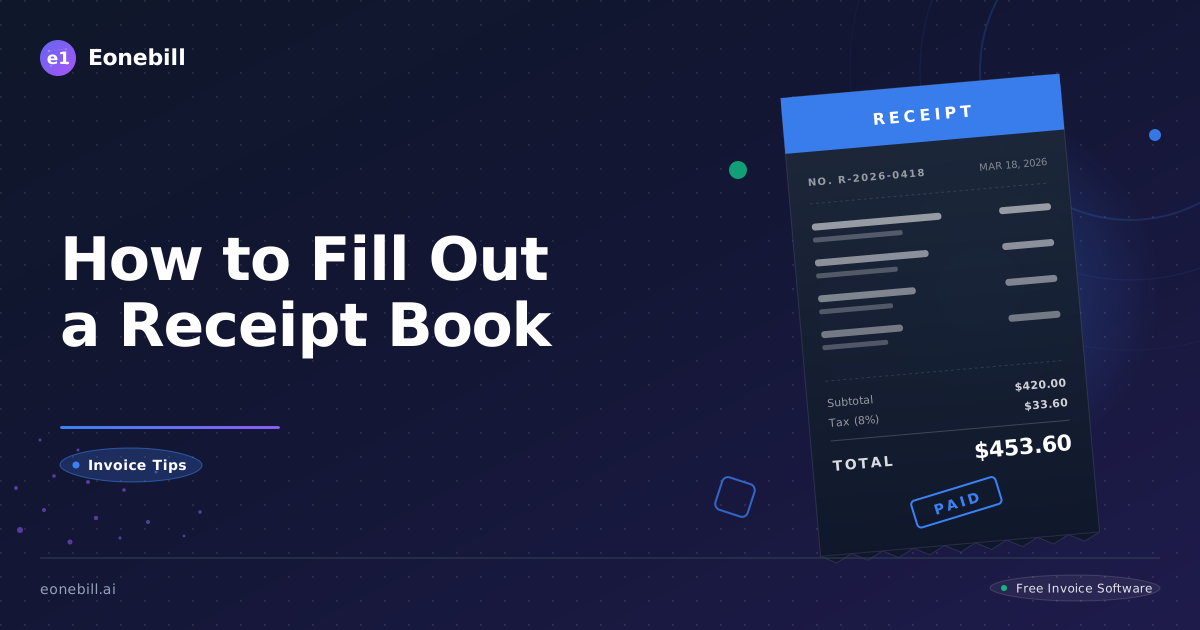
How to Fill Out a Receipt Book: Complete Step-by-Step Guide
Every business that accepts payments needs a reliable way to document those transactions. A receipt book remains one of the simplest, most portable solutions — no internet connection, no software setup, no learning curve.
But here's the catch: a receipt book only works if you fill it out correctly. An incomplete or incorrectly filled receipt can create bookkeeping headaches, cause tax problems, and leave you unprotected in payment disputes.
This guide walks you through exactly how to fill out a receipt book — step by step — so every transaction is properly documented and IRS-compliant.
What Is a Receipt Book?
A receipt book is a bound booklet containing duplicate receipt forms. Each receipt has a customer copy (to hand to the buyer) and an office copy (for your records). The forms are pre-numbered, making it easy to track which transactions have been documented.
Receipt books are particularly popular among:
- Small retail businesses
- Home service providers (plumbers, electricians, cleaners)
- Freelancers and independent contractors
- Mobile businesses that work on-site
According to the SBA, all businesses must keep records of income and expenses. A properly maintained receipt book satisfies this requirement.
When Do You Need a Receipt Book?
Not every business needs a paper receipt book. But you definitely need one — or an equivalent digital system — if any of the following apply:
- You accept cash payments — Cash transactions are nearly impossible to verify without a receipt
- You provide on-site services — Mobile businesses often work in locations without reliable internet
- Your clients request documentation — Many clients, especially in B2B contexts, want proof of payment
- You're building a bookkeeping system from scratch — Receipt books offer a low-tech, low-cost starting point
If you're consistently dealing with card payments through a payment terminal, your payment processor likely generates its own receipts. In that case, a receipt book serves as a backup for cash and check transactions.
The 7 Steps to Fill Out a Receipt Book Correctly
Step 1: Complete Your Business Information
At the top of each receipt, fill in your:
- Business name (or your full name if you're a sole proprietor)
- Address (street, city, state, ZIP)
- Phone number or email
- EIN (Employer Identification Number), if you have one
This information establishes your business as the seller and allows clients to contact you later if needed.
> Tip: Pre-print your business information on the receipt book cover or first page if the book allows. This saves time on every receipt.
Step 2: Enter the Date
Write the full date of the transaction. Use a consistent format — MM/DD/YYYY or YYYY-MM-DD — throughout the entire book.
The date is critical for tax attribution. The IRS requires that expenses and income be recorded in the tax year they occurred. An unclear or missing date creates ambiguity.
Step 3: Record Buyer Information
Fill in the customer's details:
- Full name
- Address (required for larger transactions, optional for small retail purchases)
- Email or phone (useful for digital follow-up)
For B2B transactions, this information is essential for 1099 reporting and bookkeeping accuracy.
Step 4: List Items or Services
This is the most important part of the receipt. For each item or service provided, write:
- Description (be specific: "Logo design — 3 concepts" not just "Design")
- Quantity
- Unit price
- Line total
If you're billing for multiple items, create separate lines for each. This level of detail matters come tax time and in any future dispute.
Step 5: Calculate the Total
Add up all line items, apply any discounts, calculate applicable sales tax, and write in the grand total.
Always double-check your math before moving on. Mistakes in the total amount create problems — you may either lose money or face accusations of overcharging.
Step 6: Record the Payment Method
Most receipt books have checkboxes for payment method:
- Cash
- Check (include the check number)
- Credit/Debit Card (include last 4 digits of card or transaction ID)
- Other
For partial payments or deposits, note the amount paid and any remaining balance.
Step 7: Sign and Distribute Copies
Sign the receipt in blue or black ink — never pencil. Tear out the customer copy and hand it to the buyer. Keep the office copy in the book.
> Never remove the office copy. The duplicate is your proof of the transaction. Without it, you have no record if the customer claims they never received a receipt.
Receipt Book vs. Digital Receipts: A Quick Comparison
| | Receipt Book | Digital Receipts |
|---|---|---|
| Setup cost | $10–$30 per book | Free (Eonebill and similar tools) |
| Accessibility | Always available offline | Requires internet or app |
| Organization | Physical filing required | Auto-sorted and searchable |
| Durability | Paper degrades, can be lost in fires | Cloud-backed,永久保存 |
| Tax prep | Manual entry into books | Exportable directly to accounting software |
| Professional image | Old-fashioned feel | Modern and polished |
| Scalability | Difficult for high-volume businesses | Handles any volume easily |
For most modern small businesses, digital receipts offer overwhelming advantages. But if you work in environments with no connectivity — construction sites, rural properties, event venues — a receipt book remains a practical backup.
How to Create Digital Receipts Instead
If you're ready to move beyond paper, Eonebill's free receipt generator lets you create professional, IRS-compliant digital receipts in under 30 seconds.
Need a complete invoicing solution too? Eonebill also offers transparent pricing for businesses ready to automate their full billing workflow — no credit card required.
What you get with digital receipts:
- Instant generation from any device — phone, tablet, or computer
- Automatic cloud storage with no risk of loss
- Professional formatting with your branding
- PDF download or email directly to clients
- Full audit trail with timestamps
Create a free digital receipt →
Key Takeaways
- A receipt book documents every payment received and satisfies IRS record-keeping requirements
- Every receipt must include: business info, date, buyer info, itemized goods/services, total, payment method, and signature
- Use blue or black ink, write legibly, and never use correction fluid on financial documents
- Keep office copies in the book — they are your only proof of transaction
- For most businesses, digital receipts offer superior organization, durability, and professionalism
- Eonebill's free receipt generator creates compliant receipts in seconds
Create this in 30 seconds — free invoice with Eonebill, no sign-up required.
Create Free Invoice →Frequently Asked Questions
More Posts
Filing Taxes Late: Penalties, Extensions, and How to Catch Up (2026)
Missed the April deadline? Understand the 5 percent failure-to-file vs 0.5 percent failure-to-pay penalty difference, how Form 4868 extensions help, and the four-step protocol for catching up on years of unfiled returns.

Penalties for Not Filing a 1099: What Freelancers and Small Businesses Need to Know (2026)
Failing to file 1099 forms on time triggers escalating IRS penalties from 60 to 660 dollars per form. Learn the four-tier schedule, how to fix a missed filing, and when First-Time Penalty Abatement applies.

How to Write a Gentle Reminder Email (Templates + Examples)
Learn how to write a professional gentle reminder email that gets results. Includes 8 ready-to-use templates for invoices, meetings, deadlines, and more.
Newsletter
Join the community
Subscribe to our newsletter for the latest news and updates