How to Collect Payment From a Client
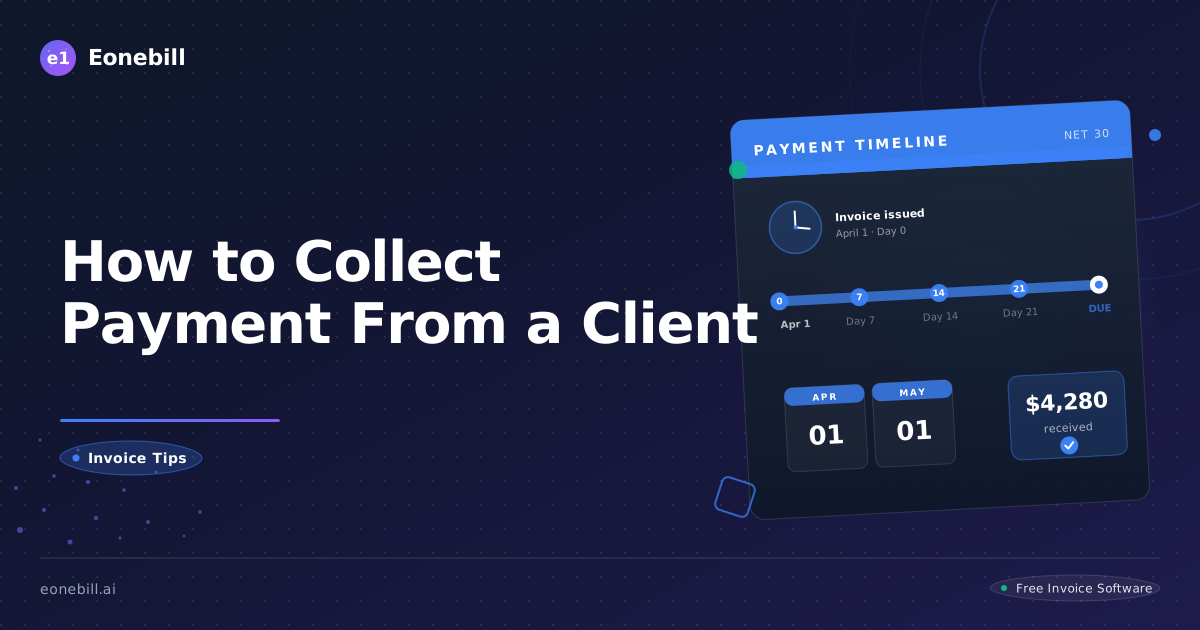
Sending an invoice is easy. Collecting on it when the client goes silent is the harder skill, and the one that separates freelancers who scrape by from those who run sustainable businesses. The good news: collection is a process, not a personality trait. With the right system, you can resolve 90 percent of slow payments without any awkwardness and the remaining 10 percent with confidence and legal backing.
This guide walks through the full collection workflow for US freelancers and small businesses. You will learn how to set up payment terms that prevent collection problems, how to follow up at each stage of overdue, how to escalate when polite reminders fail, and when to involve small claims court or a collections agency. Everything is grounded in US law and the realities of running a service business.
Prevention Beats Collection: Setting Up Terms That Get You Paid
The best collection happens before the invoice is even sent. Strong upfront terms reduce late payments by 30 to 50 percent compared to ambiguous or absent terms.
Start with a signed engagement letter or contract that specifies payment terms in writing. Include the rate (hourly or project), the payment schedule (deposit required, milestones, monthly retainer), the due date format (Net 15, Net 30, Due on Receipt), the late fee policy (1.5 percent per month is industry standard and enforceable in every US state), and the consequences of non-payment (work pauses after 30 days of nonpayment).
Require deposits for projects over $2,000. A 25 to 50 percent deposit confirms client commitment, gives you working capital, and protects you from total loss if the engagement falls apart. Bill the deposit before any work begins and wait for payment to clear before starting.
For ongoing work, require ACH auto-pay where possible. Once a client authorizes recurring ACH debit, payment becomes automatic and collection effort drops to near zero. Offer a small discount (5 to 10 percent off) as an incentive for auto-pay adoption.
State payment terms on every invoice in the same exact format every time. Include the late fee, the due date as a specific calendar day (not 'Net 30'), and the accepted payment methods with clickable links.
Finally, set realistic expectations during the kickoff call. Tell the client when invoices will be sent, when payment is expected, and what your collection process looks like if payment is late. This sets the tone of professionalism and removes any surprise from future reminders.
The Standard Follow-Up Sequence
The most effective collection sequence is a graduated set of reminders that increase in firmness as days past due grow. Here is the sequence to use.
Day minus 3 (three days before due date): friendly reminder. 'Hi Sarah, just a quick heads up that invoice INV-2026-0142 for $3,250 is due this Friday, April 11. Please let me know if there are any issues. You can pay via the link below for convenience. Thanks!' Tone: helpful, neutral, low-pressure.
Day 0 (due date): status check if not yet paid. 'Hi Sarah, wanted to confirm receipt of invoice INV-2026-0142, due today. Is everything on track for payment? Let me know if you need anything from me.' Tone: information-seeking, not demanding.
Day plus 3: late fee notification. 'Hi Sarah, invoice INV-2026-0142 is now 3 days past due. Per our engagement letter, a 1.5 percent monthly late fee began accruing on April 12. The current balance is $3,254.06. Could you let me know the expected payment date?' Tone: factual, referencing contract.
Day plus 7: escalation. CC the AP team if you have not already. 'Hi Sarah and AP team, invoice INV-2026-0142 is 7 days past due. Late fees of 1.5 percent monthly continue to accrue. Could someone please confirm the payment status? I'm available for a call if helpful.' Tone: professional, slightly firmer.
Day plus 14: pause services if applicable. 'Hi Sarah, invoice INV-2026-0142 is now 14 days past due. Per our engagement letter, work will pause on the current project effective April 25 if payment is not received. The current balance is $3,266.18. Please reach out to discuss resolution.' Tone: firm, contract-referenced.
Day plus 30: formal demand letter. Send a written letter (email and physical mail) demanding payment within 7 days, citing the contract, the late fees accrued, and the legal remedies available. Cc the company's principal contact, not just AP. Tone: serious but not threatening.
Day plus 45 to 60: legal action or collections. Small claims court (for invoices up to $5,000 to $25,000 depending on state) or a collections agency (typical fee 25 to 40 percent of collected amount). At this point you have done everything reasonable and the client has actively chosen not to pay.
Automate as much of the early sequence as possible. Eonebill.ai sends customizable reminders in your tone at each step so you never have to muster the energy to write the same email twice. Manual follow-up only kicks in at day plus 14 when human judgment matters.
How to Write Reminders That Get Responses
The wording of your reminder emails matters more than people realize. Three principles separate effective from ignored.
Principle one: ask for information, not money. 'Could you let me know the status?' gets responses where 'Please pay your invoice' gets silence. People respond better to questions than demands, especially when they feel awkward about the situation.
Principle two: reference the contract, not your emotions. 'Per our engagement letter dated January 15, late fees apply after the due date' is professional. 'I really need this money' is unprofessional, even if true. Contract language is impersonal and harder to argue with.
Principle three: make it easy to act. Include the invoice number, the amount due, the original due date, and a clickable payment link in every reminder. Reduce friction at every step. If the client has to dig for the invoice or your bank info, they will procrastinate.
Keep emails short. Three sentences max for early reminders. The longer the email, the less likely it gets read in full. Use line breaks and bullet points if you must convey multiple facts.
Never, ever send a reminder when you are angry or frustrated. Wait until you can write neutrally. An angry email creates a paper trail that hurts you if the dispute escalates to court.
Handling Common Client Excuses
Clients use a predictable set of excuses for late payment. Each has a standard response.
Excuse: 'I didn't receive the invoice.' Response: 'No problem, here's another copy attached. I also see it was sent to [email] on [date] from my system logs. Let me know once you have it queued for payment.' Always have the timestamp ready.
Excuse: 'Our AP system is delayed this month.' Response: 'Understood, thanks for the heads up. Can you give me a specific date when payment will process? I want to update my records.' Always pin down a date.
Excuse: 'We're waiting for a client to pay us first.' Response: 'I appreciate the transparency. Unfortunately, my engagement letter doesn't include a pay-when-paid clause, so the original due date stands. Can we set up a partial payment now and the balance within 14 days?' Never accept indefinite delays based on a third party.
Excuse: 'I need to dispute one of the line items.' Response: 'Happy to look at it. Can you tell me specifically which line item and what the concern is? I can revise that line and we can clear the balance on the remaining items now.' Separate disputed amounts from undisputed amounts.
Excuse: 'Cash flow is tight this month.' Response: 'I understand, and I appreciate you being direct. I can offer a payment plan: 50 percent now and 50 percent in 30 days. Late fees on the second half would be waived if the plan is honored. Would that work?' Offer structure, not unlimited extension.
Excuse: 'The check is in the mail.' Response: 'Thanks. Can you send me a tracking number or the check number so I can confirm? Or I can give you a Stripe link for faster processing if helpful.' Pin down specifics.
The pattern across all responses: be empathetic, be specific, and pin down a new date. Never accept vague reassurance.
When and How to Escalate Legally
If reminders fail after 45 to 60 days, legal escalation becomes appropriate. You have three main options.
Option one: small claims court. Every US state has a small claims process for disputes up to a certain amount (typically $5,000 to $25,000, varying by state). California allows up to $10,000 for individuals and $5,000 for businesses. New York allows up to $10,000. Texas allows up to $20,000. Filing fees are usually $30 to $100. You represent yourself; no lawyer required. The process takes 30 to 90 days from filing to judgment. Win rate for plaintiffs with clear documentation is over 80 percent.
What you need to win in small claims: the engagement letter or contract, copies of the invoices, copies of all reminder emails, proof of delivery of the work (emails, files, time logs), and your testimony. Bring printouts; courts often have limited tech. Be calm, factual, and brief. Judges decide quickly.
Option two: collections agency. Best for larger amounts ($5,000+) where small claims is impractical or the client is in a different state. Collections agencies typically charge 25 to 40 percent of collected amounts as their fee. They handle the legal threats and skip-tracing. You provide them with all documentation. The downside is they are aggressive and can damage your client relationship beyond repair; only use after you have given up on the relationship.
Option three: attorney demand letter. For amounts over $10,000 where the client is a real company with assets, an attorney's letter on letterhead often produces payment within 30 days. Cost: $200 to $500 for the letter. If the letter does not produce payment, the attorney can file a civil suit, which is expensive ($5,000 to $25,000 in fees) but appropriate for very large unpaid amounts.
Before any legal escalation, run a quick cost-benefit analysis. Filing fees, your time, and the emotional cost of conflict can exceed the amount owed if the dispute is under $1,000. Sometimes writing off a bad debt and moving on is the right business decision. Use legal action selectively, when the amount justifies it and the client clearly has the ability to pay.
Tools and Habits for Cash Flow Stability
The ultimate goal is to make collection rare. Build the habits and tools that prevent slow payment from happening in the first place.
Habit one: invoice the same day work is completed or on a fixed schedule. Predictable invoicing trains clients to expect and prioritize your bills.
Habit two: track aging receivables weekly. Know exactly which invoices are due in the next 14 days, which are 1 to 30 days late, and which are 30+ days late. Knowledge is power; surprises kill cash flow.
Habit three: maintain a 3-month operating reserve. Calculate your monthly minimum (rent, food, insurance, software, taxes) and keep 3 times that amount in a high-yield savings account. This buffer eliminates the panic of a late invoice.
Habit four: diversify clients. No single client should represent more than 30 percent of your revenue. When one client goes slow on payment, the others keep your cash flowing.
Habit five: automate everything possible. Recurring invoices, automatic reminders, payment processing, and aging reports. Eonebill.ai handles all of this and provides a clean dashboard so you always know your collections status at a glance.
Ready to make collection effortless? Try the free invoice generator at /free-tools/invoice-generator and upgrade to a paid plan at /pricing for full automation including reminder sequences, payment retries, and aging dashboards. The goal is not to be a better collector; it is to need to collect less often. Eonebill.ai helps you get there.
One more strategic frame: every collection conversation is also a relationship audit. Clients who pay on time, communicate proactively, and respect your terms are clients you want to keep. Clients who chronically pay late, make excuses, and resist your standard processes are signaling that the relationship is unhealthy. The collection process surfaces these signals; pay attention.
After resolving a late payment situation, do a post-mortem. Was the client's behavior an exception (genuine cash flow event, communication gap, system error) or a pattern (consistent slow pay across multiple invoices)? Exceptions deserve grace; patterns deserve hard conversations. For clients in the pattern category, decide whether the revenue is worth the stress and the cash flow drag. Sometimes the right answer is to gracefully end the engagement and replace the client with one who pays cleanly.
Finally, share what you learn. The freelance community benefits from shared knowledge about good and bad payers. Without naming specific clients publicly, talk with peers about industries, company sizes, or red flags that correlate with late payment. Build collective intelligence so newer freelancers can avoid the worst clients early. The collection skills you build in year one and year two compound for the rest of your career. Master them, and cash flow stops being a source of stress and becomes a managed system.
Create this in 30 seconds — free invoice with Eonebill, no sign-up required.
Create Free Invoice →Frequently Asked Questions
More Posts
Filing Taxes Late: Penalties, Extensions, and How to Catch Up (2026)
Missed the April deadline? Understand the 5 percent failure-to-file vs 0.5 percent failure-to-pay penalty difference, how Form 4868 extensions help, and the four-step protocol for catching up on years of unfiled returns.
Penalties for Not Filing a 1099: What Freelancers and Small Businesses Need to Know (2026)
Failing to file 1099 forms on time triggers escalating IRS penalties from 60 to 660 dollars per form. Learn the four-tier schedule, how to fix a missed filing, and when First-Time Penalty Abatement applies.
How to Write a Gentle Reminder Email (Templates + Examples)
Learn how to write a professional gentle reminder email that gets results. Includes 8 ready-to-use templates for invoices, meetings, deadlines, and more.
Newsletter
Join the community
Subscribe to our newsletter for the latest news and updates