How to Bill a Client Professionally
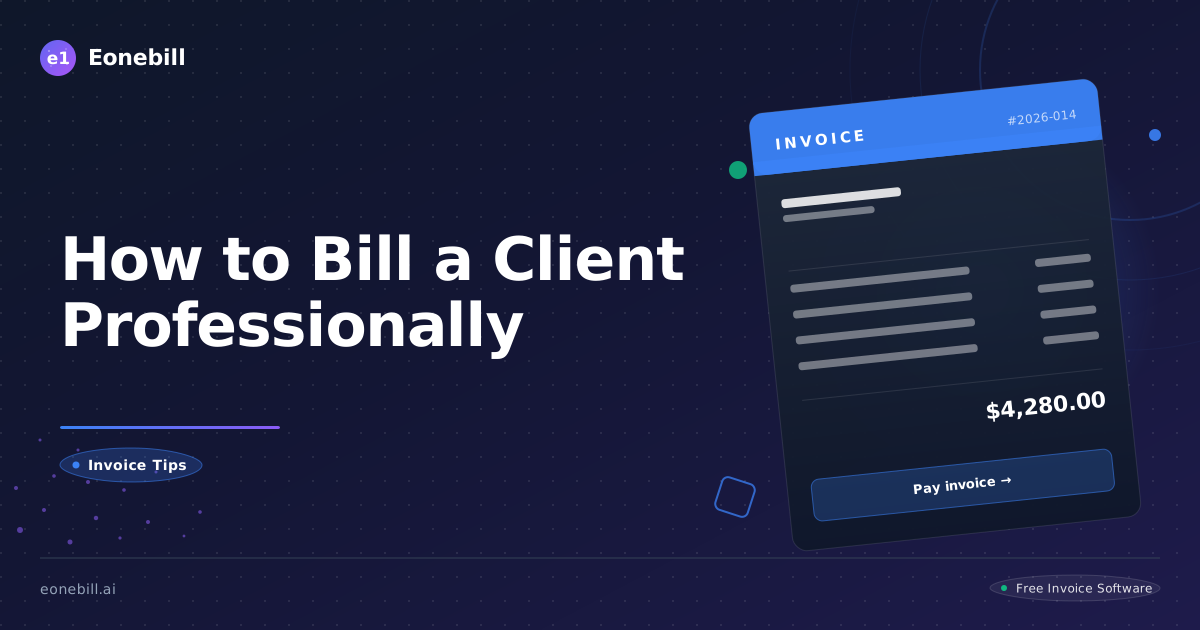
Billing a client should feel as professional and natural as delivering the work itself. Yet for many freelancers and small business owners, sending an invoice triggers anxiety about how to phrase it, when to send it, and how to follow up. The truth is that billing is a craft you can learn in an afternoon and refine over a career.
This guide walks through the complete client billing process, from the moment a project ends to the moment cash lands in your account. You will learn what to include, how to structure rates, how to set payment terms, how to deliver the invoice, and how to politely but firmly follow up when payment is late. Everything here is built for US-based service businesses.
When to Send the Invoice
Timing is the most undervalued aspect of billing. The longer you wait to invoice, the longer you wait to be paid, and the more likely you are to forget billable details.
For project-based work, invoice the day the project is delivered. Not the next day, not Monday, not after you have decompressed. Same day. Studies consistently show that invoices sent within 24 hours of work completion are paid 1.5 times faster than those sent 7 days later. The reason is psychological: the client's perception of value is highest immediately after delivery, and the work is fresh in their mind.
For retainer or recurring work, invoice on the same day every period. The 1st of the month or the last business day of the month are the two most common cadences. Predictability trains your client's accounts payable system to expect and prioritize your invoice.
For milestone-based work on larger projects, invoice the moment a milestone is approved. Do not wait for the next milestone to bundle multiple together unless your contract explicitly requires it. Each completed milestone deserves its own invoice and its own payment.
The one exception: never invoice on a Friday afternoon if you can avoid it. Accounts payable teams in the US typically run their pay cycles on Mondays and Tuesdays, so a Friday invoice often waits until the following week to even enter the queue.
Anatomy of a Professional Invoice
A professional invoice contains exactly the right information in exactly the right places. Too little and the client has to chase you with questions. Too much and the invoice looks cluttered.
Start with a clean header: your business name, address, phone, email, and either your EIN or 'EIN on file' if you have already provided a W-9. Below that, the client's full legal business name and billing address. Include 'Attn: Accounts Payable' or the specific AP contact name if you have one.
In the upper right or center, prominently display the invoice number, issue date, and due date. Use a unique sequential numbering system like INV-2026-0142 so each invoice is traceable. Spell out the due date as a specific calendar day, not 'Net 30,' to remove all ambiguity.
The line items section is the heart of the invoice. Use columns for Date, Description, Quantity, Rate, and Amount. Descriptions should be specific enough to remind the client what was done. 'Branding work' is bad. 'Logo design: 3 concepts, 2 revision rounds, final files in 4 formats' is excellent.
Below the line items: subtotal, any applicable sales tax (most US states do not tax services, but check your state), any discounts, and the total due. Then payment terms (Net 15, Net 30, or other), late fee policy (1.5 percent per month is standard and enforceable), and accepted payment methods with clickable links or wire instructions.
Close with a short, warm thank-you sentence. 'Thank you for the opportunity to work on this project. Looking forward to the next one.' This small gesture distinguishes professionals from vendors.
Setting Payment Terms That Get You Paid
Your payment terms are a contract within a contract. Choose them deliberately based on your cash flow needs, your client's standard cycle, and the size of the engagement.
Net 15 is ideal for small invoices and ongoing service relationships. It signals you expect prompt payment and matches the cadence of most small business cash flow.
Net 30 is the US business standard. Most corporate accounts payable systems are built around Net 30 cycles. If your client is a Fortune 1000 company, expect Net 30 or even Net 45 to be the minimum. Pushing for Net 15 with a large enterprise rarely succeeds and may signal inexperience.
Due on Receipt is appropriate for one-time work where you have not established a relationship, or for clients with a history of late payment. Be aware that 'Due on Receipt' often gets interpreted as 'pay within 10 days' by accounts payable teams, so do not expect literal same-day payment.
2/10 Net 30 is a powerful early payment discount: the client gets 2 percent off if they pay within 10 days, otherwise the full amount is due in 30. On a $5,000 invoice, the discount is $100, often well worth it for the cash flow boost.
Late fees are not optional aggression; they are standard business practice. Include a clear line such as 'Past due balances accrue interest at 1.5 percent per month (18 percent APR).' This is enforceable in every US state when stated on the invoice and accepted via continued business relationship. Most clients pay on time when they see a late fee policy because they know enforcement is real.
How to Deliver the Invoice
Delivery method matters more than people realize. The wrong delivery channel can delay payment by a week or more.
Email is the universal default. Send the invoice as a PDF attachment, not as a body of text, and not as a link to a portal that requires a login. The PDF must be openable on any device. In the email body, include a one-paragraph summary: 'Hi Sarah, attached is invoice INV-2026-0142 for the March website refresh work, totaling $3,250 and due April 11. Please let me know if you have any questions. You can pay via ACH or credit card using the link below.'
Always CC the accounts payable team if the client has one. Many of your day-to-day project contacts are not the same person who pays bills, and sending only to your contact adds 3 to 7 days of internal forwarding delay.
For large enterprise clients, ask in advance whether they require submission through a vendor portal like Coupa, SAP Ariba, or Bill.com. Submitting via portal is often non-negotiable for Fortune 500 companies, and email invoices to these clients are simply ignored.
If your client is government or institutional, you may need to mail a paper invoice in addition to or instead of email. Confirm requirements during contract signing, not after the work is done.
Polite, Effective Follow-Up
Around 30 percent of US business invoices are paid late. Following up is not pushy; it is part of professional practice. The key is tone and timing.
Three days before the due date, send a courtesy reminder. 'Hi Sarah, just a quick reminder that invoice INV-2026-0142 for $3,250 is due this Friday, April 11. Please let me know if there are any issues. Payment link below for convenience.'
On the due date if unpaid, send a neutral status check. 'Hi Sarah, I wanted to confirm receipt of invoice INV-2026-0142. Is everything on track for payment today?' Notice you are asking for information, not demanding payment.
Three days past due, send a slightly firmer note that mentions the late fee. 'Hi Sarah, invoice INV-2026-0142 is now 3 days past due. Per our terms, a 1.5 percent monthly late fee began accruing on April 12. Could you let me know the status?'
Fourteen days past due, escalate. CC the AP team if you have not already. Send a formal email referencing the engagement letter and stating that work will pause if not resolved within 7 more days.
Thirty days past due, send a final demand with a specific deadline. After 45 to 60 days, consider small claims court (jurisdiction up to $5,000 to $25,000 depending on state) or a collections agency.
Automate as much of this as possible. Eonebill.ai sends customizable reminders on your behalf, in your tone, at intervals you choose, so you never have to muster the energy to write the same email twice.
Tools That Make Billing Effortless
The right tool transforms billing from a Sunday-night chore into a 5-minute task. Look for these features when choosing software.
Client profiles that remember contact details, billing address, payment terms, and tax settings, so you do not retype them each invoice. Recurring invoice automation that sends monthly retainers without manual effort. Multiple payment methods built in: ACH (free), credit cards via Stripe (2.9 percent plus 30 cents), and PayPal (3.49 percent plus 49 cents). Automated reminders before and after the due date. Real-time payment status so you know the moment a client pays without checking your bank account. PDF generation that produces clean, branded invoices automatically. Reporting that shows your aging accounts receivable, average days to pay, and revenue by client.
For a free starting point, try the invoice generator at /free-tools/invoice-generator. It produces a clean, branded PDF in under two minutes. When you are ready for recurring invoices, reminders, and integrated payments, upgrade to a paid plan at /pricing. Eonebill.ai was built specifically for service businesses that want to invoice like a Fortune 500 finance department without hiring one.
Professional billing is a habit that compounds. Each well-timed, well-formatted invoice trains your clients to pay you faster and respects the work you do. Start today.
One underrated practice: review your invoicing process quarterly. Pull your last 90 days of invoices and ask three questions. First, what was the average days-to-pay across all clients? If it is above 25, your terms or follow-up cadence need tightening. Second, which clients consistently pay late? Are they worth the friction? Third, were there any disputes? What caused them, and how do you prevent the same dispute from recurring?
Document lessons learned in a simple 'invoicing playbook' for your business. The playbook captures your standard rates, terms, follow-up sequences, escalation paths, and notes about specific clients (which AP contact to CC, which payment method they prefer, which day of the month their cycle runs). After six months, this playbook becomes the most valuable operations document in your business.
Finally, treat invoicing as a brand touchpoint, not a back-office task. Every invoice your client receives is a moment they form an opinion about working with you. A beautifully formatted invoice, sent on time, with clear payment options and a warm thank-you, signals that you are organized, professional, and worth recommending. A typo-ridden, generic invoice sent late signals the opposite. Your invoice is your last word to your client at the end of each month. Make it a strong one.
For freelancers managing multiple clients, build a 'billing dashboard' that shows three numbers at a glance: total invoiced this month, total collected this month, and current accounts receivable. These three numbers, reviewed every Monday morning, tell you the health of your cash flow without requiring deep analysis. Tools like Eonebill.ai surface these metrics automatically. When the receivables number grows faster than collections, you have early warning to tighten follow-up before the situation becomes critical.
Finally, remember that great billing is a competitive advantage, not just a back-office function. Clients notice when invoices arrive on time, are formatted cleanly, and are easy to pay. Over a multi-year engagement, professional billing reinforces every other aspect of the relationship. A freelancer who delivers strong work but invoices sloppily is judged on the sloppiness; a freelancer who delivers strong work and invoices flawlessly is judged on the work. Make your billing operations a quiet but consistent signal of overall excellence. Operational excellence in billing is rarely flashy, but it pays the bills (literally) and protects every other part of your business from chaos.
Build the habits early, refine them quarterly, and within 3 years you will have a billing system that runs almost without thought, freeing your attention for the creative or strategic work that actually moves your business forward.
Create this in 30 seconds — free invoice with Eonebill, no sign-up required.
Create Free Invoice →Frequently Asked Questions
More Posts
Filing Taxes Late: Penalties, Extensions, and How to Catch Up (2026)
Missed the April deadline? Understand the 5 percent failure-to-file vs 0.5 percent failure-to-pay penalty difference, how Form 4868 extensions help, and the four-step protocol for catching up on years of unfiled returns.
Penalties for Not Filing a 1099: What Freelancers and Small Businesses Need to Know (2026)
Failing to file 1099 forms on time triggers escalating IRS penalties from 60 to 660 dollars per form. Learn the four-tier schedule, how to fix a missed filing, and when First-Time Penalty Abatement applies.

How to Write a Gentle Reminder Email (Templates + Examples)
Learn how to write a professional gentle reminder email that gets results. Includes 8 ready-to-use templates for invoices, meetings, deadlines, and more.
Newsletter
Join the community
Subscribe to our newsletter for the latest news and updates