Payment Terms for Freelancers — Net 30, Deposits & Late Fee Guide
Complete guide to freelancer payment terms: Net 15 vs Net 30, deposit strategies, late fee policies, and how to get paid faster.
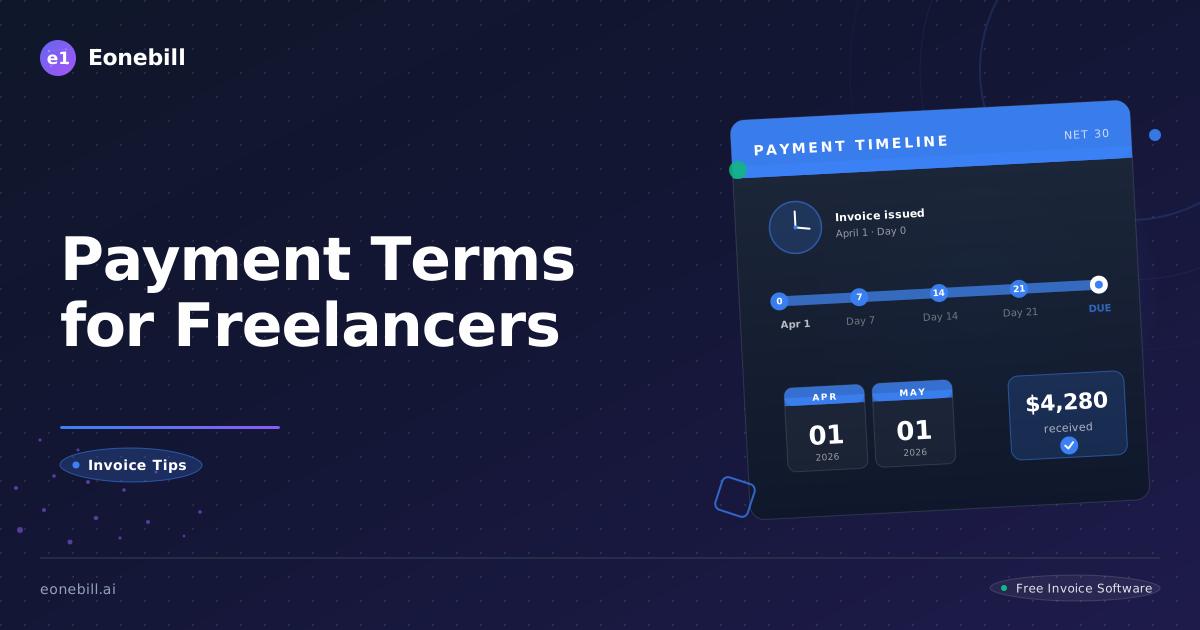
Payment terms are the conditions under which you'll be paid — how much, when, and what happens if the client doesn't pay on time. They are not optional paperwork. They are the rules of the game. Without them, you're running a business on handshake deals and optimism.
For US freelancers and independent contractors, payment terms determine your cash flow, your legal standing when disputes arise, and whether you spend your time doing billable work or chasing checks.
Understanding Payment Terms
The most common payment terms in US freelance contracts are expressed as "Net [number]" — meaning payment is due within that many days of the invoice date.
Net 15
Payment due in 15 days. Use when:
- You have an established, reliable relationship with the client
- Your project or retainer is smaller and recurring
- You need faster cash flow (e.g., you're billing weekly or bi-weekly)
- The client's standard accounts payable cycle is short
Best for: Recurring monthly retainers, small project engagements, clients you trust completely.
Net 30
Payment due in 30 days. This is the US standard for B2B and freelance services. Use when:
- You're working on a standard project engagement
- The client is a mid-size company with a formal accounts payable process
- You're new to the client relationship
Best for: The majority of freelance engagements. Most corporate AP departments run on Net 30 cycles.
Net 60
Payment due in 60 days. Use when:
- The client is a large enterprise or government entity (their AP cycles are notoriously slow)
- The project spans multiple months and milestones
- You've negotiated this as part of a larger contract
Caution: Net 60 is brutal on cash flow. Only accept it if your operating expenses can sustain 60-day payment cycles, or if you've negotiated a higher rate to compensate for the delay.
Net 90
Rare, but sometimes used in government contracts or very large enterprise deals. Cash flow here requires careful planning and potentially an invoice factoring arrangement.
Key rule: Always agree on payment terms before starting work. Once the project is done and you're invoicing, you have far less leverage.
Deposit Strategies
A deposit (also called a down payment or upfront payment) protects you from scope creep, project cancellations, and non-payment. Here's how to structure it:
25% Deposit
The minimum reasonable deposit for a new client. Covers your initial costs (research, planning, first deliverables) and demonstrates client commitment.
When to use: Established clients on larger projects, repeat engagements, when the project has clear scope.
50% Deposit
The industry standard for most freelance projects. Cuts your financial exposure in half and ensures the client has real skin in the game.
When to use: New clients, custom creative work, projects with any scope ambiguity, anything over $5,000.
Milestone-Based Payments
For large projects ($20,000+), structure payments in phases tied to deliverables. This reduces risk for both parties.
Example structure:
- 25% upon project start
- 25% upon completion of Phase 2 (midpoint)
- 50% upon final delivery and client sign-off
When to use: Large projects, custom product development, multi-phase campaigns, client relationships you're still building trust with.
No Deposit Situations
Some contexts make deposits difficult — highly transactional work, platform-based freelancing (Upwork, Fiverr), or trusted long-term clients with a perfect payment history. In these cases, rely on strong payment terms and automatic reminders to protect yourself.
Late Fee Policies
A late fee policy is your most effective tool for getting paid on time. Without one, clients have zero financial incentive to prioritize your invoice over their other bills.
- 1% per month: Conservative, client-friendly. Better for long-term relationships you're protecting.
- 1.5% per month: Industry standard for a reason. Signals you're serious about getting paid.
State Law Considerations
Late fee rules vary by state:
- New York: 0.5% per month maximum for commercial transactions unless contract specifies otherwise
- California: No statutory maximum, but courts may reduce unconscionably high fees
- Most states: 1-1.5% is universally upheld as commercially reasonable
Always include your late fee policy in the original invoice or contract. You cannot retroactively apply late fees that were never disclosed.
> "Payment is due within 30 days of the invoice date. A late fee of 1.5% per month (18% annual) applies to all overdue balances. Client is responsible for any collection costs, including reasonable attorney fees."
Follow-Up Email Templates
Structure your payment follow-up in three stages — friendly, firm, final. Here are three ready-to-use templates:
Template 1: Friendly Reminder (Day 7)
Subject: Quick reminder — Invoice [#] is due [date]
> Hi [Client Name],
>
> I hope this finds you well. Just a friendly reminder that Invoice [#] for $[amount] is due on [date]. If you've already sent payment, feel free to ignore this — and thank you!
>
> If you have any questions about the invoice or need any additional documentation, just let me know.
>
> Looking forward to hearing from you.
>
> Best,
> [Your Name]
Template 2: Firm Reminder (Day 14)
Subject: Invoice [#] is overdue — Please remit payment
> Hi [Client Name],
>
> I wanted to follow up on Invoice [#] ([amount]), which was due [date] — that's now [number] days overdue.
>
> Per our payment terms, a late fee of [X%] now applies to this balance. To avoid additional charges, please prioritize this payment at your earliest convenience.
>
> If there's an issue with the invoice or the work delivered, I'd welcome the chance to resolve it quickly. I'm here if you need to connect.
>
> Thank you,
> [Your Name]
Template 3: Final Notice (Day 30)
Subject: FINAL NOTICE — Invoice [#] overdue, payment required within 7 days
> Dear [Client Name],
>
> Invoice [#] for $[amount] remains unpaid. Despite previous reminders, we have not received payment or any communication regarding this balance.
>
> This is your final notice. Payment must be received within 7 days of this email to avoid the following:
>
> - Late fees of [X%] per month going forward
> - Suspension of any ongoing services
> - Referral to a collections agency
> - Potential legal action to recover the owed amount, including court costs and attorney fees
>
> If payment is not received by [date], we will proceed with collections.
>
> Please contact us immediately if you are experiencing financial difficulties or dispute this invoice.
>
> Regards,
> [Your Name]
How to Enforce Payment Terms
Enforcement is easier when you've set clear terms from the start. Here's how to protect yourself legally and practically:
1. Put Everything in Writing
A verbal agreement is nearly unenforceable. Before starting work, send a brief written contract or Statement of Work (SOW) that includes:
- Scope of work
- Payment amount and schedule
- Payment terms (Net 15/30/etc.)
- Late fee policy
- Kill fee / cancellation policy
- Revision limits
Eonebill's proposal tool includes built-in terms templates that cover all of this.
2. Use a Tool That Tracks and Reminds Automatically
Don't rely on yourself to remember to follow up. Eonebill automatically sends reminders at 7, 14, and 30 days — without you lifting a finger. This removes the emotional awkwardness of chasing money and keeps your follow-ups professional and consistent.
3. Know When to Escalate
If a client ignores multiple reminders:
- Day 30: Final notice with a 7-day deadline and collections warning
- Day 37+: Consider small claims court (for amounts under your state's limit, typically $3,000-$10,000), a demand letter from an attorney, or a collections agency
Prevention is always cheaper than enforcement. Vet clients before taking on large projects — check references, look at payment terms in their standard contracts, and don't be afraid to require a 50% deposit.
Getting Paid Faster — 10 Proven Strategies
These strategies work. Pick the ones that fit your client type and business model.
- Require deposits (25-50%). Money upfront aligns incentives and reduces your exposure.
- Invoice immediately upon delivery. Don't wait until end of week. The faster you invoice, the faster the clock starts.
- Use Net 15 instead of Net 30. If you're not getting paid faster, it's because clients aren't prioritizing you — shorter terms can help.
- Offer a 2% discount for same-week payment. "2/10 Net 30" (2% discount if paid within 10 days) is standard in many industries and can dramatically accelerate payment.
- Accept credit cards and ACH. Friction kills payment speed. If paying you requires a wire transfer, some clients will拖延.
- Send automatic reminders. Don't chase manually. Eonebill sends them for you.
- Make it easy to find and pay your invoice. Use clear subject lines, direct payment links, and simple formatting.
- Offer multiple payment methods. ACH, credit card, PayPal, Stripe — the more options, the better.
- Tie payment to milestones, not project completion. If a project has phases, invoice at each phase. Getting 50% at midpoint means you're not waiting until the very end for most of your money.
- Build repeat-client payment habits. If a client consistently pays late, switch them to shorter terms or require prepayment for the next engagement. Reward on-time payers with goodwill and continued quality.
Eonebill's invoicing platform handles the entire payment cycle:
- Automatic reminders at 7, 14, and 30 days — no manual chasing
- Built-in late fee calculation applied automatically to overdue invoices
- Multiple payment acceptance including ACH and credit card
- Milestone tracking for phased projects
- Payment status dashboard so you always know who owes what
Get started with Eonebill — free for 14 days →
Stop wasting hours on payment follow-up. Eonebill handles the reminders, the math, and the paper trail — so you can focus on the work that pays.
Ready to manage invoices, contracts & proposals in one place? Try Eonebill free — no credit card required.
Start Free →Frequently Asked Questions
More Posts
Filing Taxes Late: Penalties, Extensions, and How to Catch Up (2026)
Missed the April deadline? Understand the 5 percent failure-to-file vs 0.5 percent failure-to-pay penalty difference, how Form 4868 extensions help, and the four-step protocol for catching up on years of unfiled returns.
Penalties for Not Filing a 1099: What Freelancers and Small Businesses Need to Know (2026)
Failing to file 1099 forms on time triggers escalating IRS penalties from 60 to 660 dollars per form. Learn the four-tier schedule, how to fix a missed filing, and when First-Time Penalty Abatement applies.
How to Write a Gentle Reminder Email (Templates + Examples)
Learn how to write a professional gentle reminder email that gets results. Includes 8 ready-to-use templates for invoices, meetings, deadlines, and more.
Newsletter
Join the community
Subscribe to our newsletter for the latest news and updates
Ready to streamline your freelance workflow?