Best Free Wave Accounting Alternative 2026
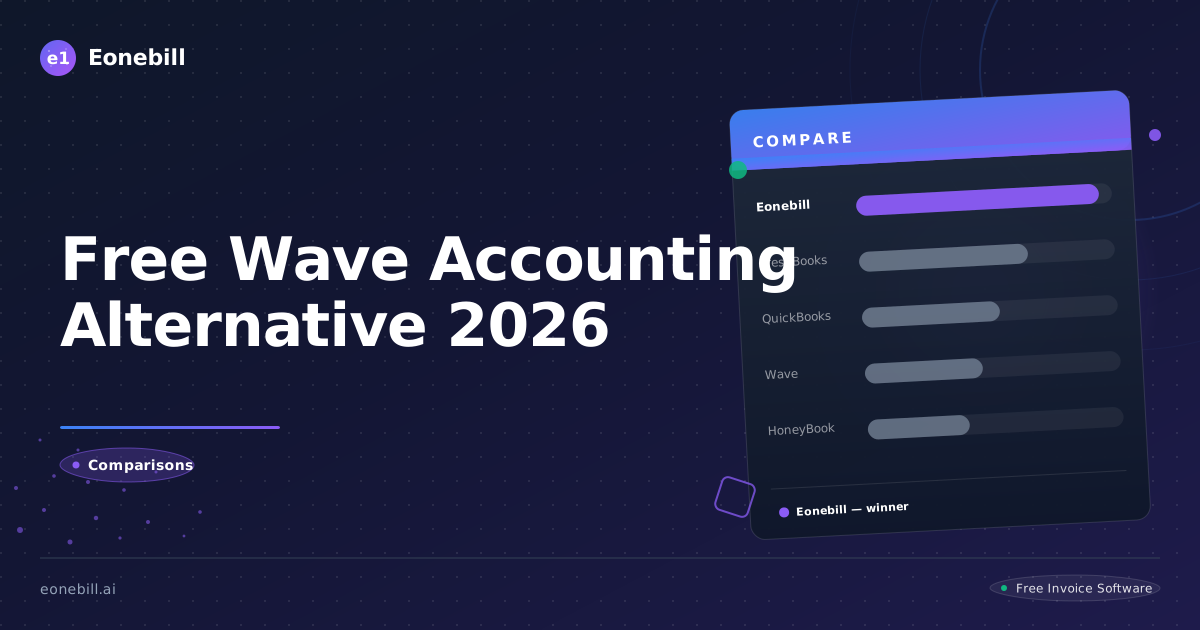
Best Free Wave Accounting Alternative 2026
Wave has been a beloved free invoicing and accounting tool for more than a decade. It earned a loyal following by offering genuinely free invoicing, full double-entry accounting, and receipt scanning at zero cost — a remarkable value proposition supported by payment processing fees and an optional paid payroll module. For many years, Wave was the obvious answer when a freelancer asked, "What's a good free invoicing tool?"
But the market has evolved. Wave was acquired by H&R Block in 2019, the product roadmap has slowed, and AI-native competitors have arrived with significantly more modern user experiences. If you're looking for a Wave alternative in 2026, this guide compares your real options and helps you decide what fits your business best.
What Wave Still Does Well
It's worth acknowledging upfront: Wave is a solid product, especially for the price (free). The invoice and estimate creation flow is reliable. The double-entry accounting engine is fully functional and includes a chart of accounts, P&L reports, balance sheets, and journal entries — features many paid tools charge $30+/month for. Receipt scanning works adequately. The platform connects to bank feeds for automatic transaction import.
Wave also has a long track record. The platform has been operating since 2010 and has handled tens of millions of invoices. The infrastructure is reliable, and the data export options are clean.
The critical caveat: Wave's pace of innovation has slowed since the H&R Block acquisition. The mobile app was discontinued in some regions and re-launched with reduced features. AI-driven workflows are minimal. The UI feels increasingly dated compared to newer tools. Customer support on the free plan is email-only and response times can be slow.
If those trade-offs don't bother you and the free price tag is the dominant factor, Wave remains a perfectly viable choice. If you want a more modern user experience or AI-assisted workflows, alternatives are worth considering.
Top Free Wave Alternatives
Eonebill.ai is the leading AI-first alternative for US freelancers and small business owners. The platform uses AI to draft invoices from natural-language prompts, suggest line items based on past work, and surface insights about your billing patterns. The free tier covers solo freelancer volumes comfortably. The trade-off versus Wave is depth of double-entry accounting — Eonebill focuses on invoicing, payment tracking, and Schedule C-friendly exports rather than a full general ledger. If you don't need a balance sheet, Eonebill is faster and more modern. If you do, you'll want to pair it with a bookkeeping tool or hire a bookkeeper.
Zoho Invoice is free for up to 1,000 invoices/year (effectively unlimited for most freelancers). The UI is modern and clean, the mobile apps are well-built, and the integration with Zoho's broader CRM and project tools is a plus. The trade-off: the free Zoho Invoice tier is invoicing-focused; full accounting requires Zoho Books, which is a paid product. For pure invoicing, Zoho Invoice is one of the strongest free options.
Square Invoices is free with no caps. It excels for freelancers who already use Square for in-person payments and want unified reporting. Card processing is at standard rates (2.6% + $0.30 in 2026). The trade-off: it's optimized for retail-style invoicing rather than service businesses, with limited project tracking and time entry.
PayPal Invoicing is free to use (you pay only PayPal's processing fees, around 3.49% + $0.49 for commercial transactions). It's barebones but functional. The trade-off: weak reporting and dated branding options.
Invoice Ninja has a free self-hosted version (Invoice Ninja open source) and a paid hosted version starting around $10/month. It's powerful for those willing to manage a server or pay for hosting. The trade-off: setup complexity is higher than the cloud-native options.
Side-by-Side: Feature Comparison
Let's compare the most relevant dimensions for solo freelancers and small businesses.
Free invoice volume. Wave: unlimited. Eonebill.ai: generous free-tier cap, designed to cover solo freelancers. Zoho Invoice: 1,000/year. Square: unlimited. PayPal: unlimited.
Double-entry accounting. Wave: yes, full double-entry. Eonebill.ai: focused on invoicing rather than GL. Zoho Invoice: invoicing-only on free tier. Square: minimal accounting. PayPal: minimal.
AI invoice creation. Wave: minimal. Eonebill.ai: AI-first design, natural-language invoice drafting. Zoho: limited. Square: limited. PayPal: limited.
Mobile app. Wave: functional but inconsistent. Eonebill.ai: responsive web works well on mobile. Zoho: solid native apps. Square: excellent. PayPal: solid for invoicing.
Bank feed integration. Wave: yes, for transaction import. Eonebill.ai: integrations available via payment processors. Zoho Invoice: limited on free tier. Square: yes. PayPal: yes for PayPal transactions.
Receipt scanning. Wave: yes. Eonebill.ai: focus is invoicing rather than expense management. Zoho: yes (Zoho Expense). Square: yes via the Square app. PayPal: limited.
User interface modernity. Wave: dated. Eonebill.ai: modern, AI-native. Zoho: modern. Square: very modern. PayPal: dated.
Customer support. Wave: email-only on free tier. Eonebill.ai: email and chat. Zoho: email and chat. Square: phone and email. PayPal: phone and email.
Migrating Off Wave
If you decide to move from Wave, here's the painless playbook.
Export your data. Wave allows CSV export of clients, invoices, transactions, and reports. Go to Settings, find the Export menu, and download everything. Store the files in a backup folder labeled "Wave Archive [Year]." Even if you don't import all of it into your new tool, you'll have the records for tax purposes and audit defense (keep for at least four years).
For invoices, exporting individual PDFs is also worthwhile. Wave generates PDF invoices that look identical to what your clients received. Store these by client and by year.
For transaction data (bank feeds, expense categorization), you'll need to decide whether to import into the new system or treat the Wave archive as historical and start fresh. For most freelancers switching mid-year, starting fresh on the new system from a specific cutoff date (often January 1 or the start of the current quarter) is cleanest.
Set up the new platform in parallel for a month. Continue sending invoices from Wave while you onboard the new tool. Once the new tool is running smoothly, cut over fully at the next month-end. Cancel any Wave paid add-ons (Payroll, Advisors) you no longer need.
For accountants and bookkeepers, give them advance notice. If your bookkeeper is comfortable with Wave, ask what they'd prefer you switch to. Many bookkeepers happily work with CSV exports from any tool.
When to Stick with Wave
Wave is still the right answer for some freelancers. If you're highly price-sensitive (every dollar matters) and you need full double-entry accounting in a free tool, Wave is unmatched. The free tier includes features that Eonebill.ai, Zoho Invoice, and Square treat as paid add-ons or don't offer at all.
If your bookkeeper or accountant is fluent in Wave, switching costs you their learning curve. Bookkeeper time can be expensive — keeping them on familiar software often pencils out.
If you have a multi-year history of transactions in Wave and the workflow is dialed in, the migration cost is high. The status quo has real value when it's working.
If you don't need AI assistance and value stability over innovation, Wave delivers exactly that. Some freelancers don't want a tool that's constantly updating; they want a tool that does the same thing reliably year after year. Wave fits.
When to Switch
If any of these apply, switching to a Wave alternative makes sense.
You want AI-assisted invoicing. Drafting an invoice in 15 seconds from a sentence-long prompt is genuinely useful. Eonebill.ai leads here. Wave has not made meaningful AI investments yet.
You rely heavily on mobile. The Wave mobile app has been inconsistent. Eonebill.ai's mobile-responsive design, Zoho's native apps, and Square's mobile app are all stronger.
You bill primarily B2B and want professional, modern invoice branding. Wave's templates feel dated. Eonebill.ai and Zoho both produce cleaner, more contemporary designs.
You're starting fresh. No reason to inherit Wave's legacy patterns if you don't have to. Pick a modern tool from day one.
You want strong customer support without paying a subscription. Phone support on Wave's free plan is unavailable. Square and PayPal offer phone support without a paid plan.
For a quick test, try the free invoice generator at /free-tools/invoice-generator. Create a sample invoice in under two minutes and see how it compares to your typical Wave invoice flow. For full plan comparison, see /pricing.
Bottom line: Wave was the pioneer of free invoicing and remains a solid choice, but the market has moved. If AI-assisted workflows, modern UX, or mobile excellence matter to you, you have better options today than you did three years ago. Evaluate the alternatives honestly, migrate carefully if you decide to switch, and don't let inertia keep you on a tool that's no longer the best fit.
A final point worth making: the cost of switching tools is not just time. There's a psychological cost too — learning new keyboard shortcuts, internalizing new menus, retraining your fingers. Most freelancers underestimate this. Plan for a month of slightly slower workflow after switching as you build muscle memory in the new tool. After that month, the new tool typically feels faster than the old one, especially if you've switched to a modern AI-assisted platform like Eonebill.ai. The break-even point is usually 4-8 weeks of regular use. Stick with the new tool through that period before judging whether the switch was worth it. Quitting after a week typically means you reverted to old habits before the new tool had a chance to demonstrate its value. Many freelancers who tried newer tools and went back to Wave actually didn't give the new tool enough time. If you commit to switching, commit for at least two months. After 60 days of regular use, you'll have a clear-eyed view of whether the new tool actually serves you better. Then decide. Most who give it the full evaluation period don't go back. Migrate deliberately, evaluate honestly, and trust your assessment after a fair trial period.
Closing thought on the Wave-replacement decision: don't switch tools just because something newer exists. Switch when the new tool meaningfully improves your workflow. The cost of switching is real (4-8 hours of setup, a month of slightly slower work), and many freelancers switch tools every year chasing the latest thing without ever giving any tool a fair evaluation. Pick a tool, commit to it for at least 12 months, dial in your workflow, and only re-evaluate after that period. Tool-hopping is its own form of procrastination — the freelancers who win are the ones who pick a stack, get good at it, and focus their attention on client work rather than tool evaluation.
A final thought on Wave's competitive position: even with the slowdown post-acquisition, Wave remains one of the most generous free tools in the small-business software space. The free tier truly is free, and the platform handles tens of millions of invoices reliably. If you're already on Wave and the platform is meeting your needs, there's no urgency to switch. The case for switching is real but situational. Evaluate honestly — do you actually use Wave's accounting features beyond invoicing, or are they just there in case you need them? If they're unused, a more focused tool like Eonebill.ai may serve you better. If they're actively useful, Wave's free full-accounting offering is hard to beat. Make the decision based on actual usage patterns, not theoretical feature sets.
Ready to manage invoices, contracts & proposals in one place? Try Eonebill free — no credit card required.
Start Free →Frequently Asked Questions
More Posts
Filing Taxes Late: Penalties, Extensions, and How to Catch Up (2026)
Missed the April deadline? Understand the 5 percent failure-to-file vs 0.5 percent failure-to-pay penalty difference, how Form 4868 extensions help, and the four-step protocol for catching up on years of unfiled returns.
Penalties for Not Filing a 1099: What Freelancers and Small Businesses Need to Know (2026)
Failing to file 1099 forms on time triggers escalating IRS penalties from 60 to 660 dollars per form. Learn the four-tier schedule, how to fix a missed filing, and when First-Time Penalty Abatement applies.
How to Write a Gentle Reminder Email (Templates + Examples)
Learn how to write a professional gentle reminder email that gets results. Includes 8 ready-to-use templates for invoices, meetings, deadlines, and more.
Newsletter
Join the community
Subscribe to our newsletter for the latest news and updates