Create Free Paycheck Stubs Online — No Signup
Create Free Paycheck Stubs Online — No Signup
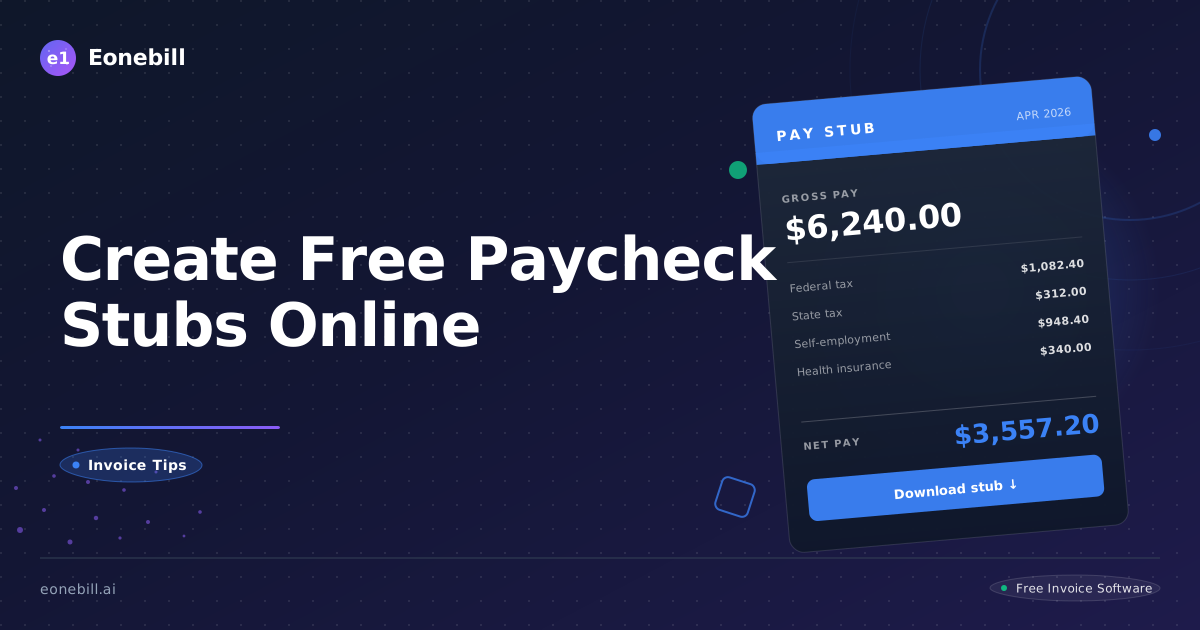
Generating a professional paycheck stub should not require a software contract, a credit card, or hours of setup. The right online tool lets you create an accurate, IRS-compliant pay stub in minutes with no signup, no credit card, and no friction. Whether you are a small business owner running payroll, a self-employed individual needing proof of income, or a manager generating an off-cycle stub, the no-signup approach gets the job done fast.
This guide walks through what to look for in a free no-signup pay stub generator, how to use it correctly, and how to make sure the result is a credible document that serves your purpose.
Why No-Signup Matters
The pay stub generation landscape is full of tools that demand email addresses, credit card details, and account creation before they show you anything. This friction is usually about lead capture for sales pitches rather than any technical necessity. A genuinely free, no-signup tool delivers value first and lets you decide later whether you want to create an account for additional features.
No-signup speeds up the workflow significantly. If you need a stub right now for a loan application due today, you cannot wait for verification emails or onboarding sequences. You enter the information, generate the stub, download the PDF, and move on.
No-signup also reduces privacy exposure. You are not handing over your email to a list that will market to you for months. You are not creating a password you will need to remember or reset. You are not storing personal financial information in yet another account.
No-signup does come with trade-offs. You typically cannot save your stub to retrieve later, you cannot generate a series of stubs that share data, and you cannot integrate with other tools. For occasional one-off needs, these trade-offs are acceptable. For ongoing payroll, a signup-based tool with persistent storage is usually better.
The ideal arrangement combines a free no-signup option for one-off stubs and a free account tier that adds storage, history, and integration for users who want more. Eonebill.ai's pay stub generator at /free-tools/pay-stub-generator follows this pattern. Generate without an account when you need quick stub, sign up for ongoing payroll workflows when you want persistence.
What a Free Pay Stub Generator Must Get Right
Free does not mean low quality. A free pay stub generator must produce documents that meet professional and regulatory standards. The non-negotiable requirements include the following.
Accurate federal tax calculations using current IRS Publication 15-T tables. Federal income tax withholding depends on the employee's W-4 settings and the current year's tables. A free tool that uses outdated tables produces stubs with incorrect withholding, which creates problems for tax verification and W-2 reconciliation.
Correct FICA calculations. Social Security tax is 6.2 percent on wages up to the annual wage base, which was $168,600 in 2024 and increases each year with inflation (check the current figure before using). Medicare tax is 1.45 percent on all wages plus an additional 0.9 percent on wages exceeding $200,000 in a calendar year.
State and local tax handling. Every state has different income tax rules. Seven states have no state income tax. Other states have flat rates or graduated brackets. Local taxes apply in some cities including New York City, San Francisco, and many others. The pay stub generator must apply the correct rate based on the work state and locality.
Pay schedule flexibility. The tool should support weekly, biweekly, semimonthly, monthly, and other schedules with correct gross pay calculation for each.
Deduction flexibility. Pre-tax deductions like traditional 401(k), Section 125 health insurance, HSA, and FSA reduce taxable wages. Post-tax deductions like Roth 401(k) and garnishments do not. The tool must handle both correctly.
Year-to-date tracking. YTD totals for gross pay, each tax type, and each deduction should accumulate consistently across the year.
Professional PDF output. The downloaded document should look like a real pay stub from a payroll system, not a homemade form. Clean layout, consistent formatting, and clear presentation matter for credibility.
State-specific compliance. California's nine required items under Labor Code Section 226, New York Wage Theft Prevention Act requirements, and similar rules in other states should be met automatically based on the work location.
A free tool that cuts corners on any of these requirements produces stubs that look unprofessional or fail compliance review.
Step-by-Step: Creating Your First Pay Stub
Using a no-signup pay stub generator follows a consistent flow. Here are the steps.
Step one is choosing the type of stub. Are you an employer creating a stub for an employee, or are you a self-employed individual creating a stub for yourself? Some tools have different forms for each case.
Step two is entering employer information. For an employer-issued stub, this is the company name, address, EIN, and phone number. For a self-employed stub, this is your business name and your information.
Step three is entering employee information. The employee's full legal name, address, the last four digits of their Social Security number, and any internal employee ID. Never put the full Social Security number on a printed stub.
Step four is entering pay period information. Start and end dates of the pay period, the pay date, and the check or direct deposit reference number.
Step five is entering earnings. For an hourly employee, enter hours and rate for regular and overtime hours. For a salaried employee, enter the annual salary and pay frequency to calculate the period gross. Add any bonuses, commissions, or other earnings as separate line items.
Step six is entering deductions. Pre-tax deductions like 401(k), health insurance, HSA, and FSA reduce taxable wages. Enter actual amounts or percentages. Post-tax deductions like Roth 401(k) and garnishments are subtracted after taxes.
Step seven is reviewing the calculated taxes. The tool calculates federal income tax, Social Security, Medicare, state income tax, and local taxes automatically. Review the numbers for reasonableness. Federal income tax should align with your W-4 settings. State tax should match your work state.
Step eight is reviewing year-to-date totals. If this is not your first stub of the year, enter the YTD figures from your previous stubs to keep the running totals accurate. If you are starting fresh, the YTD totals equal the current period totals.
Step nine is generating and downloading the PDF. Review the final document one more time before saving or printing.
Step ten is keeping a copy. Save the PDF to your records. Even if the tool does not store stubs, you should keep your own backup.
Common Use Cases for No-Signup Pay Stubs
Several situations are well-served by no-signup pay stub generation.
Loan application proof of income is a common use. Lenders typically request the most recent two to four pay stubs alongside tax returns and bank statements. A self-employed person applying for a mortgage or auto loan can generate stubs that consistently align with their tax returns and bank deposits.
Rental application proof of income is similar. Landlords often request pay stubs as part of the application process. Self-employed renters can use a no-signup generator to produce documents that complement their other financial records.
Replacement of a lost pay stub is another common use. An employee who needs to provide a recent pay stub for a financial transaction but cannot get a replacement from their employer in time can recreate the document accurately based on their bank deposit, W-2, and other records.
Off-cycle payments for small businesses are well-suited to a quick no-signup tool. An employer issuing a one-time bonus, severance payment, or correction payment can generate a stub for that specific payment without going through the full payroll software.
First-time payroll for a new small business might use a no-signup tool while the business decides on a full payroll software solution. Once the business commits to ongoing payroll software, signups make sense.
Freelancer income summaries for tax planning or financial review purposes are easy with a no-signup tool that pulls from invoicing data.
Avoiding Pitfalls with No-Signup Tools
A no-signup workflow has fewer guardrails than a signed-in workflow. A few pitfalls to avoid include the following.
Forgetting to save a copy. Without signup, the tool typically does not keep your stub for later retrieval. Save the PDF to your records immediately after generation.
Losing the input data. If you need to make a correction, you may have to re-enter everything because the tool did not store your inputs. Take a screenshot of your inputs before generating, or save them in a text file.
Using the wrong tax year. Some free tools default to a specific year that may not match the current year. Confirm the year is correct, especially in early January when the year transition happens.
Generating stubs that do not match your real records. Self-employed users in particular should ensure stubs align with tax returns and bank deposits. Inconsistencies between documents are the primary way generated stubs raise red flags during verification.
Not tracking year-to-date totals. If you generate one stub now and another in three months, the second stub's YTD totals should include the first stub's amounts. Without persistent storage, you have to maintain this manually.
Generating stubs for fraudulent purposes. Creating fake pay stubs to inflate income for loans, rentals, or credit applications is mortgage fraud, rental fraud, or other criminal activity depending on the use. The penalties are severe including prison time and fines. Never use any pay stub generator for fraudulent purposes.
Build Free Pay Stubs with Eonebill.ai
Eonebill.ai offers a free pay stub generator at /free-tools/pay-stub-generator with no signup required for basic stub generation. Enter your information, generate the stub, download the PDF, and move on. No email required, no credit card, no waiting.
The generator includes accurate federal and state tax calculations using current tables, support for all pay schedules and deduction types, year-to-date entry for series stub generation, professional PDF output, and state-specific compliance for California, New York, and other strict states.
For users who want more, signing up for a free account adds persistent storage of all generated stubs, recurring payroll schedules for small business owners, employee self-service portal, integration with invoicing records for self-employed users, and accountant access for shared workflows.
For ongoing small business payroll, the full Eonebill platform combines invoicing, payroll, and pay stub generation in a single connected workflow. Compare tier options at /pricing and pick the plan that fits your needs.
A professional pay stub is a small but important financial document. Use a reliable free tool for one-off needs, sign up for ongoing workflows, and always use accurate information for legitimate purposes. The right combination of free no-signup generation and account-based persistence covers every scenario without forcing you into the wrong tier of service.
For people unfamiliar with payroll mechanics, building a first pay stub can feel intimidating. The tax calculations involve federal brackets, FICA caps, state and local rules, and pre- and post-tax deductions, with year-to-date totals layered on top. A good pay stub generator hides this complexity behind a simple form, calculating everything automatically based on your inputs. You enter the gross pay, the work state, and the deductions, and the tool produces a complete stub in seconds. The first stub takes five minutes. Subsequent stubs take less than two minutes once you know the workflow.
The accuracy of a free no-signup pay stub generator depends entirely on the underlying tax data the tool uses. Verify that the tool is current with the latest federal tax tables for the relevant year and applies the correct state rules for your work location. A tool that has not been updated for tax year changes will produce stubs with incorrect withholding, which creates problems when reconciling with W-2 forms at year-end or when lenders verify the math against your tax returns. Reputable tools update their tables annually as IRS publishes the new tables in late December for the following year. Eonebill.ai maintains current tax data across all federal, state, and local jurisdictions automatically.
For self-employed individuals, the choice of how to calculate the equivalent of taxes and deductions on a self-generated stub depends on your situation. A common approach is to use your effective tax rate from the previous year's tax return as a starting point for estimating combined federal and state tax. Self-employment tax of 15.3 percent on net earnings below the Social Security wage base ($168,600 for 2024, adjusted annually for inflation) plus 2.9 percent above the cap should be included as a separate line representing the equivalent of FICA. Health insurance premiums you pay personally can be shown as a deduction. The result is a stub that approximates what a comparable employee paycheck would look like, which is what lenders and landlords are comparing against.
The broader point is that pay stubs are evolving from simple paper documents into structured data that flows through digital systems for verification, lending, and government reporting. The pay stub of the future will be machine-readable, cryptographically signed, and directly verifiable by third parties without the manual review that current verification requires. Platforms like Eonebill.ai are already moving in this direction, producing stubs with metadata that supports automated verification while maintaining the human-readable format that workers and employers expect. For now, focus on accuracy and consistency. The infrastructure around pay stubs will continue to improve, but the fundamentals of clean data and reliable records remain constant.
For users with intermittent pay stub needs, the no-signup option provides a fast, friction-free path to a professional document when you need one. For users with ongoing payroll workflows, the account-based tier provides the persistence, automation, and integration that scales with your business. The right tool for the right need, with no requirement to commit beyond what you actually use, is the model that benefits users most.
Ready to manage invoices, contracts & proposals in one place? Try Eonebill free — no credit card required.
Start Free →Frequently Asked Questions
More Posts
Filing Taxes Late: Penalties, Extensions, and How to Catch Up (2026)
Missed the April deadline? Understand the 5 percent failure-to-file vs 0.5 percent failure-to-pay penalty difference, how Form 4868 extensions help, and the four-step protocol for catching up on years of unfiled returns.
Penalties for Not Filing a 1099: What Freelancers and Small Businesses Need to Know (2026)
Failing to file 1099 forms on time triggers escalating IRS penalties from 60 to 660 dollars per form. Learn the four-tier schedule, how to fix a missed filing, and when First-Time Penalty Abatement applies.

How to Write a Gentle Reminder Email (Templates + Examples)
Learn how to write a professional gentle reminder email that gets results. Includes 8 ready-to-use templates for invoices, meetings, deadlines, and more.
Newsletter
Join the community
Subscribe to our newsletter for the latest news and updates