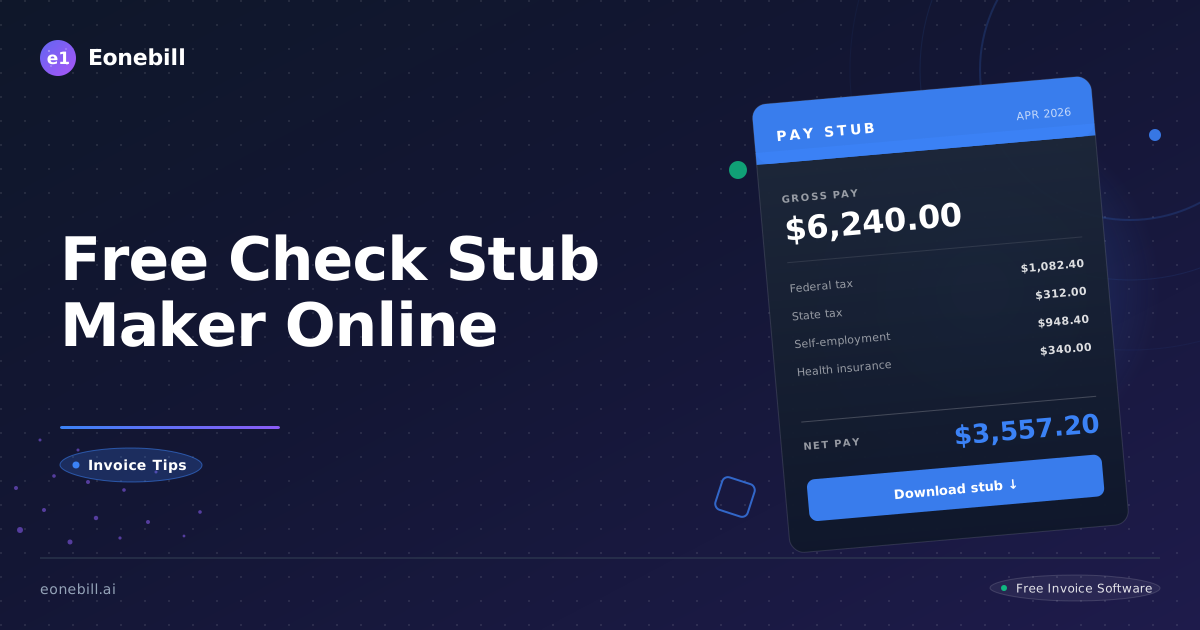
Free Check Stub Maker Online
Free Check Stub Maker Online
A check stub maker is an online tool that generates professional paycheck stubs for small business employees, contractors, and self-employed individuals. Whether you run payroll for a handful of employees, pay yourself as a sole proprietor, or need proof of income for a lender or landlord, a quality check stub maker saves hours of manual calculation and produces an accurate, professional document in minutes.
This guide walks through what makes a good check stub maker, who needs one, how to use it correctly, and the legal and tax considerations every user should understand.
Who Needs a Check Stub Maker
Several groups of people regularly need check stubs and benefit from a fast online generator.
Small business owners running payroll for their employees need a stub for every pay period. Even with payroll software, occasional stubs for off-cycle payments, bonuses, or special situations are easier with a quick online tool. Larger payroll software handles the regular cycle but may not handle a one-off stub elegantly.
Self-employed individuals and freelancers need self-generated stubs to document their income for lenders, landlords, immigration purposes, and other verification needs. Banks and landlords increasingly accept self-generated stubs from gig economy workers, freelancers, and consultants when combined with tax returns and bank statements.
Independent contractors who receive 1099 income do not get traditional W-2 pay stubs from their clients but may need a similar document to summarize their earnings for a specific period. A check stub maker can produce a payment summary for any pay period.
New employees in their first weeks of a job may need a recent pay stub for housing or financing applications before they have accumulated a sufficient pay history. An employer-issued offer letter combined with a first pay stub usually suffices, but additional documentation may be requested.
Small business owners issuing payments to occasional contractors or one-off helpers can use a check stub maker to provide a professional payment record that supports the recipient's tax reporting.
Replacement of lost pay stubs is another common use. Employees who lost a pay stub and cannot get a replacement from their employer in time for a loan or rental application sometimes recreate the document from their bank records and other information.
What a Good Check Stub Maker Provides
A quality check stub maker should produce a document that meets professional and regulatory standards. The key features to look for include the following.
Accurate tax calculations are essential. The tool should apply current federal income tax withholding tables, Social Security at 6.2 percent up to the annual wage base, Medicare at 1.45 percent plus the additional 0.9 percent above $200,000, and state and local taxes based on the work location. The 2024 Social Security wage base was $168,600 (indexed annually for inflation — verify the current figure before relying on the calculation).
Multiple pay schedule support includes weekly, biweekly, semimonthly, monthly, and annual schedules. The tool should automatically calculate the correct period gross pay based on the schedule.
Deduction flexibility allows you to add pre-tax deductions like 401(k), health insurance, HSA, and FSA, and post-tax deductions like Roth 401(k) and garnishments.
Year-to-date calculations show running totals for each category across the year, allowing the employee to track annual earnings and withholding.
State-specific compliance applies the correct fields and format for the work state. California, New York, and other strict states have specific requirements that should be met automatically.
Professional design produces a clean, printable document that looks like a real pay stub from a payroll system, not a homemade form. Format consistency builds credibility with lenders and landlords.
PDF export and email delivery are standard features. The employee should receive a PDF they can save, print, or forward as needed.
Digital storage and history allows easy retrieval of past stubs without recreating them from scratch.
Integration with invoicing and other small business workflows reduces duplicate data entry. If your check stub maker shares an account with your invoicing tool, employee and contractor records flow seamlessly.
How to Use a Check Stub Maker Correctly
Using a check stub maker correctly produces an accurate, credible document. Using it carelessly or with bad information produces a useless document that can create problems.
Start with accurate information. The employee or self-employed person's full legal name, correct address, and accurate Social Security number (only the last four digits should appear on the printed stub) are foundational. Employer name, address, and EIN should match the W-9 or business records.
Enter accurate gross pay for the period. For employees, this is hours times rate plus any additional earnings. For self-employed individuals, this is your actual business income for the period from invoicing records or bank statements.
Use current tax tables. A check stub maker should automatically use the current year's IRS tables, but verify by checking the year selector if the tool offers one.
Enter accurate deductions. If you contribute to a 401(k), enter the actual percentage or amount. If you have employer-paid health insurance with an employee portion, enter the actual employee share. Made-up deductions create inconsistencies that can be flagged during verification.
Match the stub to your other records. The stub should align with your tax returns, bank deposits, and W-2 (for employees). Inconsistencies between documents are the primary way fraudulent or inaccurate pay stubs get caught.
Never inflate income to qualify for a loan or rental. Doing so is mortgage fraud, rental fraud, or other criminal activity depending on the use. Penalties include criminal charges, loss of the loan or rental, and permanent records that affect future financial transactions.
For self-employed individuals, be conservative in your income reporting on a self-generated stub. Lenders verify income against tax returns, bank statements, and 1099 forms received. Reporting an amount higher than your tax return raises immediate red flags.
Legal and Tax Considerations
Check stub makers are legal tools when used for legitimate purposes. They are illegal tools when used to create fraudulent documents.
Legitimate uses include providing pay stubs to your own employees as an employer, generating proof of income from your own business as a self-employed person, replacing lost pay stubs with accurate recreations, and creating documents for personal records.
Illegitimate uses include creating fake pay stubs to inflate income for loan, rental, or credit applications, generating stubs for fictional employers to misrepresent employment, and any use intended to deceive a third party about actual earnings.
Mortgage fraud, rental fraud, and credit fraud are serious crimes that can result in prison time, large fines, and permanent records. Lenders and landlords have sophisticated tools to verify income, including direct verification with employers, bank statement analysis, and tax return inspection. The risk of getting caught is high and the consequences are severe.
For employers, providing inaccurate pay stubs to employees can violate state labor laws like California Labor Code Section 226, which carries penalties of $50 to $100 per employee per pay period for violations with a cap of $4,000 per employee.
For tax purposes, the IRS expects all income to be reported. Pay stubs are evidence of income that supports your tax return. Discrepancies between stubs and reported income can trigger audits.
Keep records of all pay stubs you generate or receive. The retention period is at least three years for federal tax purposes, four years for FICA, and seven years for general best practice.
Common Mistakes When Using a Check Stub Maker
A few mistakes appear repeatedly and undermine the credibility of generated pay stubs.
Incorrect tax calculations are common when using a tool that has not been updated for the current tax year. Verify the year and confirm the tool is using current rates. Federal income tax brackets, the Social Security wage base, and state tax rates all change annually.
Inconsistent pay frequency produces stubs that do not align with each other. If you say you are paid biweekly on one stub and weekly on another, the inconsistency is obvious to a reviewer.
Missing or incorrect employer information undermines credibility. The employer name, address, and EIN should match real records that can be verified.
Unrealistic deduction amounts raise questions. A 50 percent 401(k) contribution rate is not realistic for most situations. Match deductions to typical patterns for your situation.
Round numbers everywhere look manufactured. Real pay stubs typically have small cents in tax calculations and slightly varying amounts. A stub with $5,000.00 gross and $1,000.00 net pay looks too clean to be real.
Missing year-to-date totals or inconsistent YTD totals across stubs are immediate red flags during verification. YTD should accumulate consistently across your pay period sequence.
Missing state-specific fields invalidate the stub for state compliance. California stubs without all nine Section 226 items, for example, are not legally compliant.
Build Check Stubs with Eonebill.ai
Eonebill.ai provides a free, accurate check stub maker at /free-tools/pay-stub-generator. The tool handles federal and state tax calculations automatically based on the work location and applicable current tax tables.
For small business employers, the platform supports a full pay stub workflow with recurring payroll schedules, automatic generation per period, employee self-service portal access, and state-specific compliance built in. Pay stubs are stored permanently in your account with version history for easy retrieval.
For self-employed individuals and freelancers, the check stub maker creates accurate self-employment income statements that align with your invoicing records. This consistency between your stubs and your invoices makes documents more credible for lenders and landlords.
For accountants and bookkeepers serving small business clients, the platform supports multi-client access and exports stub data in formats compatible with QuickBooks, Xero, and other accounting software.
Review tier options at /pricing and pick the plan that fits your needs. Most individual users start on the free tier with basic stub generation and upgrade as their needs grow.
A professional check stub is a small but important financial document. Use a reliable check stub maker, enter accurate information, keep good records, and your stubs will serve every legitimate purpose without creating problems.
The check stub maker market has grown significantly over the past decade as more workers shift to freelance and gig work without traditional employer-provided pay stubs. Lending and rental markets have adapted to this shift by accepting self-generated pay stubs as part of a broader income verification package that includes tax returns, bank statements, and 1099 forms. This evolution has made it easier for freelancers and small business owners to qualify for mortgages, auto loans, apartment rentals, and credit cards that previously required W-2 employment. The key is consistency: your self-generated stubs should align with the rest of your financial picture.
For freelancers planning a major financial transaction like a mortgage, the preparation should start at least two years in advance. Lenders typically want to see two years of consistent self-employment income before approving a mortgage. This means your pay stubs, tax returns, and bank statements all need to tell the same story over the two-year window. Aggressive expense deductions that minimise tax liability also minimise the income visible to lenders, which can hurt mortgage qualification. Talk to a mortgage broker who specialises in self-employed borrowers before optimising your tax return for the year you plan to apply for a mortgage. The right balance between tax savings and income visibility depends on your specific situation.
The rise of fintech lenders has also changed the verification landscape. Companies like Rocket Mortgage, Better, and others use automated systems that can verify income directly from your bank account or tax records with your permission. These systems are sometimes more flexible than traditional lenders for self-employed applicants because they look at actual deposits and tax returns rather than relying solely on pay stubs. If you have struggled to get approved by traditional lenders, exploring fintech alternatives is worth considering.
For employers using check stub makers, the most important consideration is regulatory compliance rather than convenience. State-specific rules around pay stub content vary significantly. California's Labor Code 226 is the strictest, requiring nine specific items, with penalties of up to $4,000 per employee for violations. Other strict states include New York, Illinois, and Oregon. Build your check stub workflow to meet the strictest applicable rules and you avoid problems regardless of where your business operates or where your employees are located.
Finally, the check stub is increasingly the canary in the coal mine for broader payroll problems. If your check stubs frequently need corrections, contain unclear deductions, or do not match what employees see in their bank accounts, the underlying payroll process probably has issues that need addressing. Use the check stub as a diagnostic tool. Clean, consistent stubs reflect a clean, consistent payroll operation. Messy stubs reflect deeper problems that should be investigated.
Ready to manage invoices, contracts & proposals in one place? Try Eonebill free — no credit card required.
Start Free →Frequently Asked Questions
More Posts

Filing Taxes Late: Penalties, Extensions, and How to Catch Up (2026)
Missed the April deadline? Understand the 5 percent failure-to-file vs 0.5 percent failure-to-pay penalty difference, how Form 4868 extensions help, and the four-step protocol for catching up on years of unfiled returns.
Penalties for Not Filing a 1099: What Freelancers and Small Businesses Need to Know (2026)
Failing to file 1099 forms on time triggers escalating IRS penalties from 60 to 660 dollars per form. Learn the four-tier schedule, how to fix a missed filing, and when First-Time Penalty Abatement applies.

How to Write a Gentle Reminder Email (Templates + Examples)
Learn how to write a professional gentle reminder email that gets results. Includes 8 ready-to-use templates for invoices, meetings, deadlines, and more.
Newsletter
Join the community
Subscribe to our newsletter for the latest news and updates