Free Blank Invoice Template — Printable & Editable
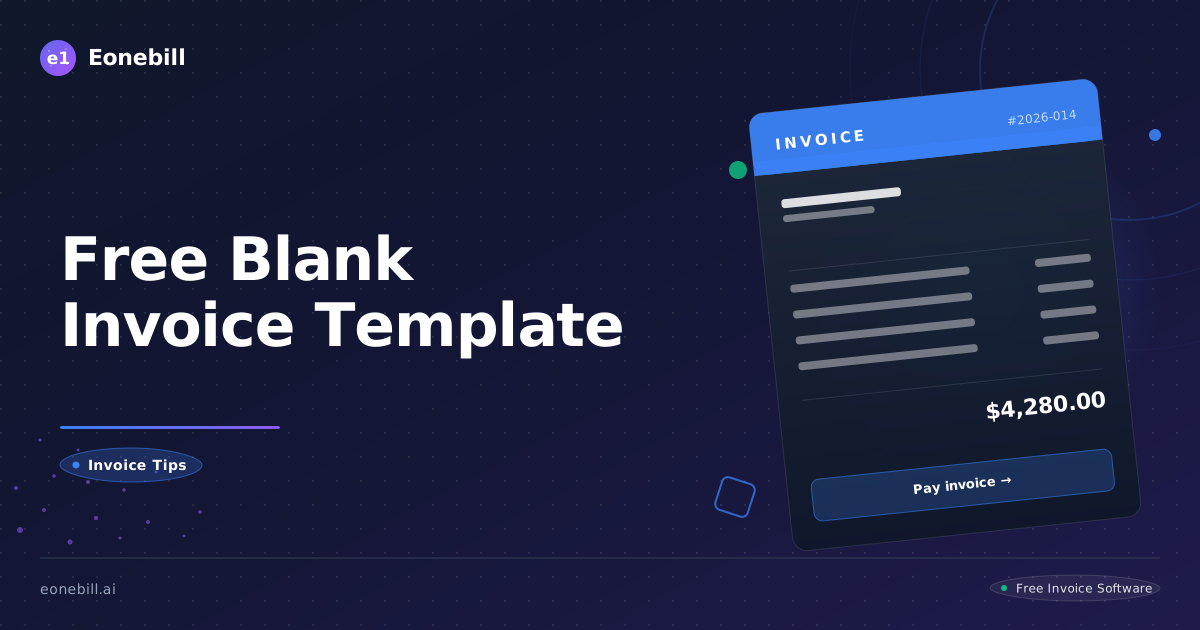
Sometimes you do not need software — you need a clean, blank invoice you can fill in by hand, in Word, or in Excel. Blank invoice templates are perfect for occasional billing, cash businesses, on-the-go services like contractors and tradespeople, and anyone who needs a printable record without learning new software. This guide covers what makes a great blank invoice template, how to fill one in correctly, and when to graduate to a digital tool.
Who Needs a Blank Invoice Template (and Who Does Not)
A blank invoice — meaning a fillable but otherwise unformatted template — works best for specific situations:
Best for:
- Contractors and tradespeople billing on-site
- Cash-based service businesses (mobile detailing, lawn care, pet sitting)
- One-off freelance jobs where you do not want a software trail
- Pop-up vendors at farmers markets, craft fairs, and events
- New businesses sending their first 1-5 invoices
- Anyone who wants a physical, printable record
Not great for:
- Businesses with 10+ invoices a month (manual entry takes too long)
- Recurring/retainer billing
- B2B with corporate AP teams (they expect digital invoices)
- Businesses needing payment tracking
- Multi-state or multi-currency billing
If you spot yourself in the first list, a blank template is the right starting tool. If you spot yourself in the second list, jump to our free invoice generator instead — it gives you the same flexibility with auto-math and instant PDF output.
Required Fields on Any Blank Invoice
A blank template still needs the same core sections as any professional invoice. The difference is you fill them in by hand or by typing — there is no auto-calculation.
Header section:
- "INVOICE" label
- Your business name and contact info
- Logo space (top-left, optional)
- Invoice number
- Invoice date
- Due date
Parties:
- Bill-To: client name, company, address
- Ship-To (if different): shipping address
Line items table:
- Description
- Quantity
- Rate / Unit price
- Amount
Totals:
- Subtotal
- Sales tax (with rate)
- Discount (if any)
- Grand Total
Terms and footer:
- Payment terms (Net 15, Due on Receipt, etc.)
- Accepted payment methods
- Late fee policy
- Thank-you line
A good blank template lays this out cleanly with enough white space that handwritten entries do not look cramped. Avoid templates with tiny boxes that force you to write small.
Printable vs. Editable: Picking the Right Blank Template
There are two main types of blank invoice templates, and they serve different needs:
Printable PDF Blank Invoice
A blank PDF you print and fill in by hand or with a pen on a tablet. Best for:
- Field service jobs (HVAC, plumbing, contracting)
- Cash transactions where the customer wants a paper receipt
- Quick one-off jobs at the customer's location
- Vendors at markets or events without internet
Keep a stack of 20-30 printed blank invoices in your truck or bag. Carbon copy versions (one copy for you, one for the customer) are even better for cash businesses.
Editable Word or Excel Blank Invoice
A template you fill in digitally, then save as PDF or print. Best for:
- Office-based freelancers
- Small businesses with semi-regular billing
- Anyone who wants to email invoices but does not need recurring features
Word templates work well for narrative invoices with longer descriptions. Excel works better when you have multiple line items and want auto-calculation of subtotals.
The practical answer for most small businesses: keep both. Print the PDF for on-site work, use the Word/Excel version for billing from your desk.
How to Fill in a Blank Invoice Correctly (With Real Example)
Let us walk through a real handheld example. You are a mobile auto detailer in Phoenix, AZ, and you just finished a full detail on a customer's truck at their house.
Header:
- Business: Desert Shine Mobile Detail
- Address: 5520 N 7th St, Phoenix, AZ 85014
- Phone: (602) 555-0182
- Email: book@desertshinedetail.com
- Invoice #: 2026-156 (just increment from your last invoice)
- Date: May 17, 2026
- Due: Today (cash service)
Bill To:
- Customer: Sarah Mitchell
- Address: 1144 W Camelback Rd, Phoenix, AZ 85013
Line items:
- "Full interior + exterior detail (Ford F-150)" — 1 unit at $185 = $185
- "Engine bay detail (add-on)" — 1 unit at $40 = $40
- "Headlight restoration" — 1 unit at $50 = $50
Totals:
- Subtotal: $275
- AZ state sales tax does not apply to most car wash/detail services — verify your specific jurisdiction
- Total: $275
Payment terms:
- Due on completion. Payment received: cash / Venmo / Zelle
- Marked PAID on May 17, 2026
Hand the customer their carbon copy or a photo of the invoice. Keep your copy for the books. Total time to fill in: 90 seconds.
Sales Tax on Hand-Written Invoices: Easy to Mess Up
The biggest mistake on blank invoices is mishandling sales tax. Common errors:
- Forgetting to charge it on taxable items. If you owe tax and did not collect, you still owe the state. Painful.
- Charging the wrong rate. Sales tax is destination-based in most states, not based on where you are.
- Forgetting to itemize the rate. "Tax: $15.62" without a rate looks made up. Use "AZ sales tax (8.6%): $15.62."
- Charging tax on non-taxable services. In many states, mobile services are exempt while products are taxed.
- Rounding incorrectly. $185 × 8.6% = $15.91, not $15.90 or $16.00.
A quick test before you write the tax number: ask yourself whether your state taxes this specific service or product. If you do not know, do not charge tax until you check with your state's department of revenue or a CPA. Charging tax you do not remit is illegal in every state.
Moving From Paper to Digital When You Are Ready
Blank invoice templates work great for the first 1-3 years of many small businesses. But there are clear graduation signals:
- You are writing 20+ invoices a month by hand.
- You have lost track of an unpaid invoice at least once.
- Your handwriting is getting harder to read on carbon copies.
- A customer asked for an email receipt instead of paper.
- You spent more than 2 hours at tax time entering hand-written invoices into a spreadsheet.
- A client asked if you take credit cards (you cannot, with paper).
When 2+ of these apply, upgrade to a digital tool. The big wins:
- Auto-math. No more $15.62 tax errors.
- Sequential numbering. No more accidental duplicate invoice numbers.
- Searchable records. "What did I bill the Garcia family last May?" — answered in 3 seconds.
- Payment options. Cards, ACH, Zelle, Venmo all from one invoice.
- Email + PDF. Customer gets a clean PDF in their inbox, you keep a digital record.
- Tax-time export. One click, all your billing data in a spreadsheet.
For mobile and field businesses, the right tool works on your phone in the parking lot. Eonebill.ai's free generator is mobile-friendly and free. Paid plans on Eonebill.ai add card payment, recurring invoices, and automatic reminders, all in the same mobile-friendly interface.
Until you outgrow paper, keep the blank invoices stocked. The simplest, fastest way to get paid is the one you actually use — and a blank pad in your truck or office is hard to beat for raw simplicity.
Choosing the Right Paper and Print Quality
For businesses using printed blank invoices, the paper and print quality matter more than people realize. Specifically:
Paper weight: 24 lb or heavier feels professional. 20 lb is acceptable. Anything lighter (cheap office copy paper) feels like a flyer, not a bill.
Paper finish: Matte beats glossy for invoices. Glossy reflects too much under fluorescent office lights.
Color: White or off-white. Avoid colored paper for invoices unless it is a very subtle ivory or cream. Colored paper looks like a promotional flyer.
Print quality: Laser printer beats inkjet for invoices. Laser print is crisper and does not smudge if the invoice gets wet or handled a lot.
NCR paper for carbon copies: 2-part or 3-part NCR (No Carbon Required) paper lets you write once and have multiple copies. Office supply stores sell pre-printed receipt and invoice pads for $20-40.
Custom-printed pads: For a couple hundred dollars, local print shops can produce 500 custom-printed invoice pads with your logo, business info, and branding pre-printed. The cost amortizes to a few cents per invoice and looks dramatically more professional than generic blank forms.
Filing Systems for Hand-Written Invoices
Hand-written invoices need a real filing system or they will disappear. The two systems that work:
Physical filing (for under 100 invoices/year):
- Manila folder for each month: "May 2026"
- Inside each folder, invoices sorted by date or invoice number
- All folders in a single filing cabinet drawer
- Backup copy of every invoice scanned and stored in cloud
Hybrid digital (for under 500 invoices/year):
- Take a photo or scan of each hand-written invoice immediately after issuing
- Name the file with invoice number and date
- Store in cloud (Google Drive, Dropbox, OneDrive)
- Original paper invoices in a single binder, sorted chronologically
- Backup ensures you can find any invoice even if paper is lost
The scanning step is the most important. Paper alone is risky — fires, floods, mice, and human error all destroy paper records. Digital backups solve this.
The Transition From Paper to Digital
Most successful small businesses eventually transition from paper to digital invoicing. The transition is easier if you plan it:
Phase 1: All paper. First 1-2 years of business. Cost: $50/year for receipt pads and pens.
Phase 2: Digital draft, paper copy. Type the invoice in a free generator, print one copy for the customer (with your handwritten signature), keep a digital copy for your records. Cost: $0/year.
Phase 3: Mostly digital, paper for cash transactions. Email invoices for credit card and ACH clients. Print only for in-person cash transactions. Cost: $0-15/month for invoicing tool.
Phase 4: Fully digital. Everything electronic. Cash still accepted but receipt is digital. Cost: $15-50/month for full invoicing and payment platform.
The transition does not have to be all-or-nothing. Many businesses operate in Phase 3 for years successfully, especially in industries where cash payments remain common (mobile services, food trucks, market vendors).
Customizing Blank Templates for Your Brand
Even a paper blank invoice can be branded. Specific upgrades:
- Pre-printed letterhead: Order 500 sheets with your logo, business name, and contact info at the top. Cost: $50-100. The invoice content is hand-written in the body but the brand is pre-printed.
- Custom stamp: A rubber stamp with your business name and logo can brand any blank invoice in 2 seconds. Cost: $20-40 from Amazon or Vistaprint.
- Color highlighter for totals: A subtle yellow or green highlighter on the total amount makes it stand out without looking gaudy.
- Embossed seal: For luxury or professional services (legal, financial, consulting), an embossed seal on the corner of each invoice signals premium status. Cost: $50-150 for a desktop embosser.
None of these are required. But they elevate paper invoices toward looking like real business documents rather than scraps of paper.
Blank Invoice Use Cases You Might Not Have Considered
Beyond the obvious uses, blank invoices serve some specific scenarios:
Estimate-to-invoice conversion. Use a blank invoice template to convert an accepted estimate into an invoice. Same format, just replace "ESTIMATE" with "INVOICE" and add the invoice number and due date.
Catch-up invoicing for late projects. If a project finished months ago and you forgot to invoice, a blank invoice lets you create one with the correct historical dates. Note the explanation in the description.
Adjustment invoices. When you need to bill for a small change order on a previous project, a blank invoice template lets you reference the original project and bill only the difference.
Reimbursement invoices. For pass-through costs (client paid for travel that you booked), a blank invoice documents the reimbursement clearly.
Pro bono documentation. Even for free work, generating a blank invoice marked "PRO BONO — NO CHARGE" creates a record of value delivered. Useful for nonprofit clients and for your own portfolio.
Quote conversion. Convert a quote or estimate into a real invoice by filling in the same line items with actual delivered quantities and prices.
Refund invoices. When you owe a client a refund, an invoice format documents the negative amount clearly.
Internal billing. If you operate multiple businesses and one provides services to another, blank invoices document inter-company transactions for tax and accounting purposes.
A blank template is a flexible business tool, not just a billing document.
Ready to manage invoices, contracts & proposals in one place? Try Eonebill free — no credit card required.
Start Free →Frequently Asked Questions
More Posts
Filing Taxes Late: Penalties, Extensions, and How to Catch Up (2026)
Missed the April deadline? Understand the 5 percent failure-to-file vs 0.5 percent failure-to-pay penalty difference, how Form 4868 extensions help, and the four-step protocol for catching up on years of unfiled returns.

Penalties for Not Filing a 1099: What Freelancers and Small Businesses Need to Know (2026)
Failing to file 1099 forms on time triggers escalating IRS penalties from 60 to 660 dollars per form. Learn the four-tier schedule, how to fix a missed filing, and when First-Time Penalty Abatement applies.

How to Write a Gentle Reminder Email (Templates + Examples)
Learn how to write a professional gentle reminder email that gets results. Includes 8 ready-to-use templates for invoices, meetings, deadlines, and more.
Newsletter
Join the community
Subscribe to our newsletter for the latest news and updates