W-9 Form: Complete Guide for Freelancers 2026
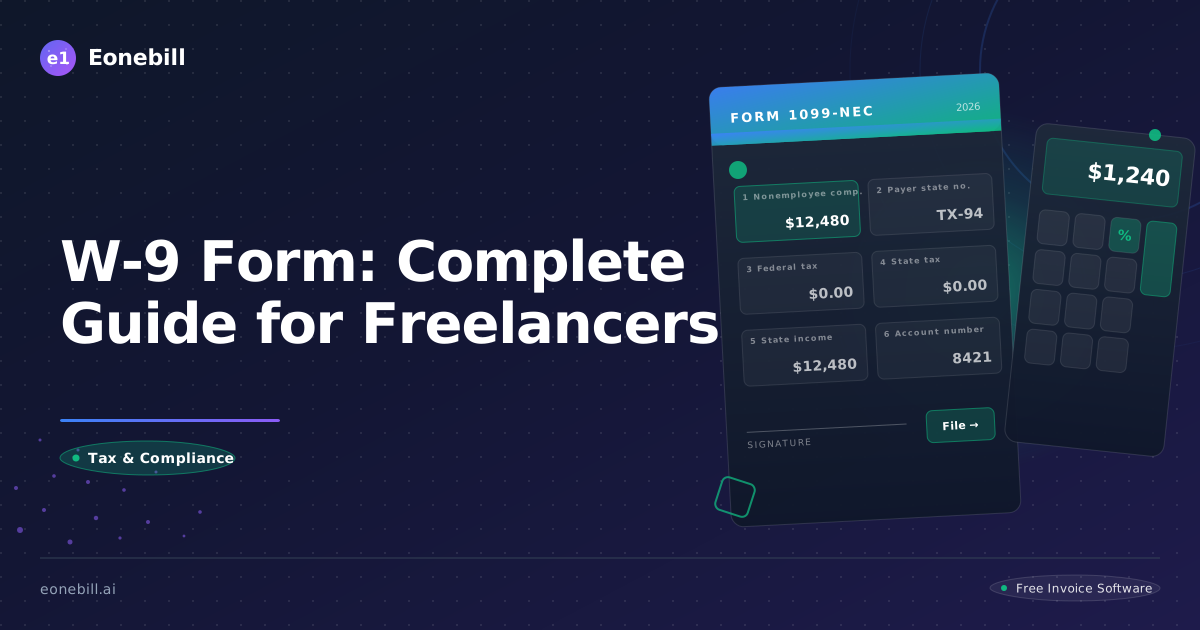
W-9 Form: Complete Guide for Freelancers 2026
If you've ever started a new freelance gig and the client asked you to "send over a W-9," you've already brushed up against one of the most common — and most misunderstood — IRS forms in the contractor world. The W-9 isn't a tax return. It doesn't trigger a tax bill. It's simply a one-page request that tells your client who you are for tax-reporting purposes. But getting it wrong can delay payment for weeks, expose you to backup withholding, or cause headaches at year-end.
This guide walks you through the W-9 line by line, explains when you need to send one (and when you should be wary of a client asking for it), and helps you stay organized through tax season. By the end, filling out and sending a W-9 should take you under three minutes.
What the W-9 Form Actually Is
IRS Form W-9, officially titled "Request for Taxpayer Identification Number and Certification," is the form US clients use to collect your tax information so they can issue you a Form 1099-NEC (or 1099-MISC) at the end of the year. The 1099 reports your income to the IRS; the W-9 is the data-collection step that makes the 1099 possible.
If a US business pays you $600 or more in a calendar year for non-employee services, they are required by the IRS to issue you a 1099-NEC by January 31 of the following year. Before they can do that, they need your legal name, your business name (if different), your federal tax classification, and your Taxpayer Identification Number (TIN), which is either your Social Security Number or Employer Identification Number. The W-9 captures all of this on one page.
It's important to know that the W-9 stays with your client. You do not file it with the IRS. The client keeps it on file for at least four years and uses it to populate the 1099-NEC at year-end. If you're audited, the client may need to produce the W-9 to substantiate that they correctly classified you as a contractor. From your side, you should keep a copy for your records too.
The form was updated most recently in March 2024 and remains the current version for 2026. Always download the latest version directly from IRS.gov to make sure you're using the correct form.
Line-by-Line: Filling Out the W-9
The W-9 has seven main fields. Here's exactly how to complete each.
Line 1 — Name: Enter your legal name as it appears on your tax return. If you're a sole proprietor, this is your personal name ("Jane M. Smith"), even if you do business under a different name. If you operate as an LLC taxed as a corporation or partnership, enter the entity's legal name. Mismatched names trigger IRS notices and can flag you for backup withholding.
Line 2 — Business name/disregarded entity name: This is your DBA or your single-member LLC name if it differs from Line 1. Single-member LLCs that haven't elected corporate taxation are treated as "disregarded entities," meaning the IRS sees the income on your personal Schedule C. Enter the LLC name here.
Line 3 — Federal tax classification: Check exactly one box. The most common for freelancers is "Individual/sole proprietor or single-member LLC." If you have a multi-member LLC, check "Limited liability company" and write the tax classification (P for partnership, C for C-corp, S for S-corp). Get this wrong and your client may withhold incorrectly.
Line 4 — Exemptions: Most freelancers leave both exemption fields blank. They apply to specific entities like corporations that are exempt from backup withholding or FATCA reporting. Unless you've been told by a CPA which code applies, leave it empty.
Line 5 and Line 6 — Address: Enter the mailing address where you want to receive the 1099 at year-end. Use your business address if you have one; otherwise your home address is fine. Keep it consistent across all clients, otherwise you may have 1099s scattered across old addresses come January.
Part I — Taxpayer Identification Number: Enter your SSN if you operate as a sole proprietor or single-member LLC without an EIN. Enter your EIN if you have one. Single-member LLCs can use either, but most accountants recommend getting an EIN (free from the IRS at IRS.gov) to keep your SSN off contractor paperwork that gets distributed across multiple clients.
Part II — Certification: Sign and date. By signing, you're certifying that the TIN is correct, that you're not subject to backup withholding, and that you're a US person for tax purposes.
When You Should (and Shouldn't) Send a W-9
Send a W-9 whenever a legitimate US business client requests one as part of onboarding. This is standard practice. Most companies will not pay you until they have a completed W-9 on file, especially larger companies with formal AP departments. Send it before you start work if possible — chasing a W-9 mid-project is awkward.
Do not send a W-9 to a random stranger who emails you asking for one. The W-9 contains your SSN or EIN, your legal name, and your address — a goldmine for identity theft. Verify the client is legitimate, communicate through a known business email domain, and consider sending the form through an encrypted document service rather than a plain email attachment. Tools like DocuSign, Adobe Sign, or even a password-protected PDF go a long way.
Never send a W-9 to a foreign client. Non-US clients should not be issuing you 1099s — they're not subject to US information-reporting rules. If a foreign client asks for a W-9, politely explain that the form is for US tax reporting and offer to provide your business contact info another way.
If a client claims they need a W-9 for any payment, regardless of amount, that's fine — many companies require it as a blanket policy. The $600 threshold is for issuing the 1099, not for requesting the W-9. So even a $200 project might trigger a W-9 request.
Common W-9 Mistakes That Cost You Money
The single most expensive W-9 mistake is mismatching your name and TIN. The IRS uses computer matching to compare the name on the 1099 to the name on file with the Social Security Administration or the IRS EIN database. If they don't match, the IRS notifies the client, who then must begin backup withholding at 24%. That means your $1,000 invoice payments suddenly arrive as $760. Backup withholding can be reversed when you file your tax return, but the cash-flow hit can wreck a small business.
Mistake two: using your SSN when you should be using an EIN. If you have an EIN, use it. EINs are free, take ten minutes to obtain online, and keep your SSN out of dozens of client files. The IRS treats EIN and SSN equivalently for sole proprietors, so there's no tax-classification reason to keep using your SSN.
Mistake three: forgetting to sign the form. An unsigned W-9 is invalid. The client cannot legally accept it as substantiation. They'll bounce it back and your payment gets delayed.
Mistake four: checking the wrong tax classification. Sole proprietors and single-member LLCs check different boxes than multi-member LLCs, S-corps, or C-corps. If you've recently elected S-corp taxation but check "sole proprietor," you'll create confusion that affects how your client reports the payment.
Mistake five: sending an outdated form. The W-9 was last revised in March 2024. Older versions are technically still valid but raise questions during audits. Always grab the current version from IRS.gov.
Storing and Tracking W-9s
Keep a copy of every W-9 you send. Create a single folder on your computer called "W-9 Sent" and save each completed form as a PDF named with the client name and date — for example, "Acme-Corp-W9-2026-03-12.pdf". This way, when a client comes back six months later asking you to resend, you can locate it in seconds.
Likewise, if you ever hire subcontractors of your own, you'll need to collect W-9s from them. Build a folder called "W-9 Received" with the same naming convention. At year-end, you'll be required to issue them a 1099-NEC if you paid them $600 or more, and you need the W-9 on file to do so.
For security, consider encrypting the folder or using a password manager that supports document storage. Identity theft from leaked W-9s is real. Some freelancers go a step further and use a P.O. Box address instead of a home address for the W-9 — perfectly legal and a nice layer of privacy.
At year-end, check each W-9 against the 1099-NEC you receive. The 1099 should reflect the legal name and TIN you provided. If there's a mismatch, contact the client immediately to request a corrected 1099. Filing a tax return with mismatched 1099s is a common audit trigger.
Beyond the W-9: Building a Compliant Freelance Business
The W-9 is one piece of a bigger compliance puzzle. The full picture for a US freelancer includes: getting an EIN, opening a business bank account, choosing a tax structure (sole prop, LLC, S-corp), making quarterly estimated tax payments via Form 1040-ES, filing Schedule C and Schedule SE with your Form 1040 each April, and keeping clean records of every invoice and expense.
Good invoicing is the backbone of all of this. Every invoice you send creates a paper trail that supports your Schedule C revenue figures, ties out to client payments, and can be cross-referenced against 1099s you receive. Sloppy invoicing leads to sloppy taxes, which leads to overpaying (or worse, audit risk). The free invoice generator at /free-tools/invoice-generator is a great starting point.
For freelancers managing multiple clients, Eonebill.ai automates the invoice-to-tax workflow. You can tag each invoice by client, export year-end summaries that map directly to Schedule C categories, and store W-9s and 1099s alongside the related invoices for easy audit defense. See /pricing for current plans. The combination of a clean W-9 process and a clean invoicing system saves most freelancers two to three full days per year at tax time.
Bottom line: the W-9 is simple if you take five minutes to understand it. Fill it out correctly the first time, store every copy securely, and use it as the entry point to a well-organized freelance tax workflow. Future-you will thank present-you every April.
One final practical tip: encrypt your W-9 PDFs at rest if you store them on a cloud drive. Both Google Drive and Dropbox support folder-level password protection through third-party tools, and macOS / Windows native disk encryption protects files at the OS level. For the highly cautious, store W-9s in a password manager like 1Password or Bitwarden under a dedicated W-9 vault. The marginal effort is minimal and the protection against identity theft is meaningful. Also consider creating a W-9 cover sheet — a simple PDF that says "Attached W-9 for [Year]" with your contact info. This professionalizes the delivery and makes it easier for the client to file. If a client uses an online contractor onboarding portal (popular at larger companies), you typically don't need to email the W-9 separately — the portal collects it directly. Always confirm receipt either way. Send a short email after submitting: "I've uploaded my W-9 through the portal — please confirm receipt." This eliminates the back-and-forth of "we never got your W-9" emails that delay first invoices by weeks. Small workflow refinements like these compound into a freelance practice that runs smoothly year after year.
Ready to manage invoices, contracts & proposals in one place? Try Eonebill free — no credit card required.
Start Free →Frequently Asked Questions
More Posts
Filing Taxes Late: Penalties, Extensions, and How to Catch Up (2026)
Missed the April deadline? Understand the 5 percent failure-to-file vs 0.5 percent failure-to-pay penalty difference, how Form 4868 extensions help, and the four-step protocol for catching up on years of unfiled returns.
Penalties for Not Filing a 1099: What Freelancers and Small Businesses Need to Know (2026)
Failing to file 1099 forms on time triggers escalating IRS penalties from 60 to 660 dollars per form. Learn the four-tier schedule, how to fix a missed filing, and when First-Time Penalty Abatement applies.

How to Write a Gentle Reminder Email (Templates + Examples)
Learn how to write a professional gentle reminder email that gets results. Includes 8 ready-to-use templates for invoices, meetings, deadlines, and more.
Newsletter
Join the community
Subscribe to our newsletter for the latest news and updates