Small Business Expense Tracking: The Complete 2026 Guide
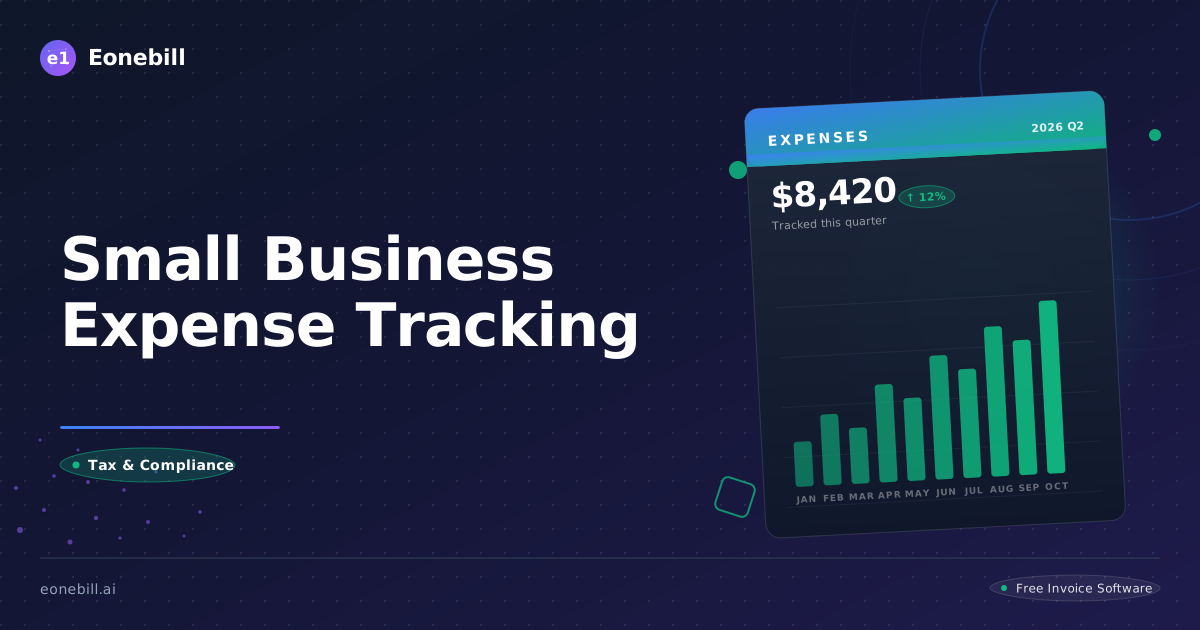
Small business expense tracking: how to track expenses effectively, best practices, top tools including Eonebill, and how to stay tax-ready year-round.
TL;DR
- Expense tracking is the discipline of monitoring every dollar your business spends — not just for tax time, but for real-time financial clarity
- The best small business expense trackers (like Eonebill) automate 90%+ of data entry via bank syncing and receipt scanning
- Track expenses by connecting business accounts + photographing every receipt + reviewing reports weekly
- Eonebill includes a free dedicated expense tracker — try it at /expense-tracker
- Poor expense tracking = missed deductions, cash flow surprises, and expensive tax season chaos
The businesses that consistently turn chaos into calm have one thing in common: they track their expenses in real time, not in a desperate Year-End Sprint. If you're still downloading bank statements into a spreadsheet once a quarter, this guide is your intervention.
Expense tracking isn't about restriction — it's about awareness. When you know where your money goes, you can make better decisions about where to cut, where to invest, and how to price your services. The businesses that thrive financially aren't necessarily the ones making the most revenue; they're the ones with the clearest picture of their numbers.
This guide covers everything small businesses need to know about expense tracking in 2026: how it works, the best tools, the key habits, and how Eonebill automates most of the process.
What Is Expense Tracking?
Expense tracking is the ongoing process of recording, categorizing, and monitoring every dollar your business spends. The goal is twofold:
- Operational clarity: knowing your real-time cash position and spending patterns so you can make informed decisions
- Tax compliance: maintaining organized, documented records of deductible expenses that will withstand IRS scrutiny
Effective expense tracking means you can answer these questions at any moment:
- How much did we spend last month vs. the month before?
- Which expense categories are growing faster than revenue?
- What's our current cash runway?
- Do we have any subscriptions we're paying for but not using?
If you can't answer these questions quickly, your expense tracking needs an upgrade.
Why Expense Tracking Matters for Small Businesses
1. Cash Flow Management
Cash flow is the #1 reason small businesses fail — not lack of profitability on paper, but actual liquidity problems. When you track expenses in real time, you see cash drain before it surprises you. That $200/month software subscription you'd forgotten about? You'll see it on your weekly review instead of discovering it at year-end.
2. Tax Deduction Capture
The average small business misses $2,000–$5,000 in legitimate tax deductions per year due to poor record-keeping. The IRS allows deductions for ordinary and necessary business expenses — but you can only deduct what you can document.
Common missed deductions:
- Home office expenses (even part-time freelancers can claim these)
- Vehicle mileage for business trips
- Professional development and conference fees
- Software subscriptions used for business
- Health insurance premiums (for self-employed)
- Client meals (50% deductible)
None of these deductions help you if you didn't record them.
3. Pricing Decisions
When you track expenses by category over time, patterns emerge. Maybe your software spend has tripled in two years and you didn't notice. Maybe client entertainment is eating into margins more than you realized. Expense data, combined with revenue data, tells you whether your pricing is actually covering your costs.
4. Access to Financing
If you ever need a business loan or line of credit, lenders want to see clean financial records — typically 2–3 years of statements, P&L, and tax returns. Businesses with organized expense tracking can apply for financing quickly; businesses with messy records wait months to get approved.
The Core Components of an Expense Tracking System
1. Business Bank Accounts
If you mix personal and business finances, expense tracking becomes nearly impossible. Open a dedicated business checking account from day one. Ideally, also get a business credit card.
This single step — separating accounts — eliminates 80% of the friction in expense tracking.
2. A Receipt Capture Habit
Every business purchase should be documented with a receipt. The habit: photograph the receipt immediately, or ask the vendor to email a digital receipt.
Tools like Eonebill's receipt scanner make this frictionless — snap a photo, AI extracts the data, done.
3. Consistent Categorization
Each expense goes into a category. Common small business expense categories:
- Advertising & Marketing: ads, promotions, website hosting
- Bank Fees & Interest: account fees, loan interest
- Contract Labor: payments to freelancers and contractors
- Insurance: business liability, health, equipment
- Legal & Professional: attorney fees, accounting, consulting
- Office Expenses: supplies, printing, postage
- Rent & Utilities: office rent, electricity, internet, phone
- Repairs & Maintenance: equipment repair, building upkeep
- Software & SaaS: every subscription tool your team uses
- Taxes & Licenses: business licenses, regulatory fees
- Travel: flights, hotels, ground transportation, mileage
- Meals & Entertainment: client meals (note: 50% limit)
- Equipment: purchases over your capitalization threshold
4. Regular Review Cycles
Tracking is worthless if you never look at the data. Set a weekly 15-minute appointment to:
- Review the week's expenses
- Categorize any uncategorized transactions
- Flag any unusual charges
- Approve reimbursements
Set a monthly 30-minute appointment to:
- Review expense reports by category
- Compare spending to the prior month and year-to-date budget
- Cancel unused subscriptions
- Send any outstanding employee reimbursements
5. Tax-Ready Export
At year-end (or quarterly, if making estimated tax payments), export your categorized expenses organized by IRS schedule. Eonebill does this in one click.
Best Expense Tracking Methods for Small Businesses
Method 1: Spreadsheets (Manual)
Pros: Free, familiar, fully customizable
Cons: Time-consuming, error-prone, no automation, no receipt storage, no real-time updates
Best for: Very small micro-businesses with fewer than 20 transactions per month who are on an extremely tight budget.
If this is you, use Google Sheets (free) and download bank transactions as CSV weekly. Set up SUMIF formulas for category totals. It's not great, but it's a start.
Method 2: Bank Statement Review (Semi-Manual)
Pros: Simple, no new software, covers all account activity
Cons: No categorization, no receipt storage, time-intensive monthly review, not real-time
Best for: Businesses that want minimal tools but need to see spending at a glance. Download statements monthly and manually categorize.
Method 3: Expense Tracking Software (Recommended)
Pros: Auto-import, AI categorization, receipt scanning, real-time reports, tax-ready export
Cons: Subscription cost (but free tiers exist)
Recommended tool: Eonebill — covers the full workflow at an accessible price point
This is the method this guide advocates. The time savings vs. manual methods are significant and immediate.
Method 4: Full Accounting Software
Pros: Complete financial picture, accounts payable/receivable, invoicing, payroll integration
Cons: More complex setup, steeper learning curve, higher price
Examples: QuickBooks Online, Xero, FreshBooks
Best for: Businesses with employees, inventory, or more complex accounting needs.
Eonebill bridges the gap — providing accounting-grade categorization and reporting without the complexity overhead.
How Eonebill Handles Expense Tracking
Eonebill is designed to make expense tracking as automatic as possible:
Automatic Transaction Import
Connect your business bank accounts and credit cards once. Eonebill imports all transactions continuously — no daily downloads, no manual entry.
AI Receipt Scanning
Photograph any receipt. Eonebill extracts vendor, date, amount, and tax — and matches it to a transaction if one exists. Receipts are stored digitally, searchable by date or vendor.
Smart Auto-Categorization
Eonebill's AI learns your business's expense patterns and categorizes transactions automatically. Over time, accuracy improves to 95%+. Ambiguous transactions are flagged for your review rather than miscategorized.
Real-Time Expense Dashboard
See your spending by category, by month, by vendor — updated continuously, not just at month-end. Identify trends before they become problems.
Budget Alerts
Set monthly spending limits by category. Eonebill alerts you when you're approaching a limit — before you exceed it, not after.
Tax-Ready Export
Export categorized expenses organized by IRS deduction categories with one click. Your accountant receives a clean file, not a shoebox of receipts.
Direct Bookkeeping Integration
Expenses flow directly into your Eonebill books — no double data entry between your expense tracker and your accounting system.
How to Track Business Expenses: A Practical 5-Minute Daily Habit
The key to consistent expense tracking is making it so easy you actually do it. Here's the daily routine that takes 5 minutes:
Morning (2 minutes): Open Eonebill. Review the previous day's imported transactions. Confirm or correct AI-categorization. Done.
At the register (30 seconds): Photograph your receipt. Upload it to Eonebill. The AI files it with the matching transaction.
End of week (5 minutes): Run the weekly expense summary. Ask: does anything look unusual? Any subscriptions I forgot about? Any category trending higher than expected?
That's it. This routine — which takes under 10 minutes per day — keeps your books perpetually current. No month-end sprint. No year-end panic.
Common Expense Tracking Mistakes
Mistake 1: No Business Card
Using your personal card for everything is the fastest way to lose track of business expenses. Open a business checking account and get a business credit card. Tomorrow, if not today.
Mistake 2: Waiting to Categorize
An uncategorized transaction at month 1 is easy to categorize. The same uncategorized transaction at month 12, from a vendor you no longer remember, is a guess. Stay current.
Mistake 3: Ignoring Small Purchases
The $3.49 parking fee, the $7.50 coffee with a client, the $15 book on Amazon — these are all deductible and they add up to hundreds or thousands of dollars per year. Track everything.
Mistake 4: Not Reviewing Reports
Data without review is just noise. Set calendar reminders to actually look at your expense reports monthly. Look at category trends. Ask questions about outliers.
Mistake 5: No Backup System
What happens if your expense tracking app goes down, or you cancel, or your computer crashes? Eonebill maintains cloud-backed records indefinitely and lets you export everything. If you're using spreadsheets, maintain backups in Google Drive.
How Eonebill Fits Into Your Expense Tracking Workflow
Eonebill provides multiple tools for different expense tracking needs:
- /expense-tracker — free dedicated expense tracker for any business, no account required
- /receipt-scanner — photograph a receipt and get instant structured data
- /expense-report-generator — generate formatted expense reports from uploaded receipts
- Full Eonebill platform — for businesses that want automated bookkeeping + expense tracking in one
FAQ: Small Business Expense Tracking
The Bottom Line
Expense tracking is not optional if you want to run a financially healthy business. The businesses that thrive have real-time visibility into their spending; the ones that struggle are always surprised by their cash position.
In 2026, there's no excuse for manual expense tracking. AI-powered tools like Eonebill have made it nearly frictionless — photograph a receipt, review three AI-categorized transactions, check your weekly dashboard. Ten minutes a day, clean books all year.
The best time to start tracking expenses was a year ago. The second best time is today.
Key Takeaways:
- Expense tracking gives you real-time financial visibility and captures every legitimate tax deduction
- The best method: business bank accounts + receipt photography + weekly review = perpetual financial clarity
- Eonebill automates 90%+ of the work: bank sync, receipt scanning, auto-categorization, tax-ready export
- The daily habit takes under 10 minutes — review transactions, photograph receipts, check for anomalies
- Start now — try Eonebill's free expense tracker and stop losing deductions to poor record-keeping
Ready to track expenses like a pro? Try Eonebill Free or use the free expense tracker now.
Receipt Scanner → | Expense Report Generator → | Pricing → | Blog Home →
Ready to manage invoices, contracts & proposals in one place? Try Eonebill free — no credit card required.
Start Free →More Posts

Filing Taxes Late: Penalties, Extensions, and How to Catch Up (2026)
Missed the April deadline? Understand the 5 percent failure-to-file vs 0.5 percent failure-to-pay penalty difference, how Form 4868 extensions help, and the four-step protocol for catching up on years of unfiled returns.
Penalties for Not Filing a 1099: What Freelancers and Small Businesses Need to Know (2026)
Failing to file 1099 forms on time triggers escalating IRS penalties from 60 to 660 dollars per form. Learn the four-tier schedule, how to fix a missed filing, and when First-Time Penalty Abatement applies.

How to Write a Gentle Reminder Email (Templates + Examples)
Learn how to write a professional gentle reminder email that gets results. Includes 8 ready-to-use templates for invoices, meetings, deadlines, and more.
Newsletter
Join the community
Subscribe to our newsletter for the latest news and updates