Free Project Proposal Template — Win Projects With a Professional Proposal
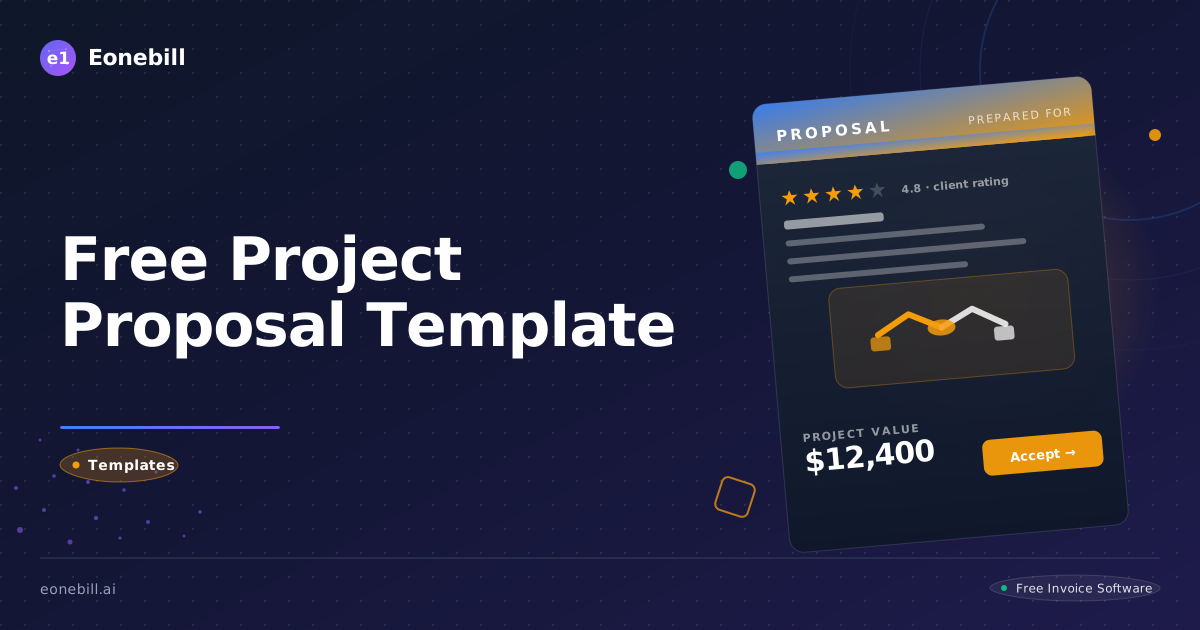
Free Project Proposal Template — Win Projects With a Professional Proposal
A project proposal turns a vague client inquiry into a signed agreement. Whether you are pitching software development, consulting, or a creative project, a clear proposal demonstrates that you understand the client's problem and have a credible plan to solve it. The difference between a freelancer who wins seven out of ten pitches and one who wins two out of ten is rarely skill — it is almost always how they communicate their approach before the work begins. A well-structured proposal removes the client's doubt, replaces vague impressions with concrete plans, and gives them a logical path to say yes.
This guide covers everything you need to know about writing a compelling project proposal: what it is and how it differs from related documents, which eight fields every strong proposal includes, a five-step process for writing one efficiently, and the best practices and common mistakes that separate winning proposals from the ones that go unanswered. Whether you are new to proposal writing or looking to tighten a process you already have, this guide will give you a repeatable framework you can use for every new client opportunity.
What Is a Project Proposal Template?
A project proposal is a formal document proposing a specific solution to a client's project need. Its job is to persuade: you are making the case that you understand the problem, that your approach is sound, and that you are the right person or team to execute it. A project proposal template gives you a pre-structured document with all the necessary sections already in place so you can focus on the content — the client's situation, your solution, your methodology, and your pricing — rather than on formatting or trying to remember what to include. For a precise definition, see the proposal glossary entry.
It is worth being clear about what a project proposal is not, because two closely related documents are frequently confused with it. A business proposal is a broader pitch — it often covers multiple service offerings, positions your overall business, and may not be tied to a specific defined scope. A project proposal, by contrast, is scoped to a single project: it has a defined start, a defined set of deliverables, and an end. The second document to distinguish is a statement of work, which is a post-agreement document that defines the specifics of how approved work will be executed. A statement of work is signed after the client says yes. A project proposal comes before the yes — its purpose is to get you there.
Project proposals are used across a wide range of service contexts: software development, IT consulting, management consulting, marketing campaigns, content strategy, event planning, construction and renovation management, research projects, and creative services of all kinds. In each of these contexts, the client is typically evaluating more than one option. Your proposal is not just a document — it is a competitive artifact. Its clarity, specificity, and professionalism directly influence whether you win the project or lose it to someone who may be less capable but better at communicating their value.
What Should a Project Proposal Template Include?
A strong project proposal covers eight distinct areas. Each one answers a specific question the client has — consciously or not — as they read your document.
1. Project Title and Client Name. Open with the project name and the client's name or organization. This sounds obvious, but many proposals skip this or use generic headers. A specific project title — "E-Commerce Platform Redesign for Northside Outdoor Co." — signals that this proposal was written for this client, not recycled from a previous pitch. It sets a professional, personalized tone from the first line.
2. Executive Summary: Problem Statement and Proposed Solution. This is the most important section of the proposal and the one most often written poorly. Open with the client's problem, stated in specific terms. Do not open with your biography or a description of your services. Describe the situation the client is in, why it is costing them time, money, or opportunity, and briefly state your proposed solution. A decision-maker who reads only this section should understand both what the problem is and what you are proposing to do about it.
3. Project Scope and Objectives — What Will Be Delivered. List the specific deliverables the client will receive. Be explicit. "Website redesign" is not a scope item. "Five web page templates (Home, Services, About, Blog, Contact), responsive for desktop and mobile, delivered as Figma prototypes" is a scope item. Clear, itemized scope does two things: it builds client confidence by showing that you have thought through the work in detail, and it protects you from scope creep by establishing a documented reference point from day one.
4. Methodology or Approach — How You Will Do It. Describe your process, not just your output. Clients are not only evaluating what you will deliver — they are evaluating whether they trust your method. Walk through your approach phase by phase: discovery, planning, execution, review, delivery. Name the activities in each phase. Identify where client input will be needed and when. A detailed methodology differentiates you from competitors who simply list deliverables without explaining how they will get there.
5. Timeline with Phases and Milestones. Show the client a realistic schedule with named phases, milestone dates, and client review windows. A timeline demonstrates that you have actually planned the work rather than guessing at a delivery date. It also creates natural payment milestones and sets shared expectations about when the client needs to be available and responsive. For longer projects, use a phase-based structure: Phase 1 (weeks 1-2), Phase 2 (weeks 3-5), and so on.
6. Budget Breakdown: Labor, Materials, and Contingency. Break your pricing into line items. Show the cost of each phase or deliverable, any third-party costs (materials, licenses, subcontractors), and a contingency allowance if appropriate for the project type. Lump-sum pricing without context invites negotiation from the wrong direction and signals that you do not have a clear handle on the scope. Itemized pricing, by contrast, makes the cost feel earned — clients can see exactly what they are paying for.
7. Team and Qualifications. If you are a solo practitioner, this is a brief paragraph about your relevant experience and any specialized credentials. If you are a team, briefly describe who will work on the project and what each person's role is. Include one or two specific examples of similar work, with outcomes if possible. A short, relevant case study — two to four sentences on the situation, what you did, and the result — is far more persuasive than a list of general credentials.
8. Terms: Acceptance Process and Proposal Expiry Date. Close the proposal with a clear description of how to move forward. What does acceptance look like — do they sign a contract, pay a deposit, confirm by email? Walk the client through the exact next steps so there is no ambiguity about what to do if they want to proceed. Then add an explicit expiry date — typically 14 to 30 days from the sending date. An expiry date is a professional norm that creates legitimate urgency and protects you from being held to outdated pricing or availability.
How to Write a Project Proposal in 5 Steps
Step 1 — Research the Client's Problem Before Writing. Before opening any template, spend time understanding the specific situation you are proposing to address. Review any notes from your discovery call, re-read the client's brief if one was provided, and write a few plain-language sentences describing the problem as you understand it. What is broken, missing, or underperforming? What outcome does the client actually want? This research becomes the foundation of your executive summary and ensures the entire proposal is oriented around the client's reality rather than your standard pitch.
Step 2 — Open the Project Proposal Template and Structure the Document. Open the project proposal template and work through the eight sections in order. Drop your problem statement into the executive summary section first — this anchors the rest of the document. Then move to scope, methodology, timeline, and budget. Working in this order keeps the client's perspective front and center throughout the drafting process rather than allowing the proposal to drift toward a generic services pitch.
Step 3 — Write the Problem Statement Before the Solution. This is worth emphasizing as a separate step because it is where most proposals go wrong. Do not jump straight to describing what you will do. First write the problem statement in full: what is the client's situation, why does it matter, and what is the cost of not addressing it? Once the problem is clearly articulated, your solution lands with far more impact because it appears as a direct response to a specific, documented need rather than a generic service offering.
Step 4 — Outline Your Methodology Specifically. Write your methodology section with enough detail that the client could understand what will happen in each phase of the project. Name the activities, identify the inputs you need from the client, and specify the outputs of each phase. Avoid placeholder language like "we will conduct a thorough analysis" — replace it with "we will conduct two discovery workshops with your team, review your existing analytics data, and deliver a written discovery summary with prioritized recommendations." Specificity at this stage builds more trust than any credential list.
Step 5 — Add E-Signature Capability Before Sending. Once the proposal is complete, do not send it as an editable file. Use the e-signature maker tool to add a professional signature block so the client can sign and return the proposal digitally. A signed proposal is the fastest path to a project kick-off — removing the friction of printing, signing, and scanning eliminates a step that causes many proposals to stall. A digital signature is legally binding, instantly delivered, and signals that your business operates with professional tools.
Free Project Proposal Template: Download and Customize
Eonebill's project proposal template is free to download and customize for any project type. The template includes all eight sections above in a clean, professional layout designed for digital delivery. You can add your logo, adjust the section headers to match your industry terminology, add or remove fields based on your specific project type, and save a customized version as your standard master template.
For businesses that need to move quickly from a signed proposal to a formal project agreement, the template pairs naturally with the service contract template, which uses the same scope and pricing information you already specified in the proposal. See the Eonebill pricing page for plans that include proposal tracking, e-signature support, and automated payment collection — all of which reduce the administrative overhead between a signed proposal and a paid invoice.
Best Practices for Writing Project Proposals
The freelancers and consultants who win the highest percentage of their proposals share a set of disciplined habits. These five practices account for the largest differences in close rates.
Lead with the client's problem, not your credentials. Every proposal starts with the same implicit question from the client: "Do they actually understand my situation?" The fastest way to answer yes is to open your executive summary with a precise description of their problem — in their language, with their specifics. Your credentials become supporting evidence for why you can solve that specific problem, rather than an uncontextualized list of achievements the client has to interpret on their own.
Include a specific methodology, not just a deliverables list. Clients are often evaluating two or three proposals with similar deliverables at similar prices. What differentiates winning proposals in those situations is usually the methodology section. A detailed, credible description of how you will do the work — the activities, the sequencing, the client touchpoints — signals experience and reduces the client's perceived risk. A deliverables list alone does not.
Price in phases for large projects. If your project exceeds $10,000 or spans more than six weeks, break the budget into phase-based payments rather than presenting a single total. Phase pricing makes large investments feel more manageable, aligns payment with visible progress, and reduces the risk the client perceives in committing. It also protects you by ensuring you are paid progressively rather than waiting for a single end-of-project payment.
Add a clear call to action with a deadline. The final section of every proposal should tell the client exactly what to do next — not suggest they reach out if they have questions, but give them a specific instruction: "To proceed, please review and sign this proposal and send the 50% project deposit by [date]." The deadline should be the proposal's expiry date, which you should set at 14 to 30 days from sending. A clear call to action with a date reduces decision paralysis and shortens the time between sending and signing.
Follow up within three business days. Most proposals that convert do so after a follow-up, not on first receipt. Send a brief, professional follow-up email three business days after sending the proposal. Reference the proposal by name, confirm the client received it, and ask one specific question — whether the timeline works for their situation, or whether they have questions about the approach. This demonstrates the responsiveness clients want to experience throughout the engagement and keeps the momentum alive.
Common Mistakes to Avoid
Even experienced service providers undermine strong proposals with avoidable errors. These five mistakes appear consistently in proposals that do not convert.
Leading with your own biography instead of the client's problem is the most common and most costly proposal mistake. A proposal that opens with "I am a software developer with 10 years of experience..." signals that you are more focused on yourself than on the client's situation. The client's internal reaction is immediate: "But what does this have to do with my project?" Reorient your opening to the client's challenge and move your credentials to the qualifications section where they belong.
Using vague pricing — "starting at $X," "project fee TBD," or a single lump sum with no breakdown — erodes the client's confidence and invites negotiation from the wrong angle. Clients who cannot see how you arrived at a number either assume they are being overcharged or conclude that you have not thought through the scope carefully. Itemized, phase-by-phase pricing communicates confidence and transparency. Even if your total is higher than a competitor's, a clearly explained breakdown often wins on trust.
Omitting a project timeline is a frequently overlooked omission with significant consequences. A proposal without a timeline asks the client to take it on faith that the work will be done in a reasonable time. It also fails to communicate when the client will need to be involved — for approvals, feedback, or content delivery — which makes the project feel like a black box the client cannot visualize. A clear timeline makes the project feel planned, not improvised.
Providing no acceptance mechanism or next steps leaves the conversion to chance. "Please let me know if you have any questions" is not a call to action — it is a passive ending that puts the burden of next steps entirely on the client. A proposal that specifies exactly how to proceed — "sign this proposal and send the 50% deposit to proceed" — removes that burden and makes it easy to say yes. Make the path forward frictionless and explicit.
Sending the proposal as an editable Word document instead of a finished PDF is a small error with a disproportionately large impact on perception. An editable file communicates that you have sent a draft. It may render inconsistently on different devices, it can be accidentally modified, and it signals that your business does not operate with polished, finalized documents. Always deliver your proposal as a PDF — it takes one extra step and fundamentally changes the professionalism of the impression you make.
Frequently Asked Questions
What should a project proposal include?
A complete project proposal should include a project title and client name, an executive summary with a problem statement and proposed solution, a detailed scope of work listing all deliverables, a methodology section explaining how you will approach the work, a timeline with phases and milestones, a budget breakdown covering labor, materials, and any contingency, a team and qualifications section, and a terms section specifying the acceptance process and the proposal's expiry date. Together these eight sections give the client everything they need to make a confident decision.
How long should a project proposal be?
For most projects, three to six pages is the right length. Small engagements under $5,000 should be on the shorter end — three pages is often sufficient. Larger, more complex projects with multiple phases may justify eight to ten pages. The test is not length but completeness: every section should address a real question the client has. Pages that exist to pad the document or impress rather than inform should be cut. Clients make faster decisions on focused, well-organized documents than on comprehensive but sprawling ones.
What is the difference between a project proposal and a project plan?
A project proposal is a pre-sale document whose purpose is persuasion: it is sent before the client has agreed to work with you, and its job is to win the project. A project plan is a post-agreement operational document: it is created after the client says yes and is used to manage the execution of the work. A project proposal is public-facing and persuasive; a project plan is internal and logistical. Many freelancers and agencies create a project plan by expanding the methodology and timeline sections of their approved proposal.
How do I price a project in a proposal?
Start from the scope of work, not from a rate card. List each deliverable and estimate the time and effort each requires. Add any hard costs — software licenses, third-party services, subcontractor fees, materials. Build in a buffer of 10 to 15 percent for coordination overhead and revision cycles. For large projects, break the total into phase-based payments. Show your work in the pricing section — clients who understand how you arrived at a number are more likely to accept it than clients who see a lump sum with no context. Price based on the value delivered, and use the cost calculation as a floor, not a ceiling.
How do I get a client to sign a project proposal?
Three things drive faster signatures: a clear call to action, a specific deadline, and a frictionless signing process. End the proposal with explicit instructions for how to proceed — not a vague invitation to reach out, but a specific instruction to sign and return the proposal or send the deposit. Set an expiry date of 14 to 30 days from sending. Then use the e-signature maker tool to add a digital signature block so the client can sign in seconds without printing, scanning, or mailing anything. Follow up three business days after sending if you have not heard back.
Ready to manage invoices, contracts & proposals in one place? Try Eonebill free — no credit card required.
Start Free →Frequently Asked Questions
More Posts
Filing Taxes Late: Penalties, Extensions, and How to Catch Up (2026)
Missed the April deadline? Understand the 5 percent failure-to-file vs 0.5 percent failure-to-pay penalty difference, how Form 4868 extensions help, and the four-step protocol for catching up on years of unfiled returns.
Penalties for Not Filing a 1099: What Freelancers and Small Businesses Need to Know (2026)
Failing to file 1099 forms on time triggers escalating IRS penalties from 60 to 660 dollars per form. Learn the four-tier schedule, how to fix a missed filing, and when First-Time Penalty Abatement applies.
How to Write a Gentle Reminder Email (Templates + Examples)
Learn how to write a professional gentle reminder email that gets results. Includes 8 ready-to-use templates for invoices, meetings, deadlines, and more.
Newsletter
Join the community
Subscribe to our newsletter for the latest news and updates