How to Prevent Scope Creep as a Freelancer
Lost $2,300 to scope creep last quarter? Here's the exact 4-step system to lock in your project scope — using Estimates, Contracts, and Change Orders that make creep impossible.
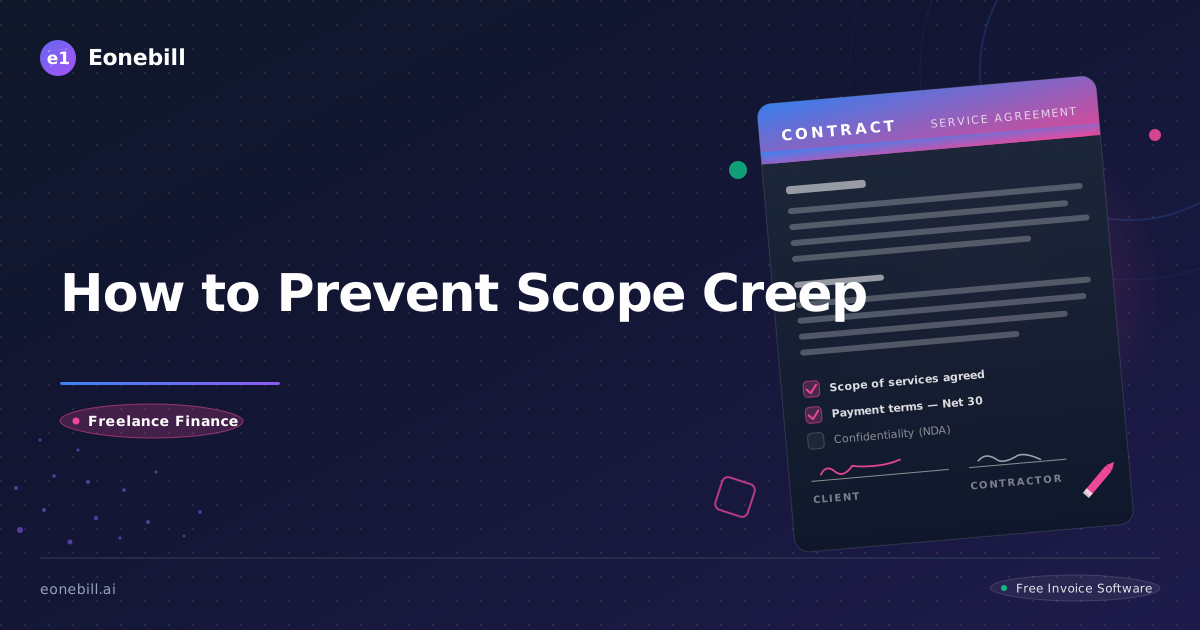
How to Prevent Scope Creep as a Freelancer
Last quarter, a Reddit user in r/freelance posted a thread that hit 66 upvotes: "Lost $2,300 to scope creep on a $5,000 project."
The story was depressingly familiar. Five pages turned into eight. One logo concept became three. The client wanted "just one more revision" on everything. By project end, he'd logged 47 hours he hadn't billed for.
Another thread, 36 upvotes: "Client keeps asking for more features after underpaying."
Same pattern. Client lowballed the initial quote. Got the freelancer locked in. Then kept tacking on requirements. The final invoice didn't cover a quarter of the work delivered.
This isn't a client problem. It's a systems problem. And it's entirely preventable.
What Scope Creep Actually Costs You
Let's do the math:
- You quote $3,000 for 30 hours at $100/hour
- Scope creep adds 10 unbilled hours
- Your effective rate drops to $75/hour
- You now need to take on additional work to hit your income target
- Burnout compounds from the excess labor
A 2025 Payoneer survey found that 53% of freelancers named scope creep as their biggest profitability challenge — ahead of client acquisition, pricing pressure, and taxes.
The average freelancer absorbs 8-12 hours of unpaid scope creep per project. At a $75/hour rate, that's $600-900 lost on every single job. Run five projects a quarter, and you're walking away with significantly less than you quoted — for the same amount of work.
Why Scope Creep Happens
1. Vague project definitions
"Build us a website that represents our brand" is an open invitation for unlimited additions. Every scope must specify: number of pages, number of concepts, number of revision rounds, what's included, and what's explicitly excluded. If it's not written down, it's not protected.
2. No Estimate sent before starting work
Jumping straight to work without a documented Estimate means there's no agreed-upon scope. If there's no defined scope, there's no "outside scope" — which means every addition is just "part of the project" in the client's mind.
3. No Change Order process defined in the contract
If the contract doesn't specify how additional work is priced and approved, the client assumes everything they think of along the way is included in the original price. The silence in your contract reads as "yes" to every request.
4. Reluctance to have uncomfortable conversations
Freelancers hate saying no to clients. This is human nature, and exploitative clients know it. A client who has learned that every request gets a yes — even without a Change Order — will keep requesting. The pattern is learned behavior, often reinforced inadvertently by freelancers who don't want to make waves.
The 4-Step System to Lock In Your Scope
Step 1: Send an Estimate — Before Any Work Begins
An Estimate is your first line of defense. It defines:
- Project scope — what's included, expressed as specific deliverables
- What's excluded — explicitly listed
- Price — fixed fee or rate-based with caps
- Timeline — milestones and delivery dates
- Revision rounds — how many are included in the price
❌ Don't write: "I will design a homepage"
✅ Write: "Deliverable: 3 homepage design concepts (desktop + mobile), 2 rounds of revisions per concept, final Figma files with annotated components. Excluded: copywriting, SEO implementation, hosting setup, additional page designs beyond the 3 concepts."
The more specific the Estimate, the harder it is for scope to creep unnoticed. "One small change" is ambiguous. "Adding a fourth homepage concept" is not.
Use our free Estimate template →
Step 2: Convert the Approved Estimate to a Contract — Immediately
Once the client approves your Estimate, convert it to a Contract the same day. Don't wait until "we're ready to start" or "we'll get to it next week."
The Contract is where scope becomes legally binding. It should include:
- All scope items from the Estimate (now locked in)
- A Change Order clause — "Any additions or modifications to the agreed scope require a written Change Order, signed by both parties, before additional work begins. Additional work will be billed at $[Rate] and invoiced separately."
- Late payment terms and what happens at 30/60/90 days
- Explicit ownership clause: "All deliverables remain the property of [Freelancer] until full payment is received"
With Eonebill, you can convert an approved Estimate to a Contract with one click. All scope items transfer automatically — no retyping, no accidentally dropping items from the original Estimate.
Browse our Contract templates →
Step 3: Define the Change Order Process in the Contract
Your contract should include explicit Change Order language. Here's the standard clause you should be using:
> "Any work requested outside the agreed scope (as defined in the attached Estimate, Exhibit A) will be subject to a Change Order — a written document outlining the additional work, associated cost, and timeline impact. No additional work will commence until the Change Order is signed by both parties. Change Orders for ongoing clients are typically invoiced at 50% upfront, balance on delivery. Verbal approvals of additional work are not binding — only written Change Orders carry contractual force."
This clause does two things:
- Creates friction for unnecessary additions — when clients see that a "quick favor" has a formal process and a price tag, they often decide it's not that urgent after all
- Gives you a professional framework to say yes — you can say "Absolutely, I'd love to help with that. Let me get a Change Order together" rather than just saying no
The Change Order clause doesn't make you difficult. It makes you professional.
Step 4: Send a Change Order Estimate for Every Additional Request
When a client asks for something outside the original scope, your response should be automatic:
Do not start the work.
Respond within 24 hours with a Change Order Estimate covering:
- What the additional work entails (specific, not vague)
- Estimated hours and cost
- Timeline impact
- Payment terms (typically 50% upfront, balance on delivery)
> "Absolutely — I can look at adding that. I'm putting together a Change Order for the additional scope now. The estimate for this addition is $[Amount], with 50% due before I begin. Would you like me to proceed?"
This process takes 15 minutes. It prevents 15 hours of unpaid work.
Sometimes clients will narrow the request when they see the price. Sometimes they'll accept the charge. Either way, you're paid fairly for the additional work.
And sometimes — more often than you'd think — the client decides the addition isn't worth paying for. Which means you just saved yourself hours of free labor by simply asking for compensation in writing.
The Eonebill Workflow: Estimate → Contract → Invoice → Change Order
Here's how the full Eonebill system handles scope management end-to-end:
- Create an Estimate — Define scope, deliverables, exclusions, and price. Send to the client for approval.
- Client approves — One click converts the Estimate to a Contract. All scope items transfer automatically. No retyping, no gaps.
- Project in progress — Work begins under the locked scope.
- Client requests additional feature — You don't start the work. Instead, you create a Change Order Estimate directly from the existing Contract.
- Client approves the Change Order — It converts to an Invoice for the additional amount. You begin the new work with a signed scope document.
- Milestone invoices — Original project invoices auto-send at each milestone. Change Order invoices go out separately, keeping scopes clean and auditable.
No scope goes undocumented. No addition goes unbilled. And every scope modification has a paper trail.
Try it free — lock in your scope today →
What If the Client Won't Pay for the Scope Addition?
What if a client agrees to the Change Order verbally, then refuses to pay the invoice?
With Eonebill, every Change Order requires a signature before work begins. That digital paper trail is your evidence. If they signed it, they owe it — and you have documentation to pursue payment.
If they never signed — and you did the work anyway — that's on you. The lesson: never work without a signed Change Order, no matter how friendly the client seems or how urgent the request is.
This is a hard line. Once you bend it, you've established that your signatures don't matter — and the scope creep will accelerate.
What to Do If Scope Creep Has Already Happened
If you're currently in a project that's bleeding scope:
- Audit the current state — What has been delivered vs. what was in the original Estimate?
- Send a scope summary — "Here's where we are vs. where we started. The additions below were not in the original scope and need to be addressed."
- Propose a Change Order retroactively — Not ideal, but better than continuing to absorb free work
- Negotiate a final scope meeting — Get explicit sign-off on what remains in scope and what is an additional charge
- Set a hard deadline — "If we don't finalize scope by Friday, the additional work moves to a Change Order" — give them a reason to decide
Don't be embarrassed to ask for what's fair. The client likely didn't realize they were asking for more than they'd paid for.
Scope Creep Prevention Checklist
Before you accept your next project, confirm you've addressed every item:
- [ ] Scope is defined as specific deliverables, not activities
- [ ] What's explicitly excluded is listed
- [ ] Revision rounds are numbered (e.g., "2 rounds of revisions included")
- [ ] Estimate is sent and client-approved before any work begins
- [ ] Approved Estimate converted to Contract immediately
- [ ] Contract includes Change Order clause
- [ ] Every scope addition triggers a new Change Order Estimate
- [ ] No work begins without a signed Change Order
- [ ] Payment milestones are tied to deliverables, not time
Lock in your scope with a professional estimate → Start Free Trial
Eonebill is the AI-powered invoice and proposal platform that turns Estimates into Contracts and keeps scope creep from eating your profits.
Create this in 30 seconds — free invoice with Eonebill, no sign-up required.
Create Free Invoice →Frequently Asked Questions
More Posts
Filing Taxes Late: Penalties, Extensions, and How to Catch Up (2026)
Missed the April deadline? Understand the 5 percent failure-to-file vs 0.5 percent failure-to-pay penalty difference, how Form 4868 extensions help, and the four-step protocol for catching up on years of unfiled returns.
Penalties for Not Filing a 1099: What Freelancers and Small Businesses Need to Know (2026)
Failing to file 1099 forms on time triggers escalating IRS penalties from 60 to 660 dollars per form. Learn the four-tier schedule, how to fix a missed filing, and when First-Time Penalty Abatement applies.

How to Write a Gentle Reminder Email (Templates + Examples)
Learn how to write a professional gentle reminder email that gets results. Includes 8 ready-to-use templates for invoices, meetings, deadlines, and more.
Newsletter
Join the community
Subscribe to our newsletter for the latest news and updates
Ready to streamline your freelance workflow?