How to Create an Invoice in 2026 — Complete Guide for Freelancers
Step-by-step guide to creating professional invoices. Free templates, what to include, common mistakes, and how AI can do it in 10 seconds.
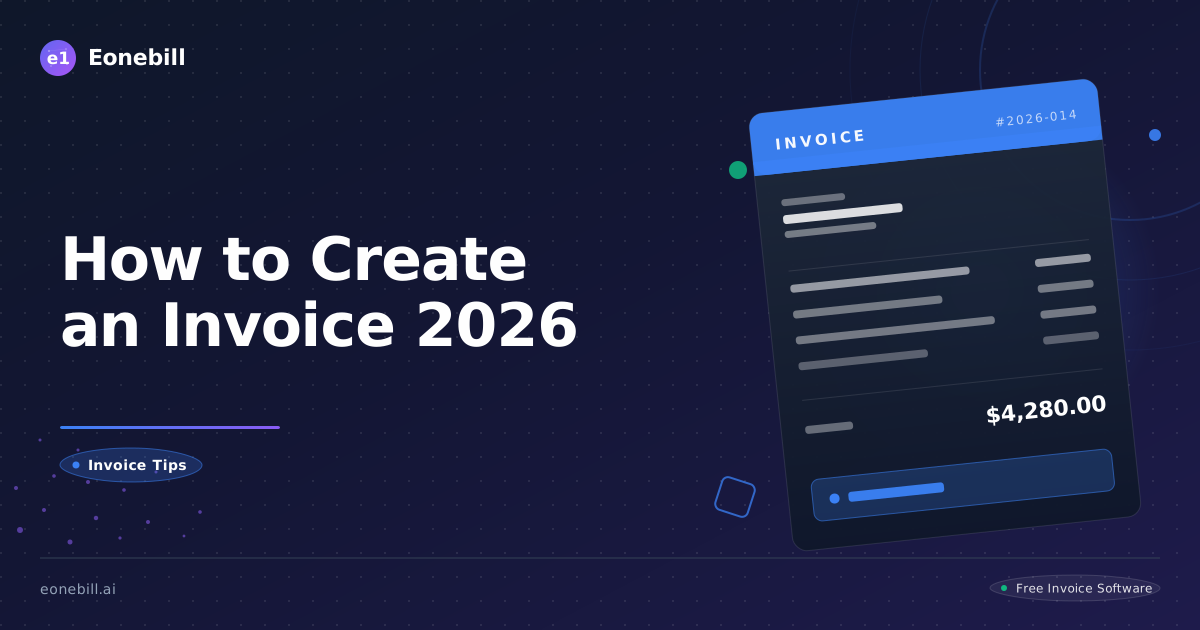
What Is an Invoice and Why Does It Matter?
An invoice is a formal, itemized document that a seller sends to a buyer to request payment for goods delivered or services rendered. Think of it as the official paper trail between you and your client — it records what was done, how much it costs, and when payment is due. For freelancers and small business owners in the United States, invoices are the backbone of getting paid consistently and on time.
Beyond simply asking for money, an invoice serves several critical functions. First, it establishes a legal record of the transaction. If a payment dispute ever arises, your invoice — along with a signed contract — is your primary piece of evidence. Second, invoices help you track your income. Every invoice you send and receive becomes part of your bookkeeping, making tax time far less painful. The IRS recommends that self-employed individuals keep detailed records of all income, and invoices are the clearest way to do that.
Third, a professional invoice signals credibility. Clients — especially businesses — expect to receive properly formatted invoices. If you send a rough estimate scrawled in an email or a poorly formatted Word document, it can undermine confidence in your professionalism, even if your actual work is excellent. A clean, detailed invoice tells clients that you run a real business and that you take your finances seriously.
For US-based freelancers and contractors, invoicing correctly also has tax implications. When you invoice a business client for $600 or more in a calendar year, that client is typically required to issue you a Form 1099-NEC. Your invoices serve as the supporting documentation for those earnings. Additionally, if you charge sales tax (which varies significantly by state and service type), the invoice is where that line item must appear.
Finally, invoices affect your cash flow. Late or missing payments are one of the top reasons small businesses struggle financially. A proper invoice, sent promptly with clear terms, sets expectations and gives you grounds to follow up professionally when payment is overdue. Understanding what an invoice is — and why it matters — is the first step to getting paid reliably.
What Every Invoice Must Include
Before you create your first invoice, you need to know what belongs on it. A missing field can delay payment, confuse your client, or even invalidate the document for accounting purposes. Here is a breakdown of every element a complete, professional US invoice should contain.
Your Business Information
At the top of the invoice, include your full legal name (or business name), your mailing address, phone number, and email address. If you operate as an LLC or corporation, use the exact registered name. Some freelancers also include their website.
Client's Information
Include the client's full name or company name, their billing address, and a contact email. If you are billing a large organization, it helps to add the name of your specific point of contact — this speeds up routing through their accounts payable department.
Invoice Number
Every invoice needs a unique identifier. Invoice numbers allow you to reference specific transactions quickly, both for your own records and when following up with clients. More on numbering best practices in the FAQ below.
Invoice Date
This is the date the invoice was created and sent. The invoice date is the anchor point for your payment terms.
Payment Due Date
Clearly state when payment is expected. Common terms include Net 15, Net 30, and Net 45, meaning payment is due 15, 30, or 45 days from the invoice date. You can also simply write an explicit date, such as "Due by May 1, 2026."
Itemized List of Services or Products
This is the heart of your invoice. List each service or product on its own line with a description, quantity, unit price, and line total. For services, you might bill by the hour, by the project, or by a deliverable. Be specific — vague descriptions like "consulting work" are more likely to be questioned than "Social media content creation for March 2026 campaign (20 posts)."
Subtotal, Taxes, and Total
After your line items, show the subtotal (before any taxes or fees). If you are required to collect sales tax, list it as a separate line item with the applicable rate. Then show the grand total due.
Payment Methods
Tell your client how they can pay you. Options might include bank transfer (ACH), check, PayPal, Venmo for Business, credit card, or a payment link. Including this information removes friction from the payment process.
Notes or Terms
This optional section can include late payment fees (e.g., "A 1.5% monthly fee applies to invoices more than 30 days overdue"), a thank-you message, or any project-specific notes the client needs.
If you want a quick way to generate a properly formatted invoice with all these fields pre-built, visit our free invoice generator — it walks you through each field and produces a download-ready invoice in minutes.
How to Create an Invoice Step by Step
Creating an invoice from scratch might seem intimidating the first time, but once you understand the process, it becomes second nature. Below is a detailed, step-by-step walkthrough for creating a professional invoice — whether you are a freelancer billing your first client, a consultant closing out a project, or a small business owner managing dozens of accounts.
Step 1: Choose Your Invoicing Method
Before you write a single line item, decide how you will create your invoice. You have three main options: a word processor or spreadsheet template, a PDF tool, or dedicated invoicing software. Each has trade-offs.
Word processor templates (Microsoft Word, Google Docs) are free and familiar but require you to manage your own numbering, track payments manually, and format everything yourself. Spreadsheet templates (Excel, Google Sheets) are better for calculations but still require significant manual effort.
PDF invoicing tools are a step up — they let you fill in a structured form and export a professional-looking document. However, you still manage files manually.
Dedicated invoicing platforms are the most efficient choice for anyone invoicing more than a handful of clients. Platforms like Eonebill automatically number your invoices sequentially, calculate totals and taxes, store your client information, and let you send invoices directly from the platform — all while keeping a searchable record of every transaction.
For this guide, we will walk through the universal steps that apply regardless of which method you choose.
Step 2: Gather Your Business and Client Information
Open your invoicing tool — whether that is a template or software — and start with the header. You will need:
- Your name or business name
- Your address
- Your phone number and email
- Your client's name or company name
- Your client's billing address and contact email
If you are using software, this information is often stored from previous invoices and auto-populated. If you are using a template, create a "master" version with your information pre-filled so you do not have to re-enter it every time.
Step 3: Assign an Invoice Number
Every invoice needs a unique invoice number. Start with a simple sequential system: INV-001, INV-002, INV-003, and so on. If you work with multiple clients, you might prefix the number with a client code: SMITH-001, JONES-001. Whatever system you choose, be consistent and never reuse a number. Your invoice number is how you and your client will reference this specific transaction if questions arise later.
Step 4: Set the Invoice Date and Due Date
Add the current date as your invoice date. Then determine your payment terms. Consider the nature of the project and your relationship with the client. For new clients or smaller projects, Net 15 (payment due within 15 days) is reasonable. For established clients with strong payment histories and larger projects, Net 30 is the industry standard. Some industries use Net 45 or Net 60, but these terms can create cash flow pressure for small businesses and freelancers — negotiate terms that work for you.
Write the due date explicitly. Do not rely on the client to calculate it from the invoice date. State clearly: "Payment due: May 3, 2026."
Step 5: List Your Services or Products in Detail
This step requires the most attention. For each deliverable, service, or product, create a line item that includes:
- Description: Be specific. Instead of "Web design," write "Responsive homepage redesign including wireframes, 2 rounds of revisions, and final Figma handoff."
- Quantity: How many units, hours, or items?
- Rate: What is the price per unit, per hour, or per item?
- Line Total: Quantity multiplied by rate.
If you are billing for a flat-rate project, you may have only one line item. That is perfectly fine. If you tracked billable hours, list each type of work as a separate line (e.g., "Research: 4 hours @ $75/hr = $300" and "Writing: 8 hours @ $75/hr = $600").
Clear, detailed descriptions reduce the likelihood of disputes and speed up the client's internal approval process. Accounts payable departments at larger companies often require detailed descriptions before they can cut a check.
Step 6: Add Up the Subtotal, Apply Taxes if Required, and Show the Total
After all your line items, show the subtotal. Then, if you are required to collect sales tax — this depends on your state, the type of service or product, and the client's location — list it as a separate line item with the percentage. For example: "Sales Tax (8.25%): $49.50."
Finally, show the grand total in a prominent font. Make it impossible to miss.
If you offer a discount for early payment or for a long-term client relationship, apply it here as a line item (e.g., "Loyal client discount: -$50").
Step 7: Add Your Accepted Payment Methods
List every payment option you accept. The more options you offer, the fewer excuses clients have for delayed payment. Common US options include:
- ACH bank transfer: Include your bank name, routing number, and account number (or use a secure payment link)
- Check: Include your mailing address
- PayPal, Venmo for Business, or Zelle: Include your username or email
- Credit card: If your invoicing software supports it, include a payment link
Never omit this section. Clients who have to email you to ask how to pay are clients who will pay later than they should.
Step 8: Include a Notes Section if Needed
Use the notes section for late payment policies, a brief thank-you, project-specific instructions, or any other relevant communication. Keep it professional and concise. A good late fee policy might read: "Invoices unpaid after 30 days are subject to a 1.5% monthly late fee."
Step 9: Review for Accuracy
Before sending, review every line:
- Is the client's name spelled correctly?
- Are the dates right?
- Do the math and totals add up?
- Is the invoice number unique and sequential?
- Have you included payment instructions?
A simple error — a wrong total, a misspelled name, or a missing payment method — can delay payment by days or weeks while the client reaches out for corrections.
Step 10: Send the Invoice Promptly
Send your invoice as soon as the work is completed or at the agreed billing milestone. Delayed invoices signal a relaxed attitude about payment, which often leads to delayed payment. Send via email with the invoice attached as a PDF. Write a professional subject line: "Invoice #INV-042 — [Your Name/Business] — Due [Date]." In the body of the email, briefly summarize what the invoice covers and confirm the payment due date.
If your invoicing platform allows it, enable read receipts or delivery confirmations so you know the invoice was received.
Invoice Formats: Paper, PDF, and Online Tools
Invoices can take several forms, and the format you choose affects how professional you appear and how quickly you get paid.
Paper invoices were once the standard, but they are now largely obsolete for most freelancers and small businesses. They require physical delivery, are easy to lose, and cannot be tracked digitally. The only scenario where paper invoices still make sense is when working with certain government entities or very traditional clients who specifically require them.
PDF invoices are the current baseline for professionalism. A PDF preserves formatting across all devices, cannot be accidentally edited by the client, and is easy to attach to an email. You can create PDF invoices using Word or Google Docs templates, Adobe Acrobat, or by downloading from an online generator. The limitation is that PDFs are static — you cannot track whether the client opened them or make updates without creating a new file.
Online invoicing platforms represent the modern standard. These tools generate professionally formatted invoices automatically, send them directly to clients, track open and payment status, send automatic reminders, and maintain a complete transaction history. For any freelancer or small business sending more than a few invoices per month, an online platform saves significant time and reduces the risk of errors.
When evaluating online tools, look for features like: automatic sequential numbering, client management, payment gateway integration, recurring invoice support, and export options. Platforms like Eonebill are designed specifically for US freelancers and small businesses, meaning they handle things like USD formatting, state tax settings, and 1099 documentation needs out of the box.
For a quick, no-account-required option, the free invoice generator lets you build and download a PDF invoice in under two minutes.
Common Invoice Mistakes to Avoid
Even experienced freelancers make invoicing mistakes that delay payment or create confusion. Here are the most common errors and how to avoid them.
1. Vague or missing descriptions
"Consulting services" or "Design work" tells your client almost nothing. Specific descriptions like "Brand identity package: logo design, color palette, typography guide, and style guide document" are clear, defensible, and far less likely to be questioned.
2. No invoice number
Unnumbered invoices are impossible to reference and suggest amateurism. Always assign a unique invoice number before sending.
3. Wrong or missing due date
Leaving off the due date — or writing only "Net 30" without specifying the actual date — gives clients an easy excuse to delay. Always write the explicit due date.
4. Sending the invoice late
Every day you wait after completing work is a day added to when you will be paid. Invoice on the day you complete the work, or on the scheduled billing date for ongoing retainers.
5. Failing to follow up
Many unpaid invoices are simply the result of an invoice getting lost in a busy email inbox. Set a reminder to follow up three to five days before the due date with a friendly reminder, and again on the due date if payment has not been received.
6. Not specifying accepted payment methods
If a client does not know how to pay you, they cannot pay you. Always include your payment options.
7. Math errors
Manual invoicing in spreadsheets or word processors is prone to arithmetic mistakes. Double-check every calculation, or use invoicing software that handles math automatically.
8. Missing contact information
Clients need to know who to contact with questions. Always include your email and phone number.
9. Forgetting to include taxes
If your state requires you to collect sales tax on your services or products, leaving it off the invoice is not just unprofessional — it can create legal and accounting complications.
10. Using inconsistent formats
Sending a different-looking invoice every time makes your business appear disorganized. Use a consistent template or platform so every invoice looks the same.
How to Get Paid Faster After Sending Your Invoice
Sending a great invoice is half the battle. The other half is ensuring that invoice actually gets paid — and paid on time. These strategies will help you accelerate your collections and maintain healthy cash flow.
Offer early payment incentives. A small discount for paying ahead of schedule can be very effective. A "2/10 Net 30" term means the client gets a 2% discount if they pay within 10 days instead of 30. For clients with tight payment cycles, this can make a real difference.
Charge late fees — and enforce them. Stating a late fee on your invoice is only useful if you actually apply it. Letting late fees slide trains clients to pay late. A 1.5% monthly fee on overdue invoices is standard and legally enforceable in most US states, provided it is stated clearly on the invoice.
Send invoices at the right time. Research suggests that invoices sent on Tuesday or Wednesday mornings have higher and faster payment rates. Invoices sent on Fridays or late in the day tend to get buried. Timing your send strategically can make a real difference.
Follow up systematically. Build a follow-up schedule: a friendly reminder three to five days before the due date, a polite but direct message on the due date if not paid, and a firmer follow-up five to seven days after the due date. Keep your tone professional throughout — most late payments are not intentional.
Accept multiple payment methods. Every barrier between the client and payment costs you time. If you only accept checks and a client prefers ACH, you will wait longer. Accepting credit cards, ACH, PayPal, and digital wallets removes those barriers.
Send invoices digitally with read receipts. When you know a client has opened your invoice, you can time your follow-ups precisely. Many invoicing platforms provide open notifications.
Build a strong upfront agreement. The best collection strategy starts before the project does. Use a written contract that specifies your payment terms, accepted payment methods, late fee policy, and what happens in the event of non-payment. When clients sign a contract with clear terms, they take the invoice more seriously.
Request partial payment upfront. For larger projects, a 25% to 50% deposit at the start of the project reduces your risk and confirms the client's commitment. This is standard practice in many industries, including design, construction, consulting, and software development.
Keep your invoicing organized. If you lose track of which invoices are paid, overdue, or outstanding, you cannot follow up effectively. Use invoicing software — or at minimum a simple spreadsheet — to monitor the status of every invoice you send.
Getting paid on time is not just about the invoice itself — it is about building systems and relationships that make prompt payment the norm rather than the exception. Start with a great invoice, back it up with clear terms, and follow up consistently.
Create this in 30 seconds — free invoice with Eonebill, no sign-up required.
Create Free Invoice →Frequently Asked Questions
More Posts
Filing Taxes Late: Penalties, Extensions, and How to Catch Up (2026)
Missed the April deadline? Understand the 5 percent failure-to-file vs 0.5 percent failure-to-pay penalty difference, how Form 4868 extensions help, and the four-step protocol for catching up on years of unfiled returns.
Penalties for Not Filing a 1099: What Freelancers and Small Businesses Need to Know (2026)
Failing to file 1099 forms on time triggers escalating IRS penalties from 60 to 660 dollars per form. Learn the four-tier schedule, how to fix a missed filing, and when First-Time Penalty Abatement applies.

How to Write a Gentle Reminder Email (Templates + Examples)
Learn how to write a professional gentle reminder email that gets results. Includes 8 ready-to-use templates for invoices, meetings, deadlines, and more.
Newsletter
Join the community
Subscribe to our newsletter for the latest news and updates