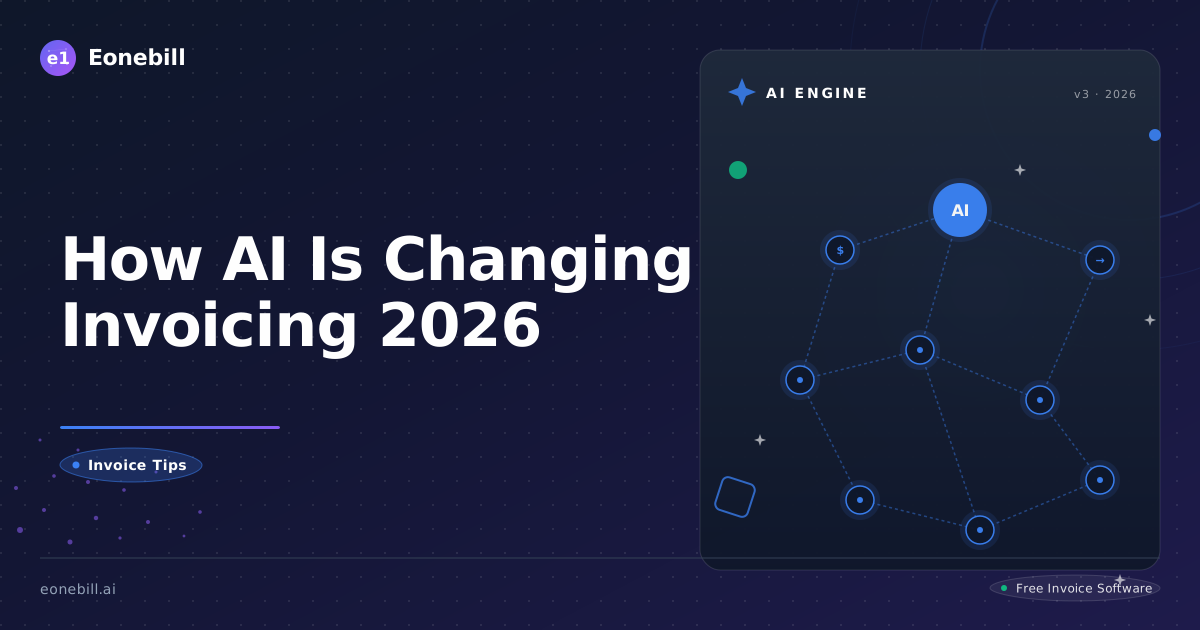
How AI Is Changing Freelance Invoicing in 2026
Freelancers spend 5+ hours a week on invoicing admin. AI-native tools are about to obliterate that number. Here's what that actually looks like.
You know the drill. It's Friday afternoon. You should be billing clients, not wrestling with a spreadsheet to figure out if you billed them for the last round of revisions.
But here you are — copying line items from a Google Doc into an invoice template, manually calculating tax, double-checking you didn't forget to add the rush fee, and wondering why you're running a business instead of doing the work you actually get paid for.
That's the reality for most freelancers. And it's exactly what AI is about to obliterate.
The Problem Nobody Talks About
Freelancers obsess over acquiring clients, negotiating rates, and doing great work. But invoicing? That's where ambition goes to die.
The average freelancer spends 5+ hours per week on invoicing and billing admin. That's nearly one full workday. Every week. On paperwork.
Worse, it's not just time — it's cognitive load. The mental overhead of remembering what you did, whether you documented it, and whether you're undercharging because you forgot a deliverable. Studies on freelancer burnout consistently cite "administrative overhead" as a top-three stressor, right alongside inconsistent income and difficult clients.
The tools haven't helped much. Most invoicing software is just a digital version of the same broken process: you fill in the blanks, we format it nicely.
That's not automation. That's digitization.
What AI Invoicing Actually Means
Here's the distinction that matters: traditional invoicing tools automate tasks. AI invoicing tools automate decisions.
When people say "AI invoicing," a lot of them mean autocomplete or smart templates. That's not AI invoicing. That's a better checkbox.
Real AI invoicing works like this:
> "Billed Acme Corp for brand identity project — 3 logo concepts, 2 revision rounds, delivered March 28. Rush fee applied. Net 30 terms."
That's it. That's the input. The AI generates a complete, professional invoice — line items, descriptions, tax calculations, payment terms, your banking details, the works.
You're not filling in a form. You're having a conversation with a system that understands invoicing, billing law, and your business context.
The Evolution: Three Generations of Invoicing
Generation 1: Manual (Excel / Word / Paper)
- Hours spent per invoice: 30–60 minutes
- Error rate: High (math mistakes, missing fields, inconsistent formatting)
- Cash flow visibility: None
- You do everything. Every. Thing.
Generation 2: Digital (Wave, FreshBooks, QuickBooks Self-Employed)
- Hours spent per invoice: 10–15 minutes
- Error rate: Medium (templates help, but you still input everything)
- Cash flow visibility: Basic
- Better, but still input-driven. You tell the software what to do.
Generation 3: AI-Native (Eonebill and its successors)
- Hours spent per invoice: 30 seconds (you describe the work, it builds the invoice)
- Error rate: Low (AI validates, calculates, and formats)
- Cash flow visibility: Predictive
- You're supervising, not typing. The software understands what you mean.
This isn't incremental improvement. It's a category shift. Generation 3 tools don't just store your data — they act on it.
5 Things AI Can Do That Traditional Invoicing Can't
1. Generate a Complete Invoice from One Sentence
Traditional tools need structured input: client name, line item, quantity, rate, tax rate, payment terms. You build the invoice block by block.
AI-native tools parse intent. You write: "Brand design for Drift Coffee, $2,200, includes logo and style guide, rush delivery extra $300." The AI outputs a fully formatted invoice, ready to send.
This isn't a template. It's document generation from comprehension.
2. Auto-Extract Expenses from Receipt Photos
Snap a photo of a receipt. AI extracts the vendor, amount, category, and date — and files it in the right place in your expense log. No manual entry. No "I'll do it later" (and then never doing it).
For freelancers with messy expense records — which is most of us — this is a genuine sanity saver.
3. Score Invoice Quality to Improve Payment Rates
Here's one that traditional tools will never touch: AI analyzes your invoices against payment success data and gives you a quality score before you send.
It flags vague line items ("consulting work"), unreasonable payment terms (Net 15 for a new client is aggressive), missing payment instructions, and even suboptimal send timing. You get a score and specific fix suggestions.
Send better invoices. Get paid faster. That's not a slogan — it's a measurable output.
4. Predict Cash Flow Based on Invoice Patterns
Traditional tools show you what you've earned. AI shows you what you're going to earn.
By analyzing your invoice history — average payment times by client, seasonal patterns, recurring vs. one-time revenue — AI can forecast your cash flow 30, 60, and 90 days out. For freelancers who live on irregular income, this isn't a nice-to-have. It's survival planning.
5. Chain Documents: Proposal → Contract → Invoice in One Click
This is the one that feels like magic until you see it.
You write a project proposal. The client approves it. Instead of starting from scratch to build a contract and then an invoice, the AI chains them: the scope from the proposal becomes the contract scope, the approved contract terms become the invoice line items, and the invoice inherits the client's billing details.
One approval. Three documents. Zero retyping.
Traditional tools can't do this because they don't understand the relationship between these documents. AI does.
The Future: AI Agents That Run Your Entire Billing Cycle
Here's where this is heading — and it's not science fiction.
The next generation of AI invoicing tools are building toward autonomous billing agents. Not just generating invoices, but managing the full cycle:
- Generate invoices automatically when project milestones are hit
- Send invoices at optimal times (AI determines when clients are most likely to open and pay)
- Follow up on late payments with escalating, professionally-written reminders — no human involvement
- Categorize expenses in real-time as receipts hit your email or camera
- Reconcile payments automatically against open invoices
- Forecast cash flow and flag upcoming dry spells before they surprise you
The agent doesn't ask for permission on every step. It acts, and you audit. That's the inversion: humans supervise, AI operates.
Stripe and Pilot have already shown glimpses of this with accounts payable and bookkeeping agents. Invoicing is next — and for freelancers, it's the highest-leverage place to start.
Stop Spending Fridays on Paperwork
If you're still spending 5+ hours a week on invoicing admin, you're not running a freelance business. You're running an administrative job that happens to pay you.
AI invoicing tools — the real ones, not the ones with "AI" in the marketing copy — will cut that to minutes. Not by making you faster at the old process. By eliminating the process entirely.
Try AI invoicing free — describe your work, get an invoice in seconds.
Grace is the voice behind Eonebill's content — focused on making freelance finance less painful, one article at a time.
Ready to manage invoices, contracts & proposals in one place? Try Eonebill free — no credit card required.
Start Free →Frequently Asked Questions
More Posts
Filing Taxes Late: Penalties, Extensions, and How to Catch Up (2026)
Missed the April deadline? Understand the 5 percent failure-to-file vs 0.5 percent failure-to-pay penalty difference, how Form 4868 extensions help, and the four-step protocol for catching up on years of unfiled returns.
Penalties for Not Filing a 1099: What Freelancers and Small Businesses Need to Know (2026)
Failing to file 1099 forms on time triggers escalating IRS penalties from 60 to 660 dollars per form. Learn the four-tier schedule, how to fix a missed filing, and when First-Time Penalty Abatement applies.
How to Write a Gentle Reminder Email (Templates + Examples)
Learn how to write a professional gentle reminder email that gets results. Includes 8 ready-to-use templates for invoices, meetings, deadlines, and more.
Newsletter
Join the community
Subscribe to our newsletter for the latest news and updates