Estimated Tax Payments: Complete Guide 2026
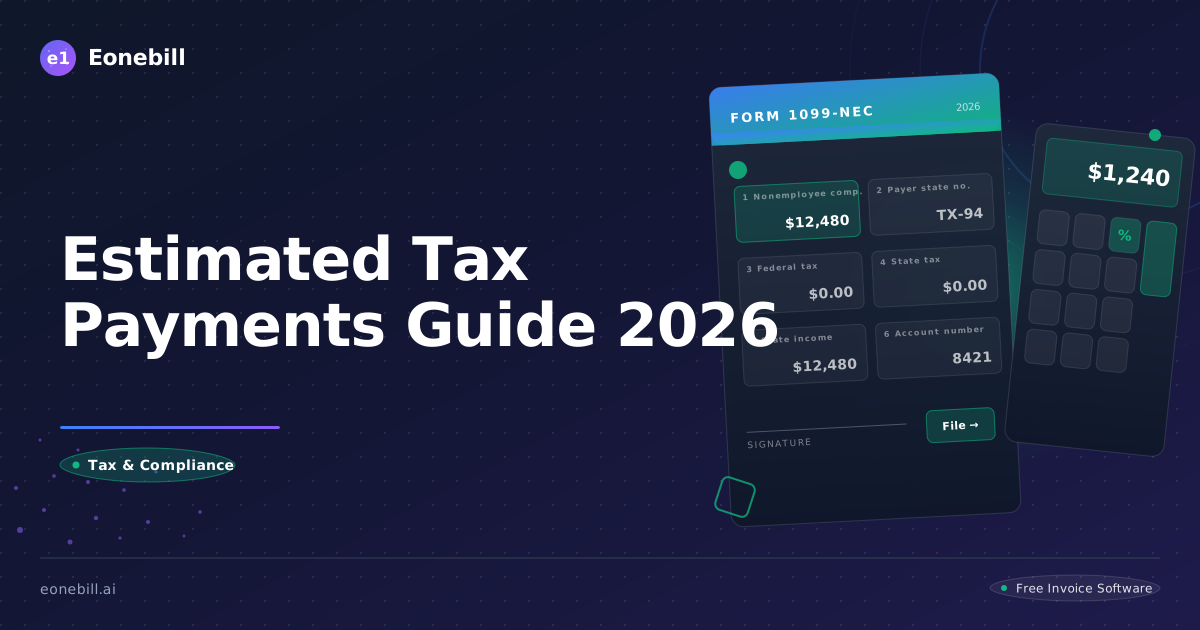
Estimated Tax Payments: Complete Guide 2026
The US tax system runs on a pay-as-you-go model. W-2 employees pay throughout the year via paycheck withholding. Self-employed freelancers, contractors, and small business owners pay throughout the year via quarterly estimated tax payments. Skip the quarterly schedule and you'll face underpayment penalties even if you ultimately settle up in April. Worse, you'll be staring at a single huge tax bill in spring that few freelancers can absorb without serious cash-flow pain.
This guide explains exactly how quarterly estimated taxes work in 2026, gives you the four due dates, walks through three methods for calculating how much to pay, and offers practical tips for staying on top of the schedule. Read on for everything you need to be a confident, timely taxpayer.
Why Estimated Tax Payments Exist
The US tax system requires that you pay your federal tax liability throughout the year as you earn the income, not in a lump sum the following April. For employees, this happens automatically — your employer withholds federal income tax, Social Security, and Medicare from each paycheck. The withholding is reconciled against your actual tax liability when you file Form 1040.
For freelancers, contractors, and small business owners, no employer is withholding on your behalf. Instead, you make estimated tax payments four times a year using Form 1040-ES. These payments cover federal income tax AND self-employment tax (the 15.3% SS and Medicare combo).
The IRS requires estimated tax payments if you expect to owe $1,000 or more in federal tax for the year after subtracting withholding and refundable credits. Most full-time freelancers cross this threshold easily — a freelancer netting $30,000 will owe roughly $7,500-$9,000 in combined federal income tax and SE tax. Even side-hustlers with modest freelance income can hit the threshold if they have minimal W-2 withholding.
If you don't make estimated payments and you owe $1,000 or more at filing, the IRS charges an underpayment penalty calculated like interest. The current rate is around 8% APR (it adjusts quarterly based on the federal short-term rate). On a $10,000 underpayment, that's $800 of avoidable cost.
The Four Quarterly Due Dates
Mark these dates in your calendar with a recurring annual reminder. For tax year 2026, the quarterly estimated tax payment due dates are: April 15, 2026 (for income earned January 1 through March 31), June 15, 2026 (for income earned April 1 through May 31), September 15, 2026 (for income earned June 1 through August 31), and January 15, 2027 (for income earned September 1 through December 31).
Notice that the "quarters" are not evenly spaced. Q1 is three months, Q2 is two months, Q3 is three months, Q4 is four months. This is a quirk of the historical tax calendar — don't fight it, just memorize the dates.
If a due date falls on a weekend or federal holiday, the deadline slides to the next business day. The IRS posts confirmed dates on IRS.gov each tax year. Mail-in payments must be postmarked by the due date; electronic payments must be initiated by 11:59 PM Eastern time on the due date.
You can pay online through IRS Direct Pay (free, instant, debits your checking account), EFTPS (free, requires advance enrollment), credit or debit card (small processing fee — currently around 1.85-3% depending on the processor), or mail a paper check with Form 1040-ES voucher. Direct Pay is the simplest for most freelancers.
Missing a due date by even one day triggers the underpayment penalty for that quarter, even if you catch up later in the year. Set calendar reminders one week before each due date so you have time to calculate and pay.
Three Methods to Calculate Your Quarterly Payment
There are three reasonable ways to estimate your quarterly tax payments. Pick the one that fits your situation.
Method 1 — Safe Harbor (the easiest). The IRS offers a "safe harbor" rule that protects you from underpayment penalties as long as you pay at least the smaller of: (a) 90% of your current-year total tax liability, or (b) 100% of your prior-year total tax liability (110% if your prior-year AGI was above $150,000, or $75,000 if married filing separately). For most freelancers with stable or growing income, simply paying 25% of last year's total federal tax liability each quarter is the safe harbor approach. If your 2025 total federal tax was $20,000, pay $5,000 each quarter in 2026 and you're penalty-proof regardless of what your 2026 income actually is.
Method 2 — Current Year Projection. Estimate your 2026 net SE earnings, apply the SE tax calculation, add federal income tax based on your bracket, and divide by four. This is more accurate than safe harbor if your income is growing fast (safe harbor underpays) or shrinking fast (safe harbor overpays). Update the projection each quarter based on actual results.
Method 3 — Annualized Income Installment Method. This is the most accurate but most complex. You recalculate each quarter based on the actual income you've earned year-to-date. It's especially useful if your income is lumpy — for example, you got a $50,000 contract in Q3 and otherwise earn $3,000-$5,000 a month. Without annualization, the safe harbor formula assumes the income was evenly distributed across the year, which can overpay your early quarters. The annualization is computed on Form 2210, Schedule AI when you file your return.
Most freelancers use Method 1 or Method 2. Method 3 is worth the trouble only if your income is genuinely uneven or you've had a major income change mid-year.
A Worked Example
Let's say in 2025 you netted $50,000 from freelancing (Schedule C net profit) and your total federal tax liability (federal income tax + SE tax) was $13,000. You also expect 2026 to be similar.
Using the safe harbor method, divide $13,000 by 4 = $3,250 per quarter. Pay $3,250 on April 15, June 15, September 15, and January 15. Even if your 2026 income is much higher, the safe harbor protects you from underpayment penalty. You'll still owe a balance in April 2027, but no penalty.
Using the current-year projection method, let's say you forecast $55,000 of net SE earnings for 2026. SE tax: $55,000 x 0.9235 x 0.153 ≈ $7,772. Federal income tax (assume 22% bracket after standard deduction and half-SE deduction): approximately $5,500. Total: $13,272. Divided by 4 = $3,318 per quarter.
Using the annualized method, after Q1 you've earned $14,000 from January-March. Annualize: $14,000 x 4 = $56,000. Calculate full-year tax on $56,000 (about $13,500), then take 25% of that for Q1: $3,375.
All three methods land in roughly the same range, which is the point — for stable income, they converge. Pick the one that matches your tolerance for complexity.
How to Pay Online
The fastest, easiest, and free option is IRS Direct Pay at IRS.gov/directpay. Here's the step-by-step.
Go to IRS.gov/directpay. Click "Make a Payment." Select "Estimated Tax" as the reason for payment and "1040ES" as the apply-to form. Select the tax year (2026). Verify your identity — the system will ask for your filing status and information from a prior-year return (typically AGI from two years ago) to authenticate you. Enter your bank routing number and account number for ACH debit. Confirm the payment amount and date. Submit.
You'll receive a confirmation number immediately and an email receipt. Save both. The payment debits your account in one to three business days. Keep all confirmation numbers in a tax folder so you can reconcile against your Form 1040 the following April.
EFTPS (Electronic Federal Tax Payment System) is another free option, but it requires enrollment in advance — the IRS mails you a PIN that can take 5-7 business days to arrive. Once enrolled, EFTPS supports scheduling payments months in advance and works well for freelancers who want to set up the full year's quarterly payments at once.
If you must pay by credit card, three IRS-approved processors handle the transaction for a fee of roughly 1.85-1.98% (debit card fees are flat, around $2.50). The fees can be worthwhile if your credit card rewards exceed the fee, but most freelancers find Direct Pay cheaper.
Avoiding Penalties and Staying on Schedule
The simplest way to avoid underpayment penalties is to follow the safe harbor rule and set up automatic quarterly transfers. Use the prior-year total federal tax divided by four (or 110% of that for high earners). Set calendar reminders one week before each due date. Use IRS Direct Pay. Save confirmation numbers.
A related habit: maintain a tax-savings sub-account at your bank. Every time a client invoice clears, move 25-30% of the gross to the tax account. This way, when April 15 / June 15 / September 15 / January 15 rolls around, the money is already there. You're not scrambling to come up with $3,000 from current cash flow.
Clean invoicing is the foundation of this whole system. The free invoice generator at /free-tools/invoice-generator helps you produce professional invoices in minutes. For more automation — including running totals of YTD income, projected tax liability, and quarterly due-date reminders — Eonebill.ai pulls it all together in one dashboard. See /pricing for plan details.
If you do miss a quarter, don't panic — just make the payment as soon as you can. The penalty is calculated on a daily basis, so a payment that's two days late costs less than one that's two weeks late. And remember: the penalty is interest-based, not a flat fine. Catch up as quickly as possible to minimize the damage.
State estimated taxes are a separate matter. Each state with an income tax has its own quarterly payment schedule, usually aligned with the federal dates but not always. California, for example, has different percentages due each quarter. Check your state's revenue department website for specifics.
Bottom line: quarterly estimated tax payments are a freelancer's most important calendar event after invoicing. Get them right and your tax life becomes a smooth, predictable rhythm rather than an April crisis. Mark the dates, save the money, and pay on time.
For freelancers with truly variable income, the safe harbor rule based on prior-year tax is your friend. Even if your current-year income is wildly different (much higher or much lower), paying 100% of last year's total federal tax in even quarterly installments (110% if prior-year AGI exceeded $150,000) protects you from underpayment penalty. You may end up overpaying or underpaying significantly when you file in April, but no penalty applies. This is the safest path for income that's impossible to project. Another tip: if you have a W-2 day job alongside freelancing, you can adjust your W-4 withholding to cover your freelance tax liability. The W-2 withholding is treated as evenly distributed across the year by default, which means you can avoid quarterly estimated payments entirely by adding extra withholding through your day job. This is the simplest approach for side-hustlers and freelancers with significant W-2 income. State estimated taxes are a separate matter and follow your state's rules — most align with federal due dates but check your state's revenue department website. Don't forget local taxes if you live in a city or county that imposes them (NYC, Philadelphia, San Francisco, and others have local income taxes that require their own quarterly payments).
A note on income that's exempt from estimated taxes: certain types of one-time income may not require estimated payments if you're otherwise paid up. If you sell a business asset and have a large one-time capital gain, you may be required to make an estimated payment for the quarter in which the gain occurred (the annualized income installment method handles this elegantly). For ordinary freelance income, the standard quarterly rhythm applies. If you take time off and have a quarter with no freelance income, you still have to make the safe-harbor payment unless you've recalculated downward using the annualized method. Most freelancers find that paying the safe-harbor amount even in lean quarters is easier than recalculating each quarter.
Ready to manage invoices, contracts & proposals in one place? Try Eonebill free — no credit card required.
Start Free →Frequently Asked Questions
More Posts
Filing Taxes Late: Penalties, Extensions, and How to Catch Up (2026)
Missed the April deadline? Understand the 5 percent failure-to-file vs 0.5 percent failure-to-pay penalty difference, how Form 4868 extensions help, and the four-step protocol for catching up on years of unfiled returns.
Penalties for Not Filing a 1099: What Freelancers and Small Businesses Need to Know (2026)
Failing to file 1099 forms on time triggers escalating IRS penalties from 60 to 660 dollars per form. Learn the four-tier schedule, how to fix a missed filing, and when First-Time Penalty Abatement applies.

How to Write a Gentle Reminder Email (Templates + Examples)
Learn how to write a professional gentle reminder email that gets results. Includes 8 ready-to-use templates for invoices, meetings, deadlines, and more.
Newsletter
Join the community
Subscribe to our newsletter for the latest news and updates