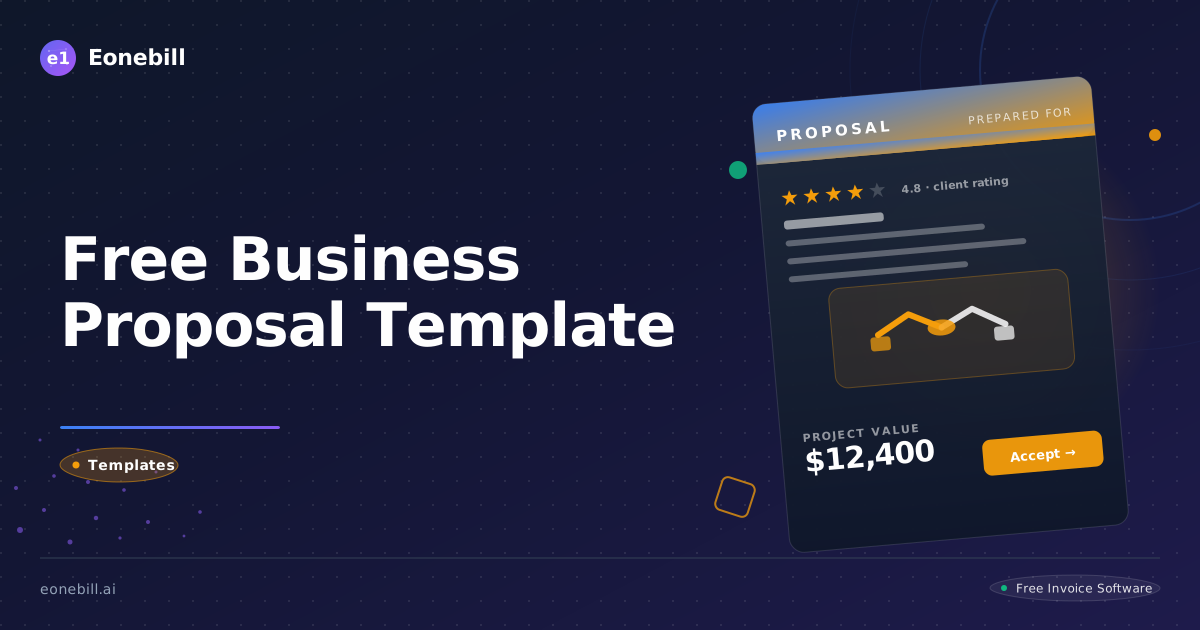
Free Business Proposal Template — Win More Clients With Professional Proposals
Free Business Proposal Template — Win More Clients With Professional Proposals
Most freelancers lose clients not because of price, but because of a weak proposal. A potential client who receives a vague, disorganized document concludes — fairly or not — that your work will be similarly vague and disorganized. A professional business proposal template demonstrates expertise before you have done a single hour of work. It tells the client that you understand their problem, that you have a clear plan to solve it, and that you have done this kind of work before. Done well, a proposal turns "I'll think about it" into a signed agreement — often within 48 hours.
This guide is for freelancers, independent consultants, agency owners, and any service-based business owner who sends proposals to win new client engagements. By the end, you will know exactly what a winning proposal contains, how to structure one in five repeatable steps, and which mistakes are costing you clients you could otherwise be closing.
What Is a Business Proposal Template?
A business proposal is a document that pitches your services, outlines your approach, and specifies pricing to a potential client. Its purpose is persuasion: you are making the case that you are the right person or team for the job, at the right price, with a clear plan to deliver results. Unlike a quote — which simply lists prices — or a contract — which is a legal agreement that comes after a client says yes — a proposal is a persuasion document. It lives in the space between first conversation and signed agreement, and its job is to move the client decisively from one to the other. For a precise definition of how proposals differ from related documents, see the proposal glossary entry.
Proposals come in two broad types. A solicited proposal is one the client specifically requested — they sent out a request for proposals (RFP), or they asked you directly during a sales conversation to send over a proposal. An unsolicited proposal is one you initiate without a formal request, typically when you have identified a clear problem a prospect has and you want to demonstrate your solution proactively. Solicited proposals are more common in most service businesses; unsolicited proposals require extra persuasive work because the client has not yet acknowledged the problem.
The contexts where proposals matter most include agency creative pitches, consulting and advisory engagements, web development or software projects, marketing retainer proposals, event management bids, architecture and interior design scopes, and any service business where multiple vendors might compete for the same client. In all of these cases, the proposal is often the first substantial document the client sees from you — and it shapes every perception they carry into the relationship if they say yes.
What Should a Business Proposal Template Include?
A strong proposal covers eight distinct areas. Each one serves a specific function in building the client's confidence and guiding them toward a decision.
1. Executive Summary / Problem Statement. Open with the client's problem, not your biography. The client wants to know immediately that you understand their situation. A strong executive summary restates the core challenge in the client's own language, demonstrates that you have listened carefully, and briefly signals your solution. This section is often the first and sometimes only thing a busy decision-maker reads — make it land.
2. Your Proposed Solution and Approach. After establishing the problem, describe how you will solve it. This is your methodology section: what you will do, how you will do it, and why your approach is the right one for this specific client. Avoid generic language like "we take a holistic approach" in favor of specifics: "We will conduct three stakeholder interviews in week one, deliver a discovery summary in week two, and present initial concepts in week three." Specificity builds credibility.
3. Scope of Work / Deliverables. List exactly what the client will receive. This is one of the most practically important sections because it becomes the reference point for managing scope creep throughout the engagement. Be explicit: not "website design" but "five web page mockups (Home, About, Services, Blog, Contact) in desktop and mobile breakpoints, delivered as interactive Figma prototypes." Clear deliverables protect both parties.
4. Timeline and Project Phases. Show the client when things will happen. Break the engagement into named phases with start and end dates or durations (e.g., Phase 1: Discovery — Weeks 1-2; Phase 2: Strategy — Weeks 3-4). A timeline demonstrates that you have actually thought through how the work will unfold, not just what you will produce. It also creates natural billing milestones and sets expectations for client feedback windows.
5. Pricing Breakdown. Be specific about cost. Whether you are billing on a fixed-fee, hourly, or retainer basis, show the math. For fixed-fee projects, list each deliverable with its cost so the client understands what they are paying for. For hourly engagements, state your rate and estimate the hours per phase. For retainers, describe what is included each month. Avoid "starting at" pricing — it signals uncertainty and invites negotiation from the wrong direction.
6. Relevant Experience and Case Studies. Include one to three examples of similar work you have done, ideally with the same type of client or in the same industry. A brief case study format works well: describe the client's situation, what you did, and the outcome. If you cannot share client names, use anonymized descriptions. This section answers the client's implicit question: "Can they actually do this?" Even one well-chosen example is more persuasive than a paragraph of general credentials.
7. Terms and Next Steps. End the body of the proposal with a clear description of how to proceed. What happens after the client decides to move forward? Do they sign a contract? Pay a deposit? Schedule a kickoff call? Walk them through the exact steps. Proposals that end with "please let me know if you have any questions" leave the client with no clear action to take. Proposals that end with "to move forward, please sign the attached contract and send the 50% deposit" close faster.
8. Proposal Expiry Date. Include an explicit expiry date — typically 14 to 30 days from the date you send the proposal. This creates legitimate urgency: your availability is finite, your pricing may change, and you need to plan your schedule. An expiry date is a professional business norm, not a pressure tactic. State it clearly: "This proposal is valid through [date]. After that date, please contact us to confirm availability and current pricing."
How to Create a Business Proposal in 5 Steps
Step 1 — Start With the Client's Problem. Before opening any template, write two or three sentences in plain language describing the client's specific situation. What are they struggling with? What outcome do they want? This becomes the raw material for your executive summary. Starting from the client's problem rather than your own services is the single most important shift in proposal writing — it immediately differentiates your proposal from the majority that open with "We are pleased to present our services."
Step 2 — Fill In the Template Structure. Open the business proposal template and work through each section in order. Drop your problem statement into the executive summary, describe your approach in concrete terms, list deliverables explicitly, and build out your timeline with real dates. A template ensures you do not skip any of the eight sections, which is the most common structural failure in first-draft proposals.
Step 3 — Customize the Pricing Section. Calculate your pricing based on the specific scope, not a generic number from a previous proposal. If the project is fixed-fee, allocate cost to each deliverable. If it is hourly, estimate honestly and build in a buffer of 10 to 15 percent for coordination overhead that always materializes. Show your work — clients who understand how you arrived at a number are more likely to accept it than clients who see a lump sum with no context.
Step 4 — Add Your Experience Proof. Select one or two case studies most relevant to this client's industry or problem type. Keep them short — three to five sentences each. If you use the invoice generator to manage your project history, you can reference past project records to identify relevant work quickly. Paste the case studies into the proposal template and make sure the relevance to the current client's situation is explicit, not assumed.
Step 5 — Set the Expiry Date and Send as PDF. Before sending, enter a specific expiry date 14 to 21 days out. Export the proposal as a PDF — never send an editable Word document or a Google Doc link as your formal proposal. A PDF is a finished document; an editable file is a draft. Send it with a brief cover email that references the conversation you had, names the proposal, and states the next step you are proposing. Then schedule a follow-up reminder for three business days later.
Free Business Proposal Template: Download and Customize
Eonebill's business proposal template is free to download and customize with your branding, preferred pricing structure, and standard terms. The template covers all eight sections above in a clean, professional layout that works for both digital delivery and print. You can add your logo, adjust section headers for your industry, and save a version as your master template to reuse across every pitch.
For businesses that generate invoices immediately after a proposal is accepted, the invoice generator tool makes it easy to convert proposal line items into a formal invoice in minutes — no re-entering data from scratch.
If you send proposals regularly and want to track which ones are viewed, signed, or expired, see the Eonebill pricing page for plans that include proposal tracking, e-signature support, and automatic follow-up reminders. Managing your entire proposal-to-payment workflow in one place dramatically reduces the administrative overhead of running a service business.
Best Practices for Writing Business Proposals
The consultants and agencies that close the highest percentage of proposals share a set of consistent habits. These five practices account for the largest differences in win rates.
Open every proposal with the client's problem, not your own credentials. This is the most impactful single change most service providers can make. Clients are not hiring you because you are impressive — they are hiring you because they have a problem and they believe you can solve it. Lead with evidence that you understand the problem in detail, and your credentials become the logical support for why you are the right person to address it, rather than a self-promotional opener that reads like every other proposal in the pile.
Keep most proposals to five pages or fewer. The temptation to include everything you know about a topic, list every service you offer, and attach a full portfolio is understandable — it feels like thoroughness. In practice, it reads as a failure to prioritize. A 15-page proposal for a $5,000 consulting engagement signals poor judgment about scope. Clients make decisions faster on focused documents. Include only what is directly relevant to this client's situation and this specific scope.
Always include a specific next-steps section with a single clear call to action. The most common reason proposals stall is that the client does not know what to do next. "Let me know if you have questions" is not a call to action. "To proceed, please review and sign the attached service agreement and send the 50% deposit to the payment details on page 5" is. Make the path to yes frictionless and explicit.
Set a proposal expiry date on every proposal without exception. A hard expiry creates legitimate urgency and protects you from being held to pricing you quoted three months ago, when your schedule was different and costs may have changed. Fourteen to thirty days is standard. Clients who are serious move within that window. Clients who miss it need to be re-engaged — which is an opportunity to update scope and pricing if warranted.
Follow up within three business days of sending. Most proposals that convert do so after a follow-up, not on first receipt. The follow-up does not need to be aggressive: a brief message asking if the client has had a chance to review, whether they have questions, and whether the timeline still works for them is enough. Silence from a prospect does not always mean no — it often means busy. A timely, professional follow-up demonstrates the kind of attentiveness clients want to experience throughout the engagement.
Common Mistakes to Avoid
Even strong service providers sabotage their proposals with avoidable errors. These five mistakes appear consistently in losing proposals.
Leading with your own background instead of the client's problem is the most common proposal mistake and the most costly. A proposal that opens with "Founded in 2019, we are a full-service marketing agency with expertise in..." immediately signals that you are more interested in yourself than in the client's situation. The client's internal monologue at that moment is "but what does this have to do with my problem?" Start with them, not with you.
Using vague pricing such as "starting at $X" or providing only a total with no breakdown erodes trust and invites pushback. Clients who cannot see how you arrived at a number assume they are being overcharged or that the number is not firm. Itemized, transparent pricing communicates confidence and professionalism. If you do not want to be held to a fixed price for a complex engagement, use estimated ranges per phase rather than a mysterious single number.
Forgetting to include a project timeline is a surprisingly frequent omission. A proposal without a timeline asks the client to trust that things will get done without providing any basis for that trust. A timeline shows that you have planned the work, sets expectations for how long the client will need to be available and responsive, and creates natural checkpoints that both parties can use to assess progress.
Submitting a proposal with no call to action or next steps leaves the conversion to chance. If the client has to figure out how to proceed, they will often default to inaction — not because they are not interested, but because "I need to find their contract and figure out the payment process" is more friction than most people want to deal with on a busy Tuesday. Eliminate that friction by making the next step completely explicit and easy.
Sending a proposal as an editable .docx file rather than a PDF is a minor detail with outsized consequences. An editable file communicates that the proposal is a draft. It can be accidentally modified. It does not render consistently across devices. And it gives the impression that your business does not operate with finished, professional documents. Always send proposals as PDFs. It takes one extra click and it changes the entire perception of your professionalism.
Frequently Asked Questions
What should a business proposal include?
A complete business proposal includes an executive summary that opens with the client's problem, a description of your proposed solution and approach, a detailed scope of work listing all deliverables, a project timeline with phases and dates, a pricing breakdown showing the cost of each deliverable or phase, one to three relevant case studies or experience examples, a clear next-steps section with a call to action, and an expiry date for the proposal. Together these eight sections give the client everything they need to make a confident decision.
How long should a business proposal be?
For most service engagements, five pages or fewer is the right target. Large, complex projects — multi-phase consulting engagements, enterprise software builds, large agency retainers — may justify eight to ten pages. The test is whether every page earns its place by addressing a specific concern the client has. Pages that exist to impress rather than inform should be cut. Decision-makers appreciate brevity; reviewers appreciate focus.
What's the difference between a proposal and a quote?
A quote is a one-dimensional document: it lists what you will provide and what it costs. A proposal is a persuasion document: it explains the client's problem, describes your approach and methodology, demonstrates relevant experience, and presents pricing in the context of the value being delivered. A quote asks the client to make a purely price-based decision. A proposal asks them to make a value-based decision. Most service businesses benefit from sending proposals rather than quotes because proposals command higher fees and generate fewer price objections.
How do I price my services in a proposal?
Start from the value you are delivering to the client, not from how many hours you expect to spend. Price based on the outcome — what is this project worth to the client's business? Then sanity-check that against your time cost to make sure the engagement is profitable. For fixed-fee projects, allocate cost by deliverable so the client sees the breakdown. For hourly engagements, provide a rate and an honest phase-by-phase estimate. Avoid ranges unless you are genuinely uncertain — specific numbers feel more confident and close faster.
How do I follow up after sending a proposal?
Send a brief follow-up email three business days after sending if you have heard nothing. Reference the proposal by name, confirm the client received it, and ask a single specific question: whether the timeline still works for them, or whether they have any questions about the approach. If you receive no response after a second follow-up a week later, a short phone call is appropriate. Follow up a maximum of three times before treating the proposal as closed. Note what you would do differently next time — proposals that go quiet are often a signal that the discovery conversation needed more depth.
Ready to manage invoices, contracts & proposals in one place? Try Eonebill free — no credit card required.
Start Free →Frequently Asked Questions
More Posts
Filing Taxes Late: Penalties, Extensions, and How to Catch Up (2026)
Missed the April deadline? Understand the 5 percent failure-to-file vs 0.5 percent failure-to-pay penalty difference, how Form 4868 extensions help, and the four-step protocol for catching up on years of unfiled returns.
Penalties for Not Filing a 1099: What Freelancers and Small Businesses Need to Know (2026)
Failing to file 1099 forms on time triggers escalating IRS penalties from 60 to 660 dollars per form. Learn the four-tier schedule, how to fix a missed filing, and when First-Time Penalty Abatement applies.
How to Write a Gentle Reminder Email (Templates + Examples)
Learn how to write a professional gentle reminder email that gets results. Includes 8 ready-to-use templates for invoices, meetings, deadlines, and more.
Newsletter
Join the community
Subscribe to our newsletter for the latest news and updates