1099-NEC Form: What Freelancers Need to Know
1099-NEC Form: What Freelancers Need to Know
Every January, US freelancers start watching their mailboxes for one particular piece of paper: Form 1099-NEC. This single form is the IRS's way of double-checking that you reported the income your clients paid you during the previous year. Get a stack of them right and tax season is a breeze. Get them wrong and you might overpay by thousands or, worse, trigger an audit.
This guide explains what the 1099-NEC actually is, when you should expect to receive one, what to do if a client gets it wrong, and how to handle the income on your Schedule C. By the time you finish reading, you'll know exactly how to use these forms to your advantage rather than feeling at their mercy.
What the 1099-NEC Form Is
Form 1099-NEC stands for "Non-Employee Compensation." The IRS reintroduced it in tax year 2020 to separate contractor income from other types of miscellaneous income previously reported on Form 1099-MISC. If you're a self-employed freelancer, this is now the primary form you'll receive from US business clients each year.
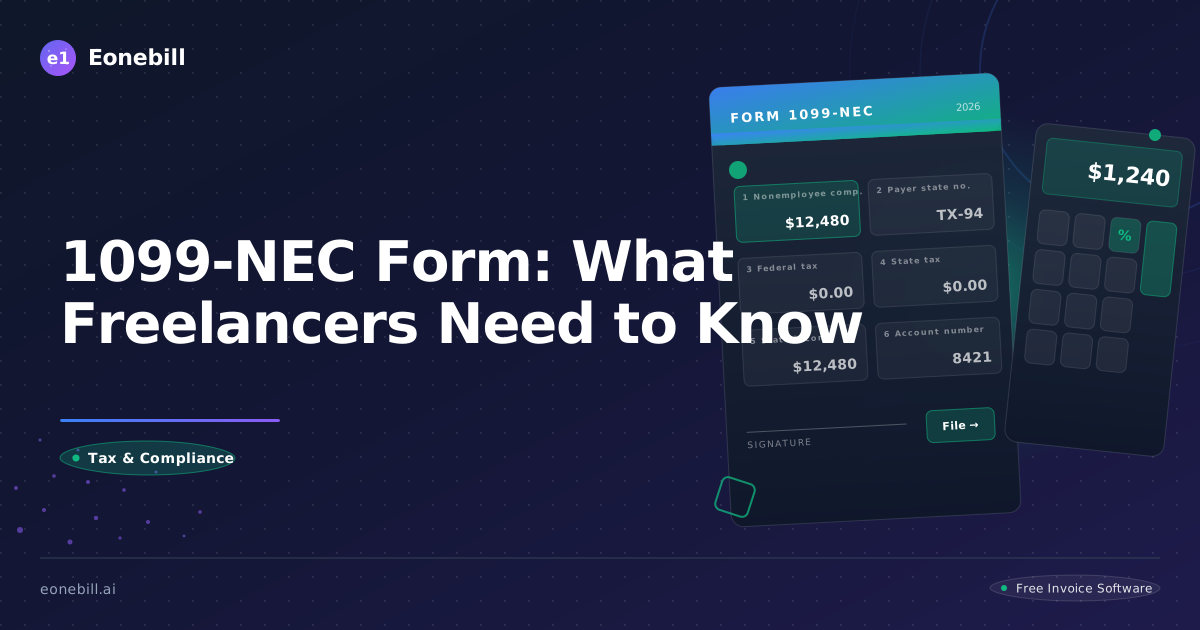
Here's the rule: any US business that pays you $600 or more during a calendar year for non-employee services must issue you a Form 1099-NEC by January 31 of the following year. They also file a copy with the IRS. The form reports your total payments for the year in Box 1, along with your name, address, and TIN (the same info you provided on your W-9).
Not every client will issue a 1099-NEC, even if they should. Companies are sometimes late, occasionally forget altogether, or skip the form for payments under $600. But here's the critical point: you are still required to report all of your business income on Schedule C, whether or not you receive a 1099. The 1099 is for the IRS's information matching, not a determination of your taxable income. Many freelancers mistakenly assume that no 1099 means no tax liability — that's wrong and an audit risk.
Payments made through third-party payment processors like PayPal, Stripe, or Venmo for Business are generally not reported on 1099-NEC. Those processors issue Form 1099-K instead. If a client pays you partly by check and partly by Stripe, they should only report the check portion on the 1099-NEC. The Stripe portion will appear on Stripe's 1099-K.
When to Expect Your 1099s
Clients must furnish 1099-NEC forms to recipients by January 31. They must also file with the IRS by January 31. That gives you a brief window in early February to review every 1099 and compare it against your own records before tax-prep season hits in earnest.
Many clients send 1099-NECs by mail, but electronic delivery is increasingly common. If your client uses a payroll provider like Gusto, ADP, or Justworks, you may receive a notification email with a link to download the PDF. Some companies use tax-prep platforms like Track1099 or Tax1099 that send secure links. Make sure your email address on file with each client is current — a 1099 that bounces to an old address can take weeks to resend.
If you haven't received a 1099 by mid-February that you were expecting, reach out to the client. A friendly email like "Hi, just confirming you'll be issuing a 1099-NEC for our 2026 work. My total per my records was $X — please let me know if your records differ." usually resolves the issue. Sometimes clients are simply late; sometimes they didn't realize they hit the threshold.
If the client refuses to issue a 1099 or you can't reach them, you can still file your return accurately. Report all income on Schedule C using your own records. The IRS will not penalize you for the client's failure to file. The client, however, may face penalties for not issuing the form.
What to Do If the 1099 Is Wrong
Wrong 1099s are common. Here's a partial list of the errors freelancers see every year: amount overstated (client included a refunded payment), amount understated (client missed an invoice), wrong TIN (mismatched SSN or EIN triggers backup withholding notices), wrong name (married names, business name changes), and 1099-NEC issued when it should have been 1099-K because the payment came through PayPal.
If the 1099 has an error, contact the client immediately and request a corrected form. Be specific: "I see Box 1 shows $12,500 but my records show $11,750 — can you check? I have invoices summing to $11,750 attached." A reputable client will issue a corrected 1099 (marked "CORRECTED" at the top) and file the corrected version with the IRS.
If the client refuses to correct, you have two options. First, report the income you actually received and attach a statement to your return explaining the discrepancy. Second, report the 1099 amount as shown and then deduct the difference as "income reported in error" with a brief explanation. Both approaches can work, but reporting your true income is cleaner and easier to defend in an audit.
Keep all correspondence with the client about the correction. Email threads are gold. If you ever face an audit, the documentation showing you tried to fix the 1099 demonstrates good-faith compliance, which mitigates penalties.
How 1099-NEC Income Goes on Schedule C
When you file your tax return, the 1099-NEC income flows onto Schedule C, Profit or Loss from Business. Specifically, all your contractor income (whether 1099'd or not) is summed and entered on Line 1, Gross Receipts or Sales. You don't need to attach the 1099s themselves to your return — the IRS already has copies from the issuers — but you should keep them with your tax records for at least three years.
Below gross receipts, you deduct your business expenses: home office, mileage at the 2026 standard rate (verify the current published rate on IRS.gov when you file), software, supplies, professional services, education, and so on. The result is your net profit, which flows to Schedule SE for self-employment tax (15.3% on the first portion subject to Social Security, with the wage base updated annually) and to Form 1040 for income tax.
A critical reconciliation: at year-end, sum all your 1099-NECs and 1099-Ks and compare to your total gross receipts. Your gross receipts should be greater than or equal to the sum of your 1099s, because not every dollar will be 1099'd (some clients pay under $600, some pay individuals directly without 1099s, some payments go through payment processors). If your Schedule C gross receipts are less than the sum of your 1099s, the IRS computer matching will flag your return. Pad your reporting to match reality, not the under-counted 1099 total.
If you receive a 1099-NEC for income you've already reported in a prior year (rare but possible if a client miscategorized a December invoice as the new year), report it correctly with a footnote. Don't double-count.
Penalties for Missing or Late 1099s
The penalties for not issuing 1099-NECs as a payer are substantial and rise each year due to inflation adjustments. For 2026, the IRS penalty per missed 1099 ranges from roughly $60 (if filed within 30 days late) to over $310 (if filed after August 1 or not at all), with maximum aggregate caps depending on whether the failure was intentional. Penalties for intentional disregard have no cap.
As a freelancer, you're usually the recipient, not the payer, but if you hire subcontractors yourself, the rules apply to you. Pay any subcontractor more than $600? Collect their W-9 before paying them, and issue a 1099-NEC by January 31 of the following year. Use the IRS's Filing Information Returns Electronically (FIRE) system or a tax-prep platform like Track1099 to file electronically.
For the freelancer side: if your client is late issuing your 1099, that's their problem, not yours. Just be sure your own reporting on Schedule C is accurate. Late or missing 1099s do not extend your tax-filing deadline.
Building a 1099-Friendly Workflow
The smoothest tax seasons happen for freelancers who treat 1099 management as a year-round habit, not an April fire drill. Here's the workflow that works.
Step one: send a W-9 to every new client before starting work. This ensures they have your tax info ready when they need to issue a 1099. Step two: track every invoice with a unique number, client name, date, and amount. The free generator at /free-tools/invoice-generator is a great starting point. Step three: reconcile monthly. At the end of each month, compare your invoices sent against payments received, and update a running annual total per client.
Step four: at year-end, generate a per-client income summary. This is what you'll compare against the 1099s you receive in January. Eonebill.ai produces this summary automatically — by client, by month, by payment method — which makes the 1099 reconciliation a 15-minute task instead of a weekend. See /pricing for plans.
Step five: store all 1099s in one folder, by year. When April comes, you grab the folder, your Schedule C is half-written, and you spend your time on deductions and strategy rather than data entry.
The 1099-NEC is not something to fear. It's just a paper trail. Build clean invoicing habits, reconcile regularly, and the form becomes a useful cross-check rather than a source of anxiety. Future-you, sitting calmly at your desk on April 14th with everything ready, will thank you.
One more annual habit that pays off: keep a master 1099 tracking spreadsheet. Columns: Client Name, Tax ID Type (SSN/EIN), Address You Provided, Total Paid, 1099-NEC Received? (Y/N), Amount Reported on 1099, Discrepancy (Y/N), Date Received, Notes. Update this once a year in February. The spreadsheet itself takes 15 minutes to maintain but saves you in three scenarios: (1) you can quickly spot missing 1099s before tax filing, (2) you can flag discrepancies before they become IRS notices, and (3) you have a one-page view of all your 1099 income for tax prep. For freelancers with five or more clients, this spreadsheet is the difference between an organized tax season and a frantic one. Pair it with the year-end summary export from Eonebill.ai or your invoicing tool, and tax prep becomes a single 1-2 hour session in February rather than a multi-day project in April. Also note: if a client issues you an incorrect 1099, your written request for a correction should reference the specific box that's wrong, the amount you believe is correct, and the date you sent the original correction request. Keep that documentation forever. In the rare event of an audit, this paper trail makes the difference between a quick resolution and a multi-month back-and-forth with the IRS.
Finally, remember that 1099-NEC isn't your only year-end form to track. You may also receive 1099-K from payment processors, 1099-INT if you earned interest in your business checking account, 1099-DIV from any business investment dividends, and 1099-MISC for non-NEC payments like equipment rentals. Build a single 'Year-end tax forms received' folder in early January and drop every form into it as it arrives. By February 15, you should have everything. If something expected hasn't arrived by then, contact the issuer. This proactive approach beats the alternative of scrambling in late March when forms are still missing and your tax appointment is imminent. Organized freelancers file their taxes in early March; disorganized ones file in April under pressure.
One closing note on 1099-NEC reconciliation: if you discover a discrepancy between a client's 1099 and your records, document everything in writing. Email the client describing the specific issue (which box, which amount, which payment is missing or incorrect). Keep the email thread. If the client issues a corrected 1099, save both the original and the corrected version. If they refuse to correct it, save the email thread as evidence of your good-faith correction attempt. This documentation matters if the IRS later sends you a CP2000 notice or audits your return. Most discrepancies resolve quickly when both sides have clean records and communicate professionally. The freelancers who run into trouble are usually the ones who let bookkeeping slip through the year and can't quickly substantiate their position.
Ready to manage invoices, contracts & proposals in one place? Try Eonebill free — no credit card required.
Start Free →Frequently Asked Questions
More Posts
Filing Taxes Late: Penalties, Extensions, and How to Catch Up (2026)
Missed the April deadline? Understand the 5 percent failure-to-file vs 0.5 percent failure-to-pay penalty difference, how Form 4868 extensions help, and the four-step protocol for catching up on years of unfiled returns.

Penalties for Not Filing a 1099: What Freelancers and Small Businesses Need to Know (2026)
Failing to file 1099 forms on time triggers escalating IRS penalties from 60 to 660 dollars per form. Learn the four-tier schedule, how to fix a missed filing, and when First-Time Penalty Abatement applies.

How to Write a Gentle Reminder Email (Templates + Examples)
Learn how to write a professional gentle reminder email that gets results. Includes 8 ready-to-use templates for invoices, meetings, deadlines, and more.
Newsletter
Join the community
Subscribe to our newsletter for the latest news and updates