1099 Invoice Template: What Independent Contractors Need to...
Master 1099 invoicing as an independent contractor. Learn what must be on your invoices, tax implications, and how to create compliant 1099 invoices.
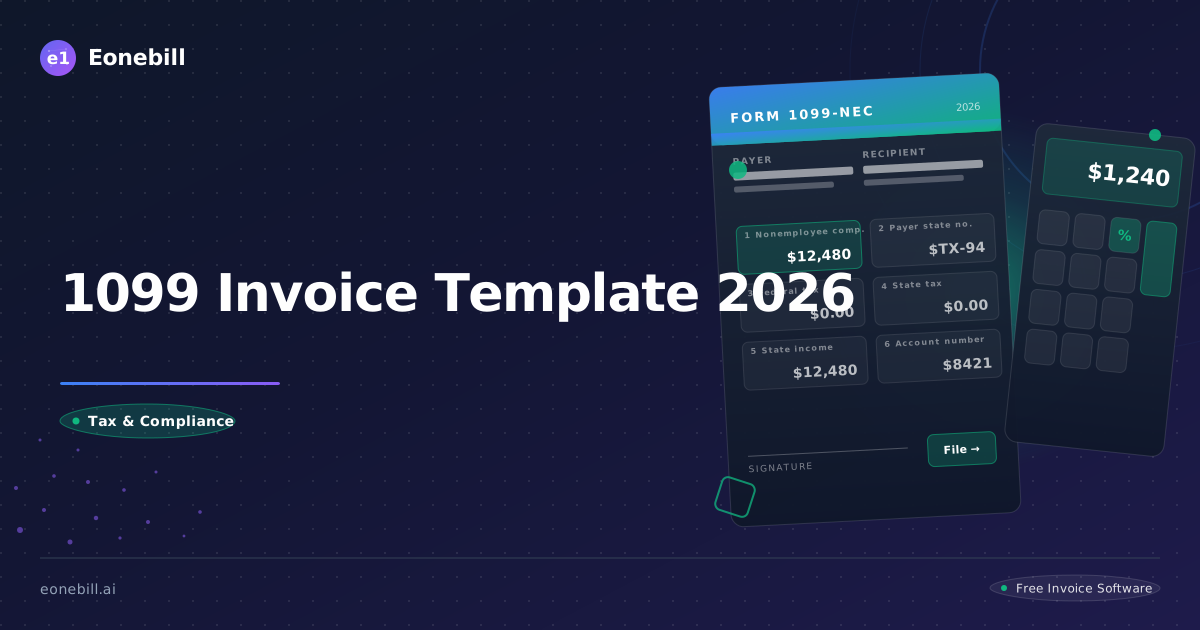
If you're working as an independent contractor in the United States, understanding how to create a proper 1099 invoice is essential. Unlike traditional employees, you're responsible for tracking your own income, paying your own taxes, and ensuring your invoices meet IRS requirements. This guide covers everything you need to know about 1099 invoicing in 2026.
What Is a 1099 Independent Contractor?
A 1099 independent contractor is someone who provides services to clients but is not an employee. You're self-employed, which means:
- You set your own hours and methods
- You use your own equipment
- You don't receive benefits from clients
- you're responsible for your own taxes
The "1099" part comes from the tax form clients use to report payments to you. If a client pays you $600 or more in a calendar year, they're required to send you a 1099-NEC form reporting that income to the IRS.
1099 Invoice vs. W-2 Employee Invoice: What's the Difference?
Understanding the distinction between 1099 contractors and W-2 employees is crucial, because it affects how you invoice and how you're taxed.
W-2 Employee
- Works for one employer
- Employer withholds taxes from paycheck
- Receives benefits (health insurance, retirement)
- Uses company's equipment
- Follows company's schedule
1099 Independent Contractor
- Works for multiple clients
- No taxes withheld—you pay quarterly
- No benefits from clients
- Uses own equipment
- Sets own schedule
For invoicing purposes, the main difference is that 1099 contractors must:
- Track their own income meticulously
- Send invoices to get paid (no automatic payroll)
- Pay self-employment tax (15.3% on net earnings)
- Make quarterly estimated tax payments to the IRS
What Must Be on a 1099 Invoice
Your 1099 invoice needs specific elements to be valid for tax purposes and to ensure you get paid properly. Here's what must be included:
1. Your Business Information
- Legal business name (or your full name if sole proprietor)
- Business address
- EIN (Employer Identification Number) or SSN if sole proprietor
- Phone number and email
2. Client Information
- Client's business name
- Client's address
- Client's EIN (for businesses) or SSN (for individuals)
3. Invoice Details
- Unique invoice number
- Invoice date
- Payment due date
4. Service Description
- Clear description of services provided
- Dates of service
- Hours worked (if hourly)
- Rates (hourly, project, or flat fee)
5. Financial Details
- Line item totals
- Subtotal
- Any applicable taxes
- Total amount due
6. Payment Information
- Accepted payment methods
- Payment instructions
- Late payment policy
7. Tax Information
- Statement that you're an independent contractor
- Your EIN or SSN (for their records)
- Note about 1099 reporting requirements
Quarterly Estimated Taxes: How They Affect Your Invoicing
As a 1099 contractor, you're responsible for paying self-employment tax (Social Security and Medicare) plus income tax. Since no employer withholds these taxes, you must pay them quarterly.
The Quarterly Payment Schedule
| Quarter | Income Period | Due Date |
|---------|---------------|----------|
| Q1 | Jan 1 – Mar 31 | April 15 |
| Q2 | Apr 1 – May 31 | June 15 |
| Q3 | Jun 1 – Aug 31 | September 15 |
| Q4 | Sep 1 – Dec 31 | January 15 |
Your invoicing directly impacts your quarterly tax payments:
Cash vs. Accrual Accounting
- Cash basis: You pay tax when you receive payment
- Accrual basis: You pay tax when you invoice (even if not yet paid)
Most freelancers use cash basis—simpler and keeps you from paying tax on money you haven't received yet.
Tracking Income for Quarterly Estimates
Keep track of invoiced amounts each month, not just what you've collected. This helps you estimate quarterly payments accurately.
Setting Aside for Taxes
A good rule of thumb: set aside 25-30% of every invoice for taxes. When quarterly payments are due, you'll have the money ready.
1099 Invoice Template You Can Use
Here's a professional 1099 invoice template you can adapt:
[YOUR BUSINESS NAME]
[Your Address]
[City, State ZIP]
[Phone | Email]
EIN: [Your EIN or SSN]
INVOICE # INV-[NUMBER]
Date: [Invoice Date]
Due Date: [Payment Due Date]
BILL TO:
[Client Company Name]
[Client Address]
[City, State ZIP]
EIN: [Client EIN]
DESCRIPTION | HOURS/QTY | RATE | AMOUNT
[Service Description 1] | [Hours] | $[Rate] | $[Total]
[Service Description 2] | [Hours] | $[Rate] | $[Total]
Subtotal: $[Amount]
Sales Tax (if applicable): $[Amount]
TOTAL DUE: $[Amount]
PAYMENT TERMS:
Payment due within [15/30] days. Late payments subject to [X]% monthly fee.
PAYMENT METHODS:
- Bank Transfer: [Account details]
- PayPal: [Email]
- Credit Card: [Payment link]
1099 TAX INFORMATION:
I am an independent contractor (not an employee). I am responsible for my own tax obligations. My EIN/SSN is listed above for your 1099 reporting purposes.
For 1099 purposes, please mail form to:
[Your Full Address]
Thank you for your business!
5 Common 1099 Invoice Mistakes to Avoid
Mistake #1: Missing Your EIN or SSN
Your tax identification number must be on every invoice for 1099 reporting. Without it, clients can't issue you a proper 1099-NEC.
Mistake #2: Not Tracking Invoice Numbers
Use sequential invoice numbers (INV-001, INV-002, etc.). This creates a clear paper trail for tax purposes.
Mistake #3: Forgetting to Specify Payment Terms
Always include due dates and late fees. Without explicit terms, clients have no incentive to pay promptly.
Mistake #4: Mixing Personal and Business Expenses
Keep your business finances separate. Your invoice should only include business income.
Mistake #5: Not Sending Invoices Promptly
Don't wait weeks to send invoices. Send them immediately upon completing work. The faster you invoice, the faster you get paid—and the easier it is to track income for taxes.
Using Eonebill for 1099 Invoicing
Eonebill makes 1099 invoicing simple. Here's how it helps:
- Professional templates designed for independent contractors
- Automatic tax calculation for self-employment estimates
- Quarterly income tracking to help with estimated payments
- Automatic 1099 preparation at year-end
- Direct payment links for faster payment
- Invoice tracking so you know when clients have seen your invoices
You focus on doing the work. Eonebill handles the invoicing and tax tracking.
Conclusion: Invoice with Confidence
As a 1099 independent contractor, proper invoicing is critical. It ensures you get paid promptly, tracks your income accurately, and keeps you compliant with IRS requirements.
Create professional invoices for every job, track your income meticulously, and set aside money for quarterly tax payments. With these habits in place, you'll build a sustainable freelance business without tax surprises.
Need a better way to create 1099 invoices? Try Eonebill Free and create professional, compliant invoices in seconds—no accounting degree required.
Ready to manage invoices, contracts & proposals in one place? Try Eonebill free — no credit card required.
Start Free →Frequently Asked Questions
More Posts
Filing Taxes Late: Penalties, Extensions, and How to Catch Up (2026)
Missed the April deadline? Understand the 5 percent failure-to-file vs 0.5 percent failure-to-pay penalty difference, how Form 4868 extensions help, and the four-step protocol for catching up on years of unfiled returns.
Penalties for Not Filing a 1099: What Freelancers and Small Businesses Need to Know (2026)
Failing to file 1099 forms on time triggers escalating IRS penalties from 60 to 660 dollars per form. Learn the four-tier schedule, how to fix a missed filing, and when First-Time Penalty Abatement applies.

How to Write a Gentle Reminder Email (Templates + Examples)
Learn how to write a professional gentle reminder email that gets results. Includes 8 ready-to-use templates for invoices, meetings, deadlines, and more.
Newsletter
Join the community
Subscribe to our newsletter for the latest news and updates